


Celebrations Erupt in Gaza and Israel at News of Deal to End Two-year War

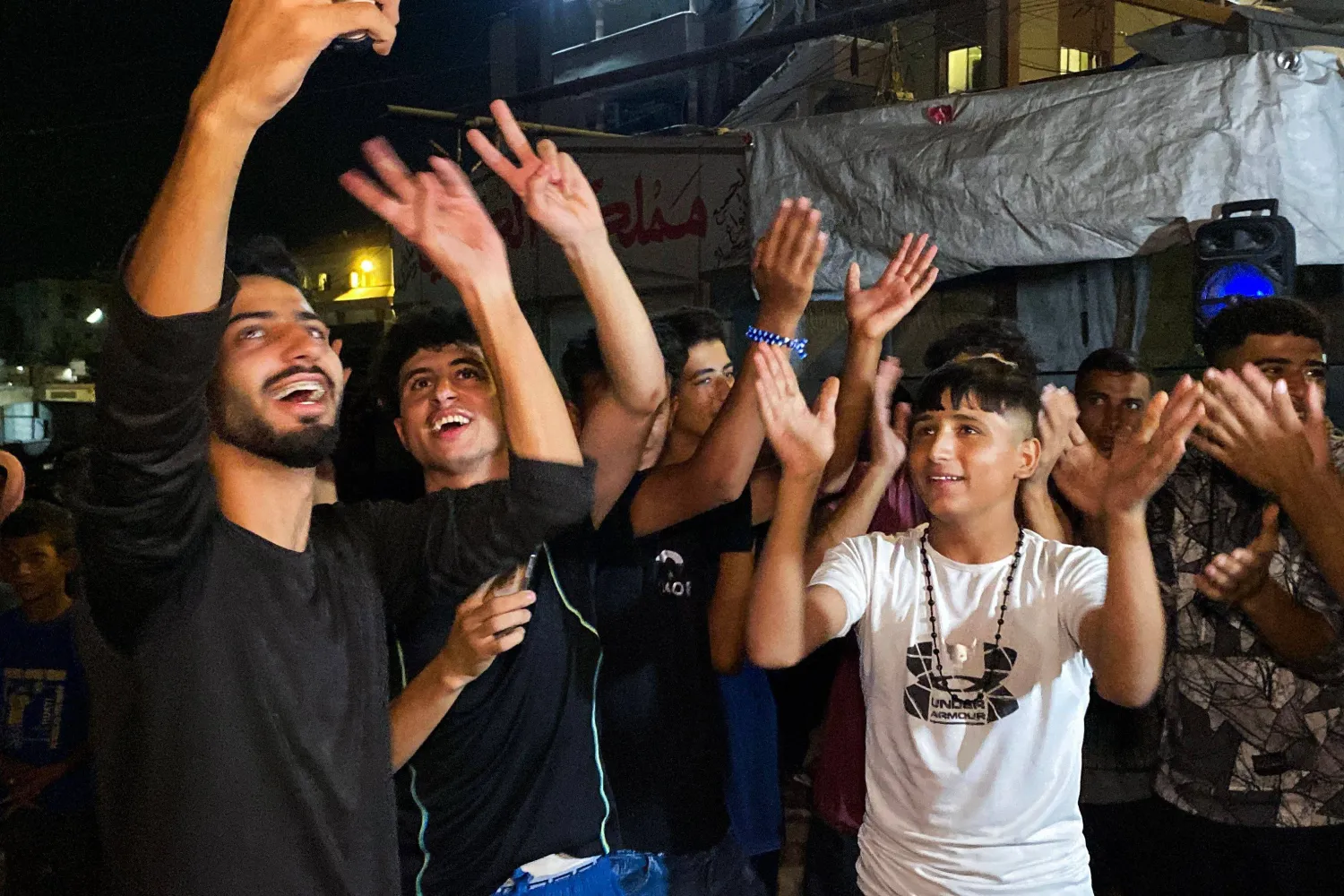
Palestinians celebrate in Khan Yunis on October 9, 2025, following news of a new Gaza ceasefire deal. (Photo by AFP)
TT

Celebrations Erupt in Gaza and Israel at News of Deal to End Two-year War

Palestinians celebrate in Khan Yunis on October 9, 2025, following news of a new Gaza ceasefire deal. (Photo by AFP)

Palestinians and the families of Israeli hostages broke into wild celebrations on Thursday after news of a pact between Israel and Hamas to end the war in Gaza and return home all the Israeli hostages, both living and dead.

In Gaza, where most of the more than 2 million people have been displaced by Israeli bombing, young men applauded in the devastated streets, even as Israeli strikes continued in some parts of the enclave.

"Thank God for the ceasefire, the end of bloodshed and killing," said Abdul Majeed Abd Rabbo in Khan Younis in southern Gaza.

"I am not the only one happy, all of the Gaza Strip is happy, all the Arab people, all of the world is happy with the ceasefire and the end of bloodshed. Thank you and all the love to those who stood with us."

In Tel Aviv's so-called Hostages Square, where families of those seized in the Hamas attack that sparked the war two years ago have gathered to demand the return of loved ones, Einav Zaugauker, the mother of a hostage, was ecstatic.

"I can't breathe, I can't breathe, I can't explain what I'm feeling ... it's crazy," she said, speaking in the red glow of a celebratory flare.

"What do I say to him? What do I do? Hug and kiss him," she added, referring to her son, Matan. "Just tell him that I love him, that's it. And to see his eyes sink into mine ... It's overwhelming — this is the relief."

Israel and Hamas agreed on Wednesday to the first phase of US President Donald Trump's plan for the Palestinian enclave, a ceasefire and hostage deal that could open the way to ending a bloody two-year-old war that has disrupted the Middle East.

"I have no words to describe it," said former hostage Omer Shem-tov, when asked how the moment felt.

Just a day after the second anniversary of the cross-border attack by Hamas militants that triggered Israel's devastating assault on Gaza, indirect talks in Egypt yielded a deal on the initial stage of Trump’s 20-point framework for peace.

In Gaza, circles of young men in the streets applauded the news, one of them clapping as he was hoisted onto the shoulders of a friend.

"These are moments ... long awaited by Palestinian citizens after two years of killing and genocide," said Khaled Shaat, a Palestinian in the city of Khan Younis.

If fully adopted, the accord would bring the two sides closer than any prior effort to halt a regional war that drew in neighbors Iran, Lebanon and Yemen, deepened Israel's international isolation and changed the Middle East.

Gaza authorities say more than 67,000 people have been killed and much of the enclave flattened since Israel began its military response to the Hamas attack on October 7, 2023.

About 1,200 people were killed and 251 were taken hostage back to Gaza, according to Israeli officials, with 20 of the 48 hostages still held believed to be alive.



Official: Yemen’s Arabian Sea Ports Poised to Become Global Logistics Hubs

Arabian Sea ports poised to become global logistics hubs (Arabian Sea Ports Authority)
TT

Official: Yemen’s Arabian Sea Ports Poised to Become Global Logistics Hubs

Arabian Sea ports poised to become global logistics hubs (Arabian Sea Ports Authority)

A Yemeni maritime official said ports along the Arabian Sea are capable of becoming global logistics hubs, citing their competitive advantages and capacity to handle various types of commercial vessels, particularly container ships and general cargo vessels, as well as dry and liquid bulk carriers.

Dr. Nabil bin Aifan, acting director of maritime affairs in Mukalla in eastern Yemen, told Asharq Al-Awsat that the Port of Mukalla is distinguished by its ability to receive all types of vessels.

He also described Saudi Arabia’s experience in developing the maritime transport and ports sector as “successful” at both regional and global levels, expressing hope that Yemeni ports — particularly Mukalla — would benefit from this experience, as well as from Saudi support for infrastructure projects in the country.

Roadmap

Mohsen al-Amri, Yemen’s transport minister, recently announced a roadmap focused on turning technical and economic studies into tangible projects, particularly regarding the ports in Hadramout, Shabwa and the Socotra archipelago, in addition to the expansion project of the Port of Mukalla, which is considered a key pillar of Yemen’s maritime activity.

Al-Amri pledged to work towards transforming Arabian Sea ports into global logistics hubs, in a move aimed at strengthening Yemen’s position on the international trade map.

Strong potential

Bin Aifan said the Port of Qana in Shabwa governorate has significant potential to become a successful commercial port, particularly in terms of its geographic location, depth, hinterland and the capacity of its berths and yards.

He also referred to a previous study he conducted on the Port of Aden and its strategic importance, noting that the port possesses global competitive advantages and, if properly invested in, could become one of the most prominent ports in the region and among the busiest in cargo handling.

“For example, the port’s geographical location links East and West, and ships need no more than four nautical miles to change direction and reach the pilot station,” he said. “It is also naturally protected from waves and from the northeast and southwest monsoon winds, enabling it to operate year-round without interruption. It lies just 105 nautical miles from the Bab el-Mandeb Strait, through which around 21,000 ships pass annually.”

Sustaining operational capacity

According to a United Nations report cited by bin Aifan, the Port of Aden requires an investment package to maintain its current operational capacity, which has declined due to insufficient maintenance, weak infrastructure and limited institutional capacity.

The report also pointed to the absence of long-term investment plans, the lack of systematic integration of risk management into decision-making processes, as well as weak awareness of health, safety and environmental issues.

Six pillars

Bin Aifan outlined six main pillars for developing Yemeni ports, foremost among them the Port of Aden: infrastructure development, digital transformation, strengthening administrative and logistics systems, developing human capital, meeting safety requirements and protecting the environment, alongside the need for a comprehensive legal framework.

“The role of the private sector in the development process cannot be overlooked, as it is one of the key pillars of successful port operations,” he said, adding that experience has shown that assigning port operations to the private sector helps improve efficiency and enhance competitiveness.

Speaking about Saudi Arabia’s role, bin Aifan said there is a strong direction within the Kingdom to support infrastructure and economic projects in Hadramout in particular and Yemen in general.

“We hope the ports will receive a substantial share of this support, based on the Kingdom’s priorities and its successful experience in this field,” he stated.


Yemen's Houthis Claim 3rd Missile Attack Targeting Israel

People ride in a vehicle past a digital billboard featuring Houthi leader Abdul-Malik al-Houthi in Sanaa, Yemen, 31 March 2026. EPA/YAHYA ARHAB
TT

Yemen's Houthis Claim 3rd Missile Attack Targeting Israel

People ride in a vehicle past a digital billboard featuring Houthi leader Abdul-Malik al-Houthi in Sanaa, Yemen, 31 March 2026. EPA/YAHYA ARHAB

Yemen's Houthis on Wednesday claimed a missile attack against Israel that they said was launched jointly with their backer Iran and Lebanon's Hezbollah group -- the third such attack by the militias since they entered the Middle East war.

Earlier on Wednesday, Israel's military said its air defenses had responded to a missile launched from Yemen, later announcing that residents were "permitted to leave protected spaces in all areas of the country.”

Israeli media said the missile was intercepted, and there were no reports of any casualties or damage.

The Houthis "carried out the third military operation... targeting sensitive Israeli enemy targets... with a barrage of ballistic missiles,” Houthi military spokesman Yahya Saree said in a video statement.

"This operation was conducted jointly with our mujahideen brothers in Iran and Hezbollah in Lebanon," he added.

Yemen's Houthis claimed missile and drone attacks targeting Israel over the weekend, their first in the current war.

The Israeli military also said on Monday that two drones launched from Yemen were intercepted.

From Yemen, the Houthis could potentially disrupt shipping through the Red Sea, as they did at the height of Israel's war on Gaza.

The Houthis have previously threatened shipping through the Red Sea and the Suez Canal, which requires vessels to travel through a narrow strait off Yemen's coast.


Syria Will Stay Out of Iran Conflict Unless It Faces Aggression, Sharaa Says from London

British Prime Minister Keir Starmer (L) welcomes the President of Syria, Ahmed al-Sharaa (R), to Downing Street in London, Britain, 31 March 2026. (EPA)
TT

Syria Will Stay Out of Iran Conflict Unless It Faces Aggression, Sharaa Says from London

British Prime Minister Keir Starmer (L) welcomes the President of Syria, Ahmed al-Sharaa (R), to Downing Street in London, Britain, 31 March 2026. (EPA)

Syrian President Ahmed al-Sharaa said on Tuesday that his country will stay out of the US-Israeli war against Iran unless Syria is subject to aggression and has no diplomatic solutions.

"Unless Syria is targeted by any party, Syria will remain outside any conflict," the Syrian president said at an event hosted by think tank Chatham House in London during his first official visit to the UK.

"We do not want Syria to ‌be an ‌arena of war. But unfortunately, today, things ‌are ⁠not governed by ⁠wise minds. The situation is volatile and random," the president said.

The month-long conflict has spread across the region, killing thousands, disrupting energy supplies, and threatening to send the global economy into a tailspin.

"We want Syria to have ideal relationships with the entire region, ⁠with Lebanon, Iraq, Türkiye, Saudi Arabia, and ‌world powers like the ‌UK, France, Germany and the US. I think that Syria is ‌qualified to start a strategic relationship network," he ‌said, responding to a question on whether Syria would stay neutral while the conflict goes on.

Syria has been keen to stay on the sidelines of the regional conflict that ‌has pulled in neighboring countries, including Lebanon, where armed group Hezbollah is locked ⁠in fighting ⁠with Israeli ground troops, and Iraq, where Iran-aligned factions have launched drone and rocket attacks.

Syria sent thousands of troops to its western border with Lebanon and its eastern border with Iraq earlier this month.

Syria's defense ministry said the deployment was part of efforts to "protect and control the borders amid the escalating regional conflict".

"We had enough war. We paid a large bill. We are not ready for another war experience," Syria's president said.

Sharaa meets Starmer, King Charles

King Charles III hosted Sharaa at Buckingham Palace on Tuesday.

Sharaa was making his first visit to Britain since ousting long-time iron-fisted former president Bashar al-Assad in 2024.

Earlier Tuesday, Sharaa discussed the war with Iran in talks with Prime Minister Keir Starmer at Downing Street.

The leaders "discussed the need for a viable plan to reopen the Strait of Hormuz, in the face of the severe economic impact of prolonged closure, and agreed to work with others to restore freedom of navigation," a Downing Street spokesperson said.

Since Sharaa has been in power, sectarian tensions have continued to cause repeated bloodshed in Syria, while the ISIS group remains at large.

Starmer said he welcomed the Syrian government's "action" against ISIS and noted progress on counter-terrorism, the spokesperson said.

The British prime minister urged "closer work together on returns (of illegal migrants), on border security, and on tackling people smuggling networks".

Between 2011 and 2021, nearly 31,000 Syrians were granted asylum in Britain after the civil war there sparked a refugee crisis, according to government statistics.

The president's visit came after London announced the resumption of diplomatic relations with Syria in July 2025.

It followed a visit by then foreign minister David Lammy to Damascus, the first visit to Syria by a British minister in 14 years.

The British government said at the time that its engagement with Damascus was aimed at supporting the country's political transition and assisting economic recovery as well as reducing illegal migration, and addressing the issue of chemical weapons.

Sharaa met German Chancellor Friedrich Merz in Berlin on Monday, as he seeks to keep Syria insulated from the repercussions of the current Middle East war.

Europe's top economy is home to the largest Syrian diaspora in the European Union at more than a million, many of whom arrived during the peak of the migrant influx in 2015-2016.

Merz, who has made a tougher immigration policy a priority since taking office last year, said he and Sharaa had agreed eight out of 10 Syrians in Germany should go back "over the next three years".