


Masked Israeli Settlers Attack 2 Palestinian Villages in the West Bank 

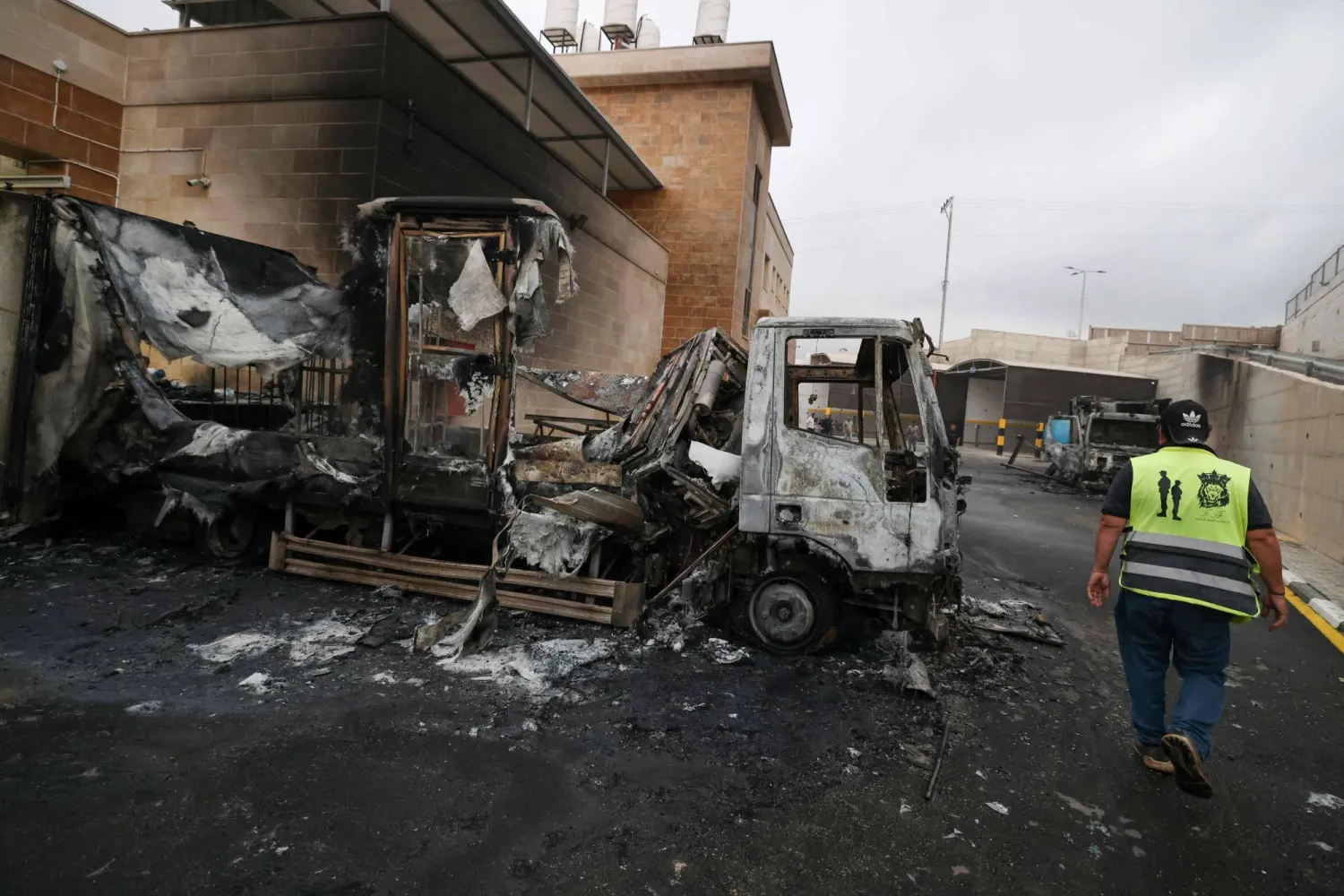
A Palestinian man inspects a burnt truck after an Israeli settlers attack in the village of Beit Lid, east of Tulkarm in the occupied West Bank on November 11, 2025. (AFP)
TT

Masked Israeli Settlers Attack 2 Palestinian Villages in the West Bank 

A Palestinian man inspects a burnt truck after an Israeli settlers attack in the village of Beit Lid, east of Tulkarm in the occupied West Bank on November 11, 2025. (AFP)

Dozens of masked Israeli settlers attacked a pair of Palestinian villages in the occupied West Bank on Tuesday, setting fire to vehicles and other property before clashing with Israeli soldiers sent to halt the rampage, Israeli and Palestinian officials said.

It was the latest in a series of attacks by young settlers in the West Bank.

Israeli police said four Israelis were arrested in what it described as “extremist violence,” while the Israeli military said four Palestinians were wounded. Police and Israel’s Shin Bet internal security agency said they were investigating.

Videos on social media showed two charred trucks engulfed in flames, with a nearby building on fire. Settler violence has surged since the war in Gaza erupted two years ago. The attacks have intensified in recent weeks as Palestinians harvest their olive trees in an annual ritual.

Earlier on Tuesday, tens of thousands of Israelis attended the funeral of an Israeli soldier whose remains had been held in Gaza for 11 years, overflowing and blocking surrounding streets as somber crowds stood with Israeli flags.

The burial of Lt. Hadar Goldin was a moment of closure for his family, which had traveled the world in a public campaign seeking his return. The huge turnout also reflected the importance for the broader public in Israel, where Goldin became a household name.

Hamas returned his remains on Sunday as part of the US-brokered ceasefire deal that began last month. The bodies of four hostages taken in the Hamas-led attack on Israel on Oct. 7, 2023, are still in Gaza.

Settler violence in the West Bank

The UN humanitarian office last week reported more Israeli settler attacks on Palestinians in the West Bank in October than in any other month since it began keeping track in 2006. There were over 260 attacks, the office said.

Palestinians and human rights workers accuse the Israeli army and police of failing to halt attacks by settlers. Israel’s government is dominated by West Bank settlers, and the police force is overseen by Cabinet minister Itamar Ben-Gvir, a hardline settler leader.

In Tuesday’s incident, the army said soldiers initially responded to settler attacks in the villages of Beit Lid and Deir Sharaf. It said the settlers fled to a nearby industrial zone and attacked soldiers sent to the scene and damaged a military vehicle.

Palestinian official Muayyad Shaaban, who heads the government’s Commission against the Wall and Settlements, said the settlers set fire to four dairy trucks, farmland, tin shacks and tents belonging to a Bedouin community.

He said the attacks were part of a campaign to drive Palestinians from their land and accused Israel of giving the settlers protection and immunity. He called for sanctions against groups that “sponsor and support the colonial settlement terrorism project.”

French President Emmanuel Macron denounced the attacks during his meeting with Palestinian President Mahmoud Abbas in Paris on Tuesday, saying that “settler violence and the acceleration of settlement projects are reaching new heights, threatening the stability of the West Bank.”

Palestinians in Gaza still struggling to access food

Displaced Palestinians in central Gaza said they continue to rely heavily on charity kitchens for their only daily meal, as soaring market prices and the lack of income leave them struggling.

Scores of people, most of them children, lined up with empty pots at a charity kitchen in Nuseirat refugee camp on Tuesday waiting to be served rice — the only food available that day.

“The rockets and planes stopped but increasing living costs has been the hardest weapon used against us,” said Mohamed al-Naqlah, a displaced Palestinian.

On Tuesday, Gaza’s Health Ministry said the number of Palestinians killed in Gaza has risen to 69,182. Its count, generally considered by independent experts as reliable, does not distinguish between fighters and civilians, but the ministry says more than half of those killed were women and children.

The latest war began with the 2023 Hamas-led attack on Israel when around 1,200 people, mostly civilians, were killed, and 251 people were kidnapped.

Close adviser to Netanyahu resigns

Cabinet Minister Ron Dermer, one of Prime Minister Benjamin Netanyahu’s closest confidants, announced his resignation on Tuesday, citing family reasons.

In a letter, Dermer said he had promised his family to serve two years but extended his term by an additional year to deal with Iran’s nuclear program and “to end the war in Gaza on Israel’s terms and bring our hostages home.”

The US-born Dermer is a former Israeli ambassador to Washington. As strategic affairs minister, he served as Netanyahu’s envoy throughout the war in dealing with the United States and ceasefire negotiations.



Israel’s Netanyahu to Discuss Second Phase of Gaza Plan with Trump Later This Month

Israeli Prime Minister Benjamin Netanyahu (R) and German Chancellor Friedrich Merz address a joint press conference in Jerusalem, 07 December 2025. (EPA)
TT

Israel’s Netanyahu to Discuss Second Phase of Gaza Plan with Trump Later This Month

Israeli Prime Minister Benjamin Netanyahu (R) and German Chancellor Friedrich Merz address a joint press conference in Jerusalem, 07 December 2025. (EPA)

Israeli Prime Minister Benjamin Netanyahu said on Sunday that the second phase of a US plan to end the war in Gaza was close, but cautioned several key issues still needed to be resolved, including whether a multinational security force would be deployed. 

Netanyahu, speaking to reporters alongside German Chancellor Friedrich Merz in Jerusalem, said that he would hold important discussions with US President Donald Trump at the end of the month on how to ensure the plan's second phase was achieved. 

The prime minister's office in November said that Trump had invited Netanyahu to the White House "in the near future", although a date for the visit has not yet been made public. 

Netanyahu said that he would discuss with Trump how to bring an end to Hamas rule in Gaza. A ceasefire between Israel and Hamas is entering its second month, although both sides have repeatedly accused each other of violating the truce agreement. 

Netanyahu said that it was important to ensure Hamas not only upholds the ceasefire but also follows through on "their commitment" to the plan to disarm and for Gaza to be demilitarized. 

Israel retained control of 53% of Gaza under the first phase of Trump's plan, which involved the release of hostages held by fighters in Gaza and of Palestinians detained by Israel. The final hostage remains to be handed over are those of an Israeli police officer killed on October 7, 2023 fighting Gazan gunmen who had invaded Israel. 

"We'll get him out," Netanyahu said. 

Since the ceasefire started in October, the militant group has reestablished itself in the rest of Gaza. 

GERMAN CHANCELLOR: PHASE TWO MUST COME NOW 

According to the plan, Israel is to pull back further in the second phase as a transitional authority is established in Gaza and a multinational security force is deployed, Hamas is disarmed, and reconstruction begins. 

A multinational coordination center has been established in Israel, but there are no deadlines in the plan and officials involved say that efforts to advance it have stalled. 

"What will be the timeline? What are the forces that are coming in? Will we have international forces? If not, what are the alternatives? These are all topics that are being discussed," Netanyahu said, describing them as central issues. 

Merz said that Germany was willing to help rebuild Gaza but would wait for Netanyahu's meeting with Trump, and for clarity on what Washington was prepared to do, before Berlin decides what it would contribute but that phase two "must come now". 

Israel has repeatedly carried out air strikes since the ceasefire came into effect that it says are fending off attacks or destroying militant infrastructure. Gaza's health ministry says 373 Palestinians have been killed since the ceasefire started. Three Israeli soldiers have been killed by gunmen. 

Netanyahu said that he would also discuss with Trump "opportunities for peace", an apparent reference to US efforts for Israel to establish formal ties with Arab and Muslim states. 

"We believe there's a path to advance a broader peace with the Arab states, and a path also to establish a workable peace with our Palestinian neighbors," Netanyahu said, asserting Israel would always insist on security control of the West Bank. 

Trump has said he promised Muslim leaders that Israel would not annex the occupied West Bank, where Netanyahu's government is backing the development of Jewish settlements. 

The "question of political annexation" of the West Bank remains a subject of discussion, Netanyahu said. 


Al-Sharaa: Israel’s Push for a Buffer Zone in Southern Syria Puts the Region at Risk

Syrian President Ahmad al-Sharaa speaks during the 23rd annual Doha Forum (Reuters). 
TT

Al-Sharaa: Israel’s Push for a Buffer Zone in Southern Syria Puts the Region at Risk

Syrian President Ahmad al-Sharaa speaks during the 23rd annual Doha Forum (Reuters). 

Syrian President Ahmad al-Sharaa warned on Saturday that Israel’s effort to establish a demilitarized buffer zone in southern Syria risks pushing the country into a “dangerous place.”

Speaking on the sidelines of the Doha Forum, al-Sharaa said US-mediated negotiations with Israel remain underway to address the “security concerns” of both sides.

Following the ouster of Bashar al-Assad on Dec. 8, Israel has carried out hundreds of airstrikes on Syrian military positions, saying its goal is to prevent the new authorities from seizing the former army’s weapons arsenal.

Over the past year, Israel has repeatedly publicized ground operations and arrests of individuals it accuses of “terrorist” activity in southern Syria. Israeli forces have also entered the Golan Heights disengagement zone established under the 1974 cease-fire agreement.

Al-Sharaa said all major international actors back Syria “in its demand that Israel withdraw and reposition to the lines of Dec. 8.” He emphasized that Damascus insists on full respect for the 1974 accord, describing it as a durable, internationally supported agreement.

“Tampering with this agreement, while proposing alternatives such as a new buffer zone, could drive us into dangerous territory,” he said.

Al-Sharaa accused Israel of “fighting ghosts” and “searching for enemies” in the wake of the Gaza war, adding that since assuming office a year ago he has sent “positive messages about peace and regional stability.”

Thirteen people were killed in late November during an Israeli incursion into the southern town of Beit Jin, a raid Damascus denounced as a “war crime.” Israel said the operation targeted suspects linked to the ISIS group.

Though Syria and Israel maintain no diplomatic relations and remain technically at war, several US-brokered ministerial meetings have been held in recent months.

“Negotiations are ongoing, and the United States is fully engaged,” al-Sharaa said, noting broad international support for addressing “legitimate security concerns so both sides can feel secure.”

He asked: “Syria is the one under attack, so who should be demanding a buffer zone and withdrawal?”

In September, al-Sharaa warned in New York of the risk of renewed Middle East instability if Damascus and Tel Aviv fail to reach a security arrangement, accusing Israel of “delaying negotiations and continuing to violate our airspace and territory.”

Israeli Prime Minister Benjamin Netanyahu visited Israeli forces deployed in the buffer zone outside the occupied Golan Heights in November, a move Damascus condemned as “illegitimate.”

Domestically, al-Sharaa said all segments of Syrian society are now represented in government “on the basis of competence, not sectarian quotas.” Syria, he said, is charting a “new path” for post-conflict governance. He acknowledged the country inherited “deep problems” from the former regime and said investigative bodies are working to address alleged crimes in the coastal region and Sweida.

He stressed that Syria is “a state of law, not a collection of sects,” and that accountability and institutional reform are essential to rebuilding the state.

The Syrian president added that economic revitalization is crucial for lasting stability, which is why Damascus continues to argue for the lifting of the Caesar Act sanctions.


Arab Parliament Backs UNRWA Mandate Renewal, Reaffirms Support for Palestinian Rights

Arab Parliament Backs UNRWA Mandate Renewal, Reaffirms Support for Palestinian Rights
TT

Arab Parliament Backs UNRWA Mandate Renewal, Reaffirms Support for Palestinian Rights

Arab Parliament Backs UNRWA Mandate Renewal, Reaffirms Support for Palestinian Rights

Speaker of the Arab Parliament Mohamed Alyammahi welcomed the UN General Assembly’s decision to renew the mandate of the United Nations Relief and Works Agency for Palestine Refugees in the Near East (UNRWA) for another three years, saying the vote reflects broad international support for Palestinian rights and a clear rejection of efforts to undermine their cause.

Alyammahi stressed that the mandate’s renewal is particularly critical amid the continued aggression and blockade facing Palestinians, ensuring the agency can maintain its essential services. He noted the strong backing for related resolutions calling for an end to the occupation and the establishment of an independent Palestinian state with Jerusalem as its capital.

The speaker urged leveraging this growing international consensus to halt the assault on Gaza, facilitate the entry of humanitarian aid, intensify legal and diplomatic action against the occupation, and advance a credible political process that can help ease the suffering of the Palestinian people.