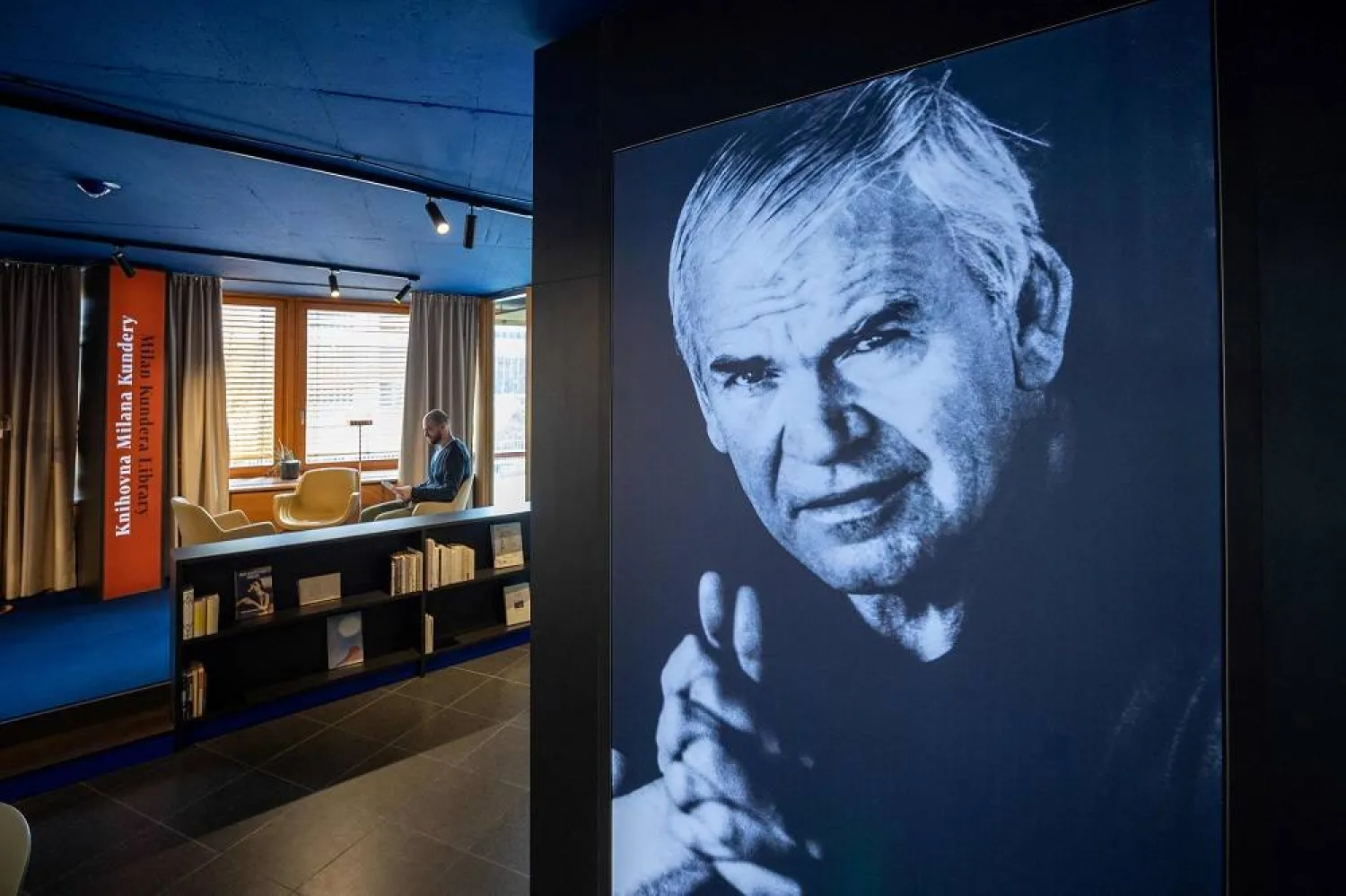

Milan Kundera, Author of ‘The Unbearable Lightness of Being’, Dies Aged 94 

A visitor to the Milan Kundera library in Brno, Czech Republic reads a book by the Czech novelist on April 6, 2023. (AFP)
TT

Milan Kundera, Author of ‘The Unbearable Lightness of Being’, Dies Aged 94 

A visitor to the Milan Kundera library in Brno, Czech Republic reads a book by the Czech novelist on April 6, 2023. (AFP)

Milan Kundera, whose dissident writings in communist Czechoslovakia transformed him into an exiled satirist of totalitarianism, has died in Paris at the age of 94, Czech media said Wednesday. 

Kundera’s renowned novel, “The Unbearable Lightness of Being,” opens wrenchingly with Soviet tanks rolling through Prague, the Czech capital that was the author’s home until he moved to France in 1975. Weaving together themes of love and exile, politics and the deeply personal, Kundera’s novel won critical acclaim, earning him a wide readership among Westerners who embraced both his anti-Soviet subversion and the eroticism threaded through many of his works. 

“If someone had told me as a boy: One day you will see your nation vanish from the world, I would have considered it nonsense, something I couldn’t possibly imagine. A man knows he is mortal, but he takes it for granted that his nation possesses a kind of eternal life,” he told the author Philip Roth in a New York Times interview in 1980, the year before he became a naturalized French citizen. 

In 1989, the Velvet Revolution pushed Communists from power and Kundera’s nation was reborn as the Czech Republic, but by then he had made a new life — and a complete identity — in his attic apartment on Paris’ Left Bank. 

To say his relationship with the land of his birth was complex would be an understatement. He returned to the Czech Republic rarely and incognito, even after the fall of the Iron Curtain. His final works, written in French, were never translated into Czech. “The Unbearable Lightness of Being,” which won him such acclaim and was made into a film in 1988, was not published in the Czech Republic until 2006, 17 years after the Velvet Revolution, although it was available in Czech since 1985 from a compatriot who founded a publishing house in exile in Canada. It topped the best-seller list for weeks and, the following year, Kundera won the State Award for Literature for it. 

Kundera’s wife, Vera, was an essential companion to a reclusive man who eschewed technology — his translator, his social secretary, and ultimately his buffer against the outside world. It was she who fostered his friendship with Roth by serving as their linguistic go-between, and — according to a 1985 profile of the couple — it was she who took his calls and handled the inevitable demands on a world-famous author. 

The writings of Kundera, whose first novel “The Joke” opens with a young man who is dispatched to the mines after making light of communist slogans, was banned in Czechoslovakia after the Soviet invasion of Prague in 1968, when he also lost his job as a professor of cinema. He had been writing novels and plays since 1953. 

“The Unbearable Lightness of Being” follows a dissident surgeon from Prague to exile in Geneva and back home again. For his refusal to bend to the Communist regime the surgeon, Tomas, is forced to become a window washer. Tomas ultimately lives out his final days in the countryside with his wife, Tereza, their lives becoming both more dreamlike and more tangible as the days pass. 

Jiri Srstka, Kundera’s Czech literary agent at the time the book was finally published in the Czech Republic, said the author himself delayed its release there for fears it would be badly edited. 

“Kundera had to read the entire book again, rewrite sections, make additions and edit the entire text. So given his perfectionism, this was a long-term job, but now readers will get the book that Milan Kundera thinks should exist,” Ststka told Radio Praha at the time. 


Amsterdam's Rijksmuseum Says Discovers New Rembrandt

Poeple look at Rembrandt's famed Night Watch, which is back on display in what researchers say in its original size, with missing parts temporarily restored in an exhibition aided by artificial intelligence, at Rijksmuseum in Amsterdam, Netherlands June 23, 2021. REUTERS/Piroschka van de Wouw/File Photo
TT

Amsterdam's Rijksmuseum Says Discovers New Rembrandt

Poeple look at Rembrandt's famed Night Watch, which is back on display in what researchers say in its original size, with missing parts temporarily restored in an exhibition aided by artificial intelligence, at Rijksmuseum in Amsterdam, Netherlands June 23, 2021. REUTERS/Piroschka van de Wouw/File Photo

The Rijksmuseum in Amsterdam said Monday it had uncovered a new painting by Rembrandt, using advanced scanning technology and stylistic analysis to confirm it was crafted by the Dutch master.

The whereabouts of the 1633 work, entitled "Vision of Zacharias in the Temple" was unknown for 65 years but was recently handed over to the museum for testing.

"Materials analysis, stylistic and thematic similarities, alterations made by Rembrandt, and the overall quality of the painting all support the conclusion that this painting is a genuine work by Rembrandt van Rijn," the museum said in a statement.


UNESCO-listed Golestan Palace in Tehran Damaged in Strikes

Plumes of smoke rise after a strike in Tehran, Iran, Sunday, March 1, 2026. (AP Photo)
TT

UNESCO-listed Golestan Palace in Tehran Damaged in Strikes

Plumes of smoke rise after a strike in Tehran, Iran, Sunday, March 1, 2026. (AP Photo)

Iran's UNESCO-listed Golestan Palace in Tehran has been damaged in US and Israeli strikes, local media reported Monday.

"Following the joint US-Israeli attack on Arag square in southern Tehran on Sunday evening, parts of the Golestan Palace... were damaged," the ISNA news agency reported, adding that windows, doors, and mirrors were hit by reverberations from blasts.

Iran's Mehr news agency carried a similar report.


Before Dawn, Ancient Drum Rite Wakes Istanbul Faithful to Fast

Turkish drummer Hakan Ozbingol plays drum and sings traditional songs in the streets of Istanbul, to wake Muslims up for the suhour, the Ramadan meal eaten at night, on February 24, 2026. (AFP)
TT

Before Dawn, Ancient Drum Rite Wakes Istanbul Faithful to Fast

Turkish drummer Hakan Ozbingol plays drum and sings traditional songs in the streets of Istanbul, to wake Muslims up for the suhour, the Ramadan meal eaten at night, on February 24, 2026. (AFP)

It's 3:30 am and lights are slowly coming on in the homes lining a narrow Istanbul street as people are woken up by the rhythmic thump of a drum.

Emerging onto a balcony, Sibel Savas and her grandson look down as the drummer -- or davulcu in Turkish -- wanders through the Ayvansaray neighborhood, his drumbeat waking the faithful for a last meal before the daily Ramadan fast begins at sunrise.

For the past 55 years, Hakan Ozbingol has got up at 3:00 am every day during Ramadan to play his davul, a large double-headed drum carried with a strap and played while walking through the streets.

He inherited the role from his father, with whom he started venturing out when he was 10.

Although their nightly sortie is purely voluntary, local residents traditionally give a tip at the end of the month, says Ozbingol, who is now 65.

If once this amounted to enough to buy the children a nice gift, these days it's barely enough "to buy them clothes or to cover the bills", he sighs, as people struggle to cope with Türkiye's bitter economic crisis.

But for him, it's not a job but more of a sacred duty.

"As long as it's to do with Allah, this drum will never fall silent. We're doing Allah's work, it's our duty," he said hoarsely, trudging with bent back through the winding streets.

- Ottoman roots -

According to Harun Korkmaz, a music historian at Istanbul University, the Ramadan drum rite "dates back to the end of the 19th century" when the Ottoman military bands, or mehters, performed several times a day, setting the pace of daily life.

"The davulcu are continuing this tradition," he told AFP of a tradition that began in Istanbul and spread to the rest of the country.

As well as drumming, "real" davulcu will also chant "mani", or short rhythmic poems, under people's windows to flatter a sleepy audience, Ozbingol explained.

"In Türkiye, there are few davulcus who know how to sing mani. It's not enough to pick up the drum and bang on it while walking around," he said, proudly tapping his temple to show where he keeps this knowledge.

The tradition began in the Fatih district near Istanbul's historic peninsula, and most of today's Ramadan drummers come from Türkiye's Roma community, who today number around 2.7 million, research figures show.

As the davulcu walks the street where washing lines vie for space with Turkish flags draped from the high facades of the buildings, he is warmly greeted by a pensioner called Zafer, who is also a musician.

"If the Roma weren't here there would be nothing. They are the musicians and Istanbul's Ramadan drummers," the 71-year-old told AFP.

- 'A tradition that must not die' -

Still holding her grandson, Sibal Savas says she has no alarm clock and relies on the early-morning drum rite to wake her up.

"This tradition is important to us this. It comes from our ancestors," she told AFP.

In a nearby street, another drummer, 58-year-old Yurdaer, is trying to play a little more quietly as he passes the home of an elderly neighbor who has heart problems.

Across Istanbul, Türkiye's largest city, there are a total of 3,000 davulcu who go out nightly to wake the faithful in 961 neighborhoods, explains Selami Aykut, who heads an organization representing the megacity's local mayors.

Since the pandemic, when the nightly rite was briefly halted, the authorities doubled the number of accredited drummers.

"We have increased the number we work with in order to better pass on our Ottoman traditions to young people, so that they can feel the excitement of Ramadan," Aykut told AFP.

With street vendors hawking traditional foods increasingly scarce across the city's streets, their services replaced by supermarkets, the davulcu is one rare tradition not at risk of disappearing due to his unique role at Ramadan.

"There are no more people selling boza (a fermented cereal-based drink), no more yoghurt sellers, nor other street vendors -- they've almost all disappeared," said Ozbingol.

"Only the davulcu are left," he murmurs, wandering off up the street.