


Study Firms up Date of Famous Ancient Shipwreck off Cyprus 

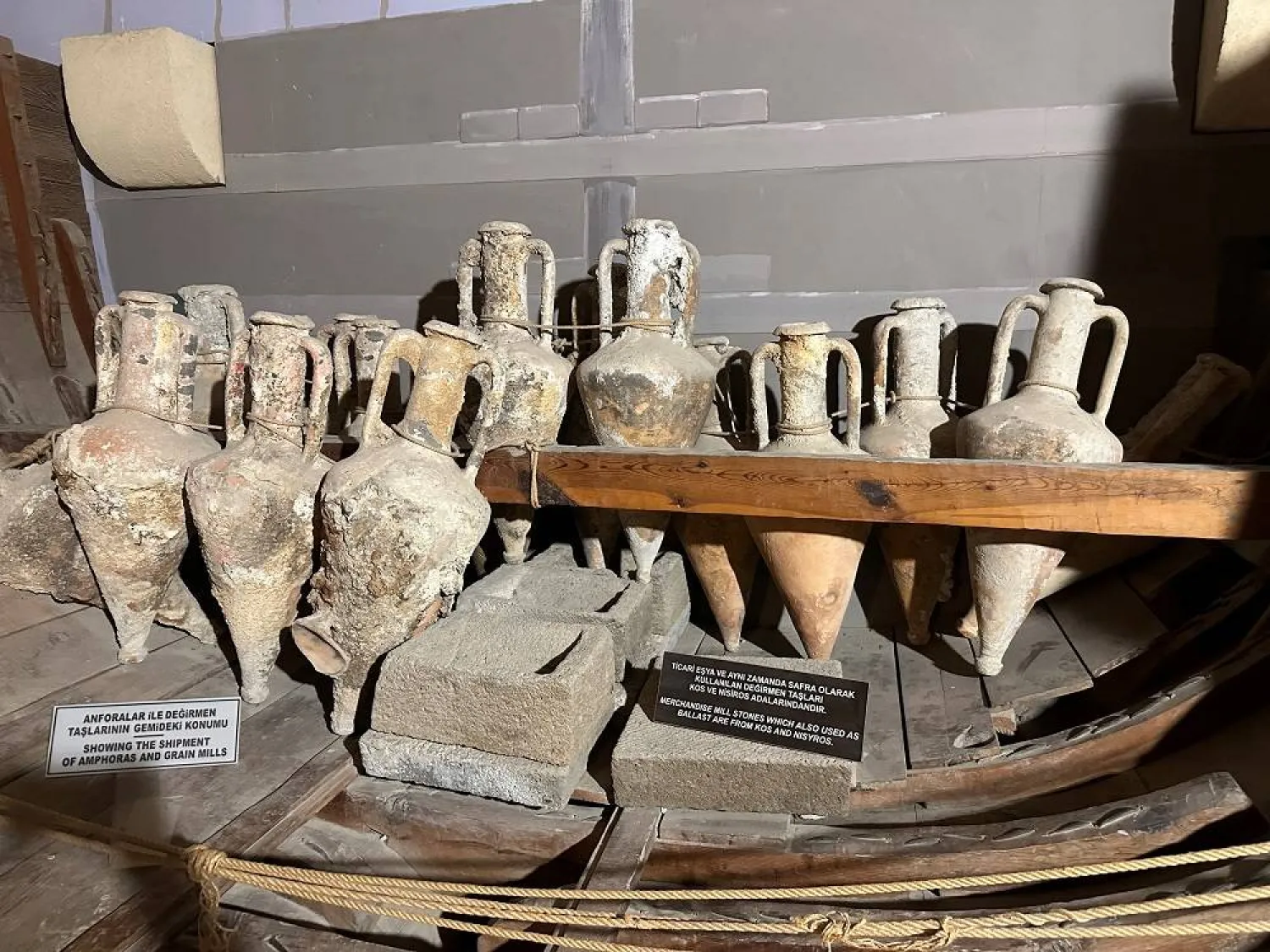
Amphoras and grain mills are seen in a museum dedicated to the ancient Kyrenia merchant ship that sank off the coast of Cyprus, at Kyrenia Castle in Cyprus, February 9, 2024. Adam Dunham/Handout via Reuters
TT

Study Firms up Date of Famous Ancient Shipwreck off Cyprus 

Amphoras and grain mills are seen in a museum dedicated to the ancient Kyrenia merchant ship that sank off the coast of Cyprus, at Kyrenia Castle in Cyprus, February 9, 2024. Adam Dunham/Handout via Reuters

When scientists in the 1960s excavated the wreck of an ancient Greek merchant ship off the northern coast of Cyprus, what they found was an amazing time capsule from a pivotal period in the Mediterranean world following the death of Alexander the Great.

But determining the date of the Kyrenia shipwreck with any sort of precision has proven difficult, and some previous scientific dating yielded conclusions that conflicted with the archeological evidence. Researchers have now calculated this timeline with new precision using improved techniques that they said can be applied to date other ancient shipwrecks as well.

By analyzing organic material from the wreck, including the vessel's wooden timbers, almonds from its cargo, and a gaming piece called an astragalus made from animal bone and used like dice, they concluded that the ship went down around 280 BC. That is a bit later than prior scientific dating estimates but a better match for the archeological evidence.

Sturt Manning, a Cornell University professor of classical archaeology, called the Kyrenia vessel an "iconic ship from the early Hellenistic period, central to the history of ancient maritime technology."

The ship, about 46 feet (14 meters) long, was built of wood with lead sheathing, with one mast bearing a square sail, and likely carrying a crew of four. It sank about a mile (1.6 km) off the coast. Aboard were nearly 400 amphoras - large two-handled pottery storage jars - some filled with almonds and others apparently with wine, along with heavy millstones as ballast.

"Likely it was going to or from Cyprus, and the cargo - amphora types - suggest it was trading in the Aegean and east Mediterranean area. The main cargo comprised amphora of a type associated with the island of Rhodes in the southeast Aegean," said Manning, lead author of the study published in the journal PLOS ONE.

Using various lines of evidence, the researchers determined that the ship had been constructed between about 345-313 BC and sank between about 286-272 BC.

The death in 323 BC of Alexander, who had conquered wide swathes of the Mediterranean region and beyond, led to regional scrambles for power. Cyprus became a contested area pitting successors of Alexander ruling in the Aegean region versus those in Egypt, with the latter winning control of the island.

The Kyrenia ship's remains are displayed at a museum in Cyprus.

"Ancient shipwrecks hold several unique sources of information for archaeologists to reconstruct the human past. In underwater sites like where the Kyrenia was buried, archaeological materials decay much more slowly. As a result, organic materials like wood, seeds or rope can be much better preserved than on land," said University of Georgia anthropology professor and study co-author Brita Lorentzen.

The discovery of a deepwater shipwreck off the coast of Israel, dating to roughly 1300 BC, was announced just last week.

"Ships were a critical source of transportation in the ancient world, which allowed people to move from one place to another, create social networks, and exchange trade goods and ideas. A shipwreck's contents can tell us specifically which items were being traded or exchanged, where and how people were moving around by sea, which groups of people were in contact with one another, and how they were impacted by these early social and economic networks," Lorentzen said.

This ship's timbers were embalmed decades ago using the chemical compound polyethylene glycol (PEG) to preserve the wood on land. This complicated the use of radiocarbon dating, a technique for determining an object's age based on the decay over time of a radioactive form of carbon.

"Adding PEG prevents ship timbers from drying out, shrinking and turning to dust out of the water. But it also contains petroleum, with lots of carbon from long-dead organic remains," Lorentzen said.

The researchers devised improved methods to remove PEG so radiocarbon dating could be used for the timbers. They also used radiocarbon dating on the almonds and astragalus.

Analysis of annual growth rings in trees also helps govern the dating of ancient wooden artifacts. The researchers found a discrepancy in a scientific standard used in analyzing wood from this time period to convert radiocarbon measurements into calendar dates for the northern hemisphere, and updated it.

"The work here is relevant to ancient shipwrecks generally," Manning said.


Madrasat Addeera Empowers AlUla Youth Through Traditional Crafts

The school focuses on empowering girls, teaching craft skills rooted in ancestral trades and presenting them in modern ways that create sustainable and creative opportunities - SPA
TT

Madrasat Addeera Empowers AlUla Youth Through Traditional Crafts

The school focuses on empowering girls, teaching craft skills rooted in ancestral trades and presenting them in modern ways that create sustainable and creative opportunities - SPA

Madrasat Addeera in AlUla Governorate offers specialized training programs and workshops to develop the skills of local youth in traditional crafts and arts, preserving cultural heritage while connecting it to contemporary life.

The school focuses on empowering girls, teaching craft skills rooted in ancestral trades and presenting them in modern ways that create sustainable and creative opportunities, SPA reported.

Throughout the year, the school contributes to the cultural vibrancy of the governorate by taking part in festivals and exhibitions. Through its workshops, visitors can explore traditional industries such as pottery, weaving, carpets, and natural products.

According to SPA, Madrasat Addeera's programs go beyond training, transforming craft skills into sustainable income, with handcrafted items sold locally and online, all entirely Saudi-made and inspired by AlUla’s culture and environment.

Since its establishment as the first girls’ school in AlUla and as the region’s first center for arts and design, the school has become a hub for nurturing talent, rediscovering heritage crafts, and attracting both local and global expertise.


British Treasury to Cover Bayeux Tapestry for Estimated £800 Million

This photo provided by Bayeux townhall shows a technician inspecting the famed Bayeux tapestry in Bayeux, Normandy, in 8th January, 2020. (Ville de Bayeux via AP/File photo)
TT

British Treasury to Cover Bayeux Tapestry for Estimated £800 Million

This photo provided by Bayeux townhall shows a technician inspecting the famed Bayeux tapestry in Bayeux, Normandy, in 8th January, 2020. (Ville de Bayeux via AP/File photo)

The British Treasury is set to insure the Bayeux Tapestry against damage for an estimated £800 million while it is on loan to the British Museum next year, reported the BBC.

The 70m-long embroidery depicting the Battle of Hastings in 1066 will travel from France to London as part of a deal between the two nations' governments.

The artifact's transit and its time in storage and on display will be covered under the Government Indemnity Scheme (GIS). Indemnity insurance covers situations like loss or damage.

The Treasury said without the long-standing scheme, “public museums and galleries would face a substantial commercial insurance premium, which would be significantly less cost effective.”

There are concerns about the move, as some French art experts have suggested the nearly 1,000-year-old work was in far too a delicate state to be transported - something French officials have denied.

It is understood the Treasury has received an initial valuation for covering the Bayeux Tapestry that has been provisionally approved. The loan will not be formally confirmed until it receives the final valuation.

That final valuation is estimated to be around £800 million.

The Bayeux Tapestry will be displayed in the Sainsbury Exhibitions Gallery of the British Museum from next September until July 2027 while its current home, the Bayeux Museum, undergoes renovations.

Comprising 58 scenes, 626 characters and 202 horses, the huge masterpiece charts a contested time in Anglo-French relations when William The Conqueror took the English throne from Harold Godwinson, becoming the first Norman king of England.

The government's indemnity scheme allows art and cultural objects to be shown publicly in the UK which "might not have been otherwise because the cost of insurance would have been too high".

The scheme - first set up in 1980 - has facilitated numerous high-value loans, including Vincent van Gogh's 1888 work "The Bedroom" to the National Gallery.

In exchange for the Bayeux Tapestry, the British Museum will loan items to France, including the 7th Century Anglo-Saxon artifacts discovered at the Sutton Hoo burial site in Suffolk and the 12th Century Lewis chess pieces.


Kolkata’s Iconic Trams Face Final Stop as Modernization Rolls in

Passengers sit inside a decorated tram during the 152nd anniversary celebrations of trams in Kolkata, India, February 24, 2025. (Reuters)
TT

Kolkata’s Iconic Trams Face Final Stop as Modernization Rolls in

Passengers sit inside a decorated tram during the 152nd anniversary celebrations of trams in Kolkata, India, February 24, 2025. (Reuters)

For more than a century, trams have rumbled past Kolkata's crumbling colonial facades, with their chiming bells contributing to the city's soundtrack as they ferried generations of ​commuters.

Now, Asia's oldest tram network is on the brink of disappearing as authorities consider pulling the plug on a mode of transport that has become more nostalgia than necessity.

The West Bengal government plans to shut down the 152-year-old system, keeping only a short heritage route. The decision has sparked a court battle as residents and heritage advocates fight to keep ‌the trams ‌rolling.

"As children, we would take the ‌trams ⁠for ​fun, ‌but as I grew older it became a necessity," said Abha Maity, 44, recalling rides to school and college. "I can’t imagine Kolkata without them."

Once a highlight of the city's streets, the wobbly trams now struggle for space amid traffic jams - competing with buses and yellow taxis - as Kolkata builds modern infrastructure and seeks faster transport.

Kolkata introduced ⁠horse-drawn trams in 1873 and electrified them in 1902. At its peak, the ‌network boasted more than 340 trams and ‍covered the entire city. Today, ‍only two routes remain, with a fleet of about 10.

"When ‍I joined, more than 340 trams were running. Now it's down to seven or eight," said Bacchu Sidda, a conductor for 36 years who still checks his duty roster pinned on a board ​at the last functioning depot in Gariahat.

The government began selling depots and scrapping cars years ago, prompting a citizens' ⁠group called Calcutta Tram Users Association (CTUA) to take the fight to court. CTUA has campaigned since 2016 to save what remains of the system.

"I love my trams more than myself," said Deep Das, 19, a journalism student and CTUA member. "If they disappear, it will be like a part of my body has left me."

Despite resistance, authorities are pouring billions into upgrading Kolkata's infrastructure, focusing on metro expansion, wider roads and new highways to ease congestion.

For now, the fate of Kolkata's aging trams awaits a ‌court review, as they continue carrying some passengers who view them as living memories of the city's past.
