


A Hungrier, Poorer and More Anxious Iran awaits 'Snapback' of UN Sanctions over its Nuclear Program

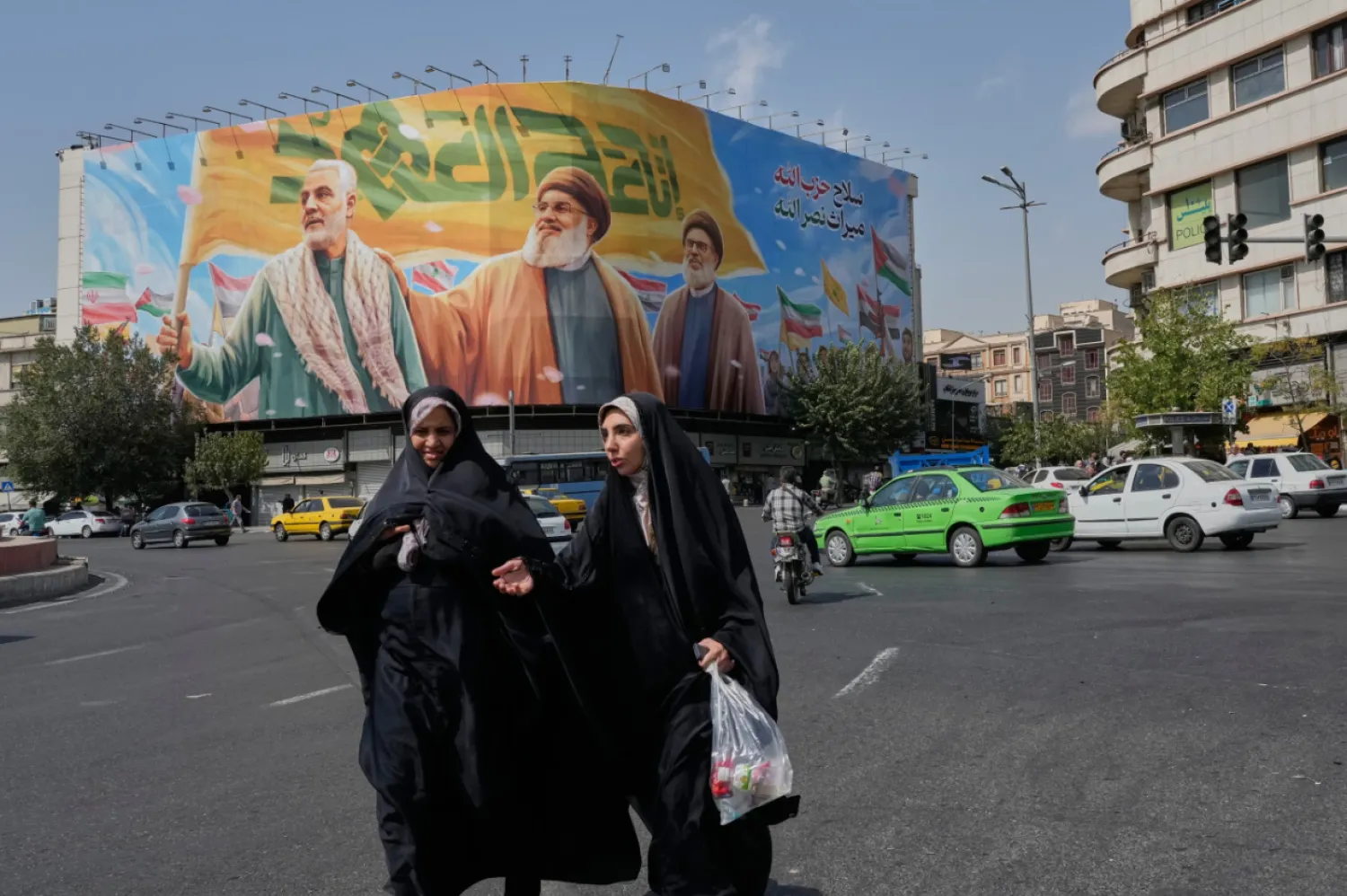
Two women walk past a huge banner showing the late commander of the Iran's Revolutionary Guard expeditionary Quds Force, Gen. Qassem Soleimani, who was killed in a US drone attack in 2020, and two late Hezbollah leaders Hassan Nasrallah, center, and Hashem Safieddine, who were killed in Israeli airstrikes in 2024, at the Enqelab-e-Eslami (Islamic Revolution) square, in Tehran, Iran, Saturday, Sept. 27, 2025.  (AP Photo/Vahid Salemi)
Two women walk past a huge banner showing the late commander of the Iran's Revolutionary Guard expeditionary Quds Force, Gen. Qassem Soleimani, who was killed in a US drone attack in 2020, and two late Hezbollah leaders Hassan Nasrallah, center, and Hashem Safieddine, who were killed in Israeli airstrikes in 2024, at the Enqelab-e-Eslami (Islamic Revolution) square, in Tehran, Iran, Saturday, Sept. 27, 2025. (AP Photo/Vahid Salemi)
TT

A Hungrier, Poorer and More Anxious Iran awaits 'Snapback' of UN Sanctions over its Nuclear Program

Two women walk past a huge banner showing the late commander of the Iran's Revolutionary Guard expeditionary Quds Force, Gen. Qassem Soleimani, who was killed in a US drone attack in 2020, and two late Hezbollah leaders Hassan Nasrallah, center, and Hashem Safieddine, who were killed in Israeli airstrikes in 2024, at the Enqelab-e-Eslami (Islamic Revolution) square, in Tehran, Iran, Saturday, Sept. 27, 2025.  (AP Photo/Vahid Salemi)
Two women walk past a huge banner showing the late commander of the Iran's Revolutionary Guard expeditionary Quds Force, Gen. Qassem Soleimani, who was killed in a US drone attack in 2020, and two late Hezbollah leaders Hassan Nasrallah, center, and Hashem Safieddine, who were killed in Israeli airstrikes in 2024, at the Enqelab-e-Eslami (Islamic Revolution) square, in Tehran, Iran, Saturday, Sept. 27, 2025. (AP Photo/Vahid Salemi)

As Iran's ailing economy braced Saturday for the reimposition of United Nations sanctions over its nuclear program, it is ordinary people who increasingly find themselves priced out of the food they need to survive and worried about their futures.

Iran's rial currency already sits at a record low, increasing pressure on food prices and making daily life that much more challenging. That includes meat, rice and other staples of the Iranian dinner table.

Meanwhile, people worry about a new round of fighting between Iran and Israel — as well as potentially the United States — as missile sites struck during the 12-day war in June now appear to be being rebuilt.

Activists fear a rising wave of repression within the Islamic Republic, which already has reportedly executed more people this year than over the past three decades, according to The AP news.

Sina, the father of a 12-year-old boy who spoke on condition that only his first name be used for fear of repercussions, said the country has never faced such a challenging time, even during the deprivations of the 1980s Iran-Iraq war and the decades of sanctions that came later.

“For as long as I can remember, we’ve been struggling with economic hardship, and every year it’s worse than the last,” Sina told The AP news. “For my generation, it’s always either too late or too early — our dreams are slipping away.”

Iran sanctions set to ‘snapback’ Early Sunday at 0000 GMT (8 p.m. Eastern), barring any last-minute diplomatic breakthrough, UN sanctions on Iran will be reimposed through “snapback,” as the mechanism is called by the diplomats who negotiated it into Iran’s 2015 nuclear deal with world powers. Snapback was designed to be veto-proof at the UN Security Council, meaning China and Russia cannot stop it alone, as they have other proposed actions against Tehran in the past.

The measure will again freeze Iranian assets abroad, halt arms deals with Tehran, and penalize any development of Iran’s ballistic missile program, among other measures.

France, Germany and the United Kingdom triggered snapback over Iran further restricting monitoring of its nuclear program and the deadlock over its negotiations with the US.

Iran further withdrew from the International Atomic Energy Agency monitoring after Israel’s war on the country in June, which also saw the US strike nuclear sites in the Islamic Republic. Meanwhile, the country still maintains a stockpile of uranium enriched up to 60% purity — a short, technical step away from weapons-grade levels of 90% — that is largely enough to make several atomic bombs, should Tehran choose to rush toward weaponization.

Iran has long insisted its nuclear program is peaceful, though the West and IAEA say Tehran had an organized weapons program up until 2003.

Tehran has further argued that the three European nations shouldn’t be allowed to implement snapback, pointing in part to America’s unilateral withdrawal from the accord in 2018, during the first term of President Donald Trump’s administration.

“The Trump administration appears to think it has a stronger hand post-strikes, and it can wait for Iran to come back to the table,” said Kelsey Davenport, a nuclear expert at the Washington-based Arms Control Association. “Given the knowledge Iran has, given the materials that remain in Iran, that’s a very dangerous assumption.”

Risks also remain for Iran as well, she added: “In the short term, kicking out the IAEA increases the risk of miscalculation. The US or Israel could use the lack of inspections as a pretext for further strikes.”

Iran on Saturday recalled its ambassadors to France, Germany and the UK for consultations ahead of the sanctions being reimposed, the state-run IRNA news agency reported.

Hunger and anxiety grow in Iran. The aftermath of the June war drove up food prices in Iran, putting already expensive meat out of reach for poorer families.

Iran's government put overall annual inflation at 34.5% in June, and its Statistical Center reported that the cost of essential food items rose over 50% over the same period. But even that doesn't reflect what people see at shops. Pinto beans tripled in price in a year, while butter nearly doubled. Rice, a staple, rose more than 80% on average, hitting 100% for premium varieties. Whole chicken is up 26%, while beer and lamb are up 9%.

“Every day I see new higher prices for cheese, milk and butter," said Sima Taghavi, a mother of two, at a Tehran grocery. “I cannot omit them like fruits and meat from my grocery list because my kids are too young to be deprived.”

The pressure over food and fears about the war resuming have seen more patients heading to psychologists since June, local media in Iran have reported.

“The psychological pressure from the 12-day war on the one hand, and runaway inflation and price hikes on the other, has left society exhausted and unmotivated,” Dr. Sima Ferdowsi, a clinical psychologist and professor at Shahid Beheshti University, told the Hamshahri newspaper in an interview published in July.

“If the economic situation continues like this, it will have serious social and moral consequences," she warned, with the newspaper noting “people may do things they would never think of doing in normal circumstances to survive.”

Executions surge in 2025 Iran has faced multiple nationwide protests in recent years, fueled by anger over the economy, demands for women's rights and calls for the country's theocracy to change. The most recent came in 2022 over the death of Mahsa Amini, a young woman who died after being detained by police allegedly for not wearing her hijab, or headscarf, to their liking.

In response to those protests and the June war, Iran has been putting prisoners to death at a pace unseen since 1988, when it executed thousands at the end of the Iran-Iraq war. The Oslo-based group Iran Human Rights and the Washington-based Abdorrahman Boroumand Center for Human Rights in Iran put the number of people executed in 2025 at over 1,000, noting the number could be higher as Iran does not report on each execution.

“Political and civic space in Iran has shrunk to nothing, and outside Iran, civil society activists and dissidents face transnational repression,” the center warned. “The Iranian people, millions of whom aspire to more than a closed and brutal theocracy, have tried every option within their reach. Their leaders have not.”



Iraq's Political Future in Limbo as Factions Vie for Power

FILED - 02 November 2025, Iraq, Najaf: Iraqi Prime Minister Mohammed Shia' al-Sudani delivers a speech during a campaign rally of his Reconstruction and Development Coalition in Najaf, ahead of the Iraqi parliamentary elections, scheduled to be held on 11 November 2025. Photo: Ameer Al-Mohammedawi/dpa
TT

Iraq's Political Future in Limbo as Factions Vie for Power

FILED - 02 November 2025, Iraq, Najaf: Iraqi Prime Minister Mohammed Shia' al-Sudani delivers a speech during a campaign rally of his Reconstruction and Development Coalition in Najaf, ahead of the Iraqi parliamentary elections, scheduled to be held on 11 November 2025. Photo: Ameer Al-Mohammedawi/dpa

Political factions in Iraq have been maneuvering since the parliamentary election more than a month ago to form alliances that will shape the next government.

The November election didn't produce a bloc with a decisive majority, opening the door to a prolonged period of negotiations, said The Associated Press.

The government that eventually emerges will be inheriting a security situation that has stabilized in recent years, but it will also face a fragmented parliament, growing political influence by armed factions, a fragile economy, and often conflicting international and regional pressures, including the future of Iran-backed armed groups.

Uncertain prospects

Prime Minister Mohammed Shia al-Sudani's party took the largest number of seats in the election. Al-Sudani positioned himself in his first term as a pragmatist focused on improving public services and managed to keep Iraq on the sidelines of regional conflicts.

While his party is nominally part of the Coordination Framework, a coalition of Iran-backed Shiite parties that became the largest parliamentary bloc, observers say it’s unlikely that the Coordination Framework will support al-Sudani’s reelection bid.

“The choice for prime minister has to be someone the Framework believes they can control and doesn't have his own political ambitions,” said Sajad Jiyad, an Iraqi political analyst and fellow at The Century Foundation think tank.

Al-Sudani came to power in 2022 with the backing of the Framework, but Jiyad said that he believes now the coalition “will not give al-Sudani a second term as he has become a powerful competitor.”

The only Iraqi prime minister to serve a second term since 2003 was Nouri al-Maliki, first elected in 2006. His bid for a third term failed after being criticized for monopolizing power and alienating Sunnis and Kurds.

Jiyad said that the Coordination Framework drew a lesson from Maliki “that an ambitious prime minister will seek to consolidate power at the expense of others.”

He said that the figure selected as Iraq's prime minister must generally be seen as acceptable to Iran and the United States — two countries with huge influence over Iraq — and to Iraq’s top Shiite cleric, Grand Ali al-Sistani.

Al-Sudani in a bind

In the election, Shiite alliances and lists — dominated by the Coordination Framework parties — secured 187 seats, Sunni groups 77 seats, Kurdish groups 56 seats, in addition to nine seats reserved for members of minority groups.

The Reconstruction and Development Coalition, led by al-Sudani, dominated in Baghdad, and in several other provinces, winning 46 seats.

Al-Sudani's results, while strong, don't allow him to form a government without the support of a coalition, forcing him to align the Coordination Framework to preserve his political prospects.

Some saw this dynamic at play earlier this month when al-Sudani's government retracted a terror designation that Iraq had imposed on the Lebanese Hezbollah militant group and Yemen’s Houthis— Iran-aligned groups that are allied with Iraqi armed factions — just weeks after imposing the measure, saying it was a mistake.

The Coalition Framework saw its hand strengthened by the absence from the election of the powerful Sadrist movement led by Shiite cleric Muqtada Sadr, which has been boycotting the political system since being unable to form a government after winning the most seats in the 2021 election.

Hamed Al-Sayed, a political activist and official with the National Line Movement, an independent party that boycotted the election, said that Sadr’s absence had a “central impact.”

“It reduced participation in areas that were traditionally within his sphere of influence, such as Baghdad and the southern governorates, leaving an electoral vacuum that was exploited by rival militia groups,” he said, referring to several parties within the Coordination Framework that also have armed wings.

Groups with affiliated armed wings won more than 100 parliamentary seats, the largest showing since 2003.

Other political actors

Sunni forces, meanwhile, sought to reorganize under a new coalition called the National Political Council, aiming to regain influence lost since the 2018 and 2021 elections.

The Kurdish political scene remained dominated by the traditional split between the Kurdistan Democratic Party and Patriotic Union of Kurdistan parties, with ongoing negotiations between the two over the presidency.

By convention, Iraq’s president is always a Kurd, while the more powerful prime minister is Shiite and the parliamentary speaker Sunni.

Parliament is required to elect a speaker within 15 days of the Federal Supreme Court’s ratification of the election result, which occurred on Dec. 14.

The parliament should elect a president within 30 days of its first session, and the prime minister should be appointed within 15 days of the president’s election, with 30 days allotted to form the new government.

Washington steps in

The incoming government will face major economic and political challenges.

They include a high level of public debt — more than 90 trillion Iraqi dinars ($69 billion) — and a state budget that remains reliant on oil for about 90% of revenues, despite attempts to diversify, as well as entrenched corruption.

But perhaps the most delicate question will be the future of the Popular Mobilization Forces, a coalition of militias that formed to fight the ISIS group as it rampaged across Iraq more than a decade ago.

It was formally placed under the control of the Iraqi military in 2016 but in practice still operates with significant autonomy. After the Hamas-led attack in southern Israel on Oct. 7, 2023 sparked the devastating war in Gaza, some armed groups within the PMF launched attacks on US bases in the region in retaliation for Washington’s backing of Israel.

The US has been pushing for Iraq to disarm Iran-backed groups — a difficult proposition, given the political power that many of them hold and Iran’s likely opposition to such a step.

Two senior Iraqi political officials, who spoke on condition of anonymity because they weren't authorized to comment publicly, said that the United States had warned against selecting any candidate for prime minister who controls an armed faction and also cautioned against letting figures associated with militias control key ministries or hold significant security posts.

“The biggest issue will be how to deal with the pro-Iran parties with armed wings, particularly those... which have been designated by the United States as terrorist entities,” Jiyad said.


What Egypt’s Red Lines Mean for Sudan’s War

Egyptian President Abdel Fattah al-Sisi holds talks with Sudan’s army chief Abdel Fattah al-Burhan in Cairo on Thursday (Egyptian Presidency)
TT

What Egypt’s Red Lines Mean for Sudan’s War

Egyptian President Abdel Fattah al-Sisi holds talks with Sudan’s army chief Abdel Fattah al-Burhan in Cairo on Thursday (Egyptian Presidency)

In unusually blunt language, and following a visit by Sudan’s Sovereignty Council Chairman and army chief Abdel Fattah al-Burhan to Cairo, the Egyptian presidency issued a statement on the war in Sudan outlining three points it described as red lines.

It said Egypt would not allow any of them to be crossed or compromised, as they directly affect Egypt’s national security, which it said is inseparable from Sudan’s national security.

The reference to activating the joint defense agreement between the two countries was seen as a signal that Egypt could bring its military, political, and diplomatic weight to bear in support of the Sudanese army.

Joint defense agreement

In March 2021, Egypt signed a military cooperation agreement with Sudan that covers training, border security, and the confrontation of shared threats. That agreement followed a joint defense pact signed in 1976 during the presidencies of Sudan’s Gaafar Nimeiry and Egypt’s Anwar Sadat.

Articles One and Two of the pact stipulate that any attack on one party is considered an attack on the other, and require immediate consultation, including the use of armed force to repel aggression. The agreement also commits both sides to coordinating their defense and military policies on matters related to their national security.

After the fall of Nimeiry’s regime in the 1985 popular uprising, then Prime Minister Sadiq al-Mahdi informed the Egyptian leadership of his desire to cancel the joint defense agreement. Instead, the two sides signed what became known as the Brotherhood Charter in 1987. While it did not explicitly cancel the 1976 agreement, its mechanisms have not been discussed or activated since then.

Regional and international messages

Sudanese journalist Osman Mirghani, editor-in-chief of Al-Tayar newspaper, said the Egyptian statements amounted to regional and international messages linked to recent developments and what he described as serious security threats facing Sudan.

He pointed to the expansion of the Rapid Support Forces in the Darfur and Kordofan regions in a way that threatens shared Sudanese and Egyptian national security, warning of risks of geographic fragmentation that could endanger Sudan’s unity.

Speaking to Asharq Al-Awsat, Mirghani said Egypt was, for the first time, using direct and tough language and signaling the possibility of intervention under international law in Sudan’s conflict. He said this reflected the level of Egyptian concern over the situation in Sudan.

Mirghani added that the reference to red lines was a message directed at all parties, noting that there are many influential players in Sudan.

The red lines

The first red line cited by Cairo was the preservation of Sudan’s unity and territorial integrity, preventing any tampering with its resources or those of the Sudanese people, and rejecting the secession of any part of the country. Egypt reiterated its categorical refusal to the establishment or recognition of any parallel entities, saying such moves would undermine Sudan’s unity and territorial integrity.

The statement also stressed the need to preserve Sudanese state institutions and prevent any harm to them. Egypt affirmed its full right to take all necessary measures permitted under international law, including activating the joint defense agreement between the two brotherly countries, to ensure these red lines are not crossed.

Timing of the visit

Former Sudanese Foreign Minister Ali Youssef noted the timing of Burhan’s visit to Cairo, stating that it occurred after his trip to Saudi Arabia earlier this week and following a visit by Saudi Crown Prince Mohammed bin Salman to the United States.

Youssef said the trip was part of efforts to end the war in Sudan through the Quartet mechanism, which includes Saudi Arabia, the United Arab Emirates, Egypt, and the United States.

Speaking to Asharq Al-Awsat, Youssef said Burhan briefed Egyptian President Abdel Fattah al-Sisi on the outcomes of his Saudi visit and the latest developments in Sudan.

He stated that the visit did not follow the usual ceremonial protocol and was a result of developments in the war, noting that Egypt’s security is linked to Sudan’s security. He added that Egypt is part of the Quartet, which seeks to end a war that is approaching its third year.

Military implications

Sudanese military expert Al-Muatasim Abdel Qader said activating the joint agreement would imply Egyptian intervention in various forms, including supplying weapons and ammunition or direct military involvement.

He said the provisions of the agreement obligate each army to defend the other, adding that the red lines outlined by the Egyptian presidency represented a significant step and carried major implications for the Sudanese state.

In remarks to Asharq Al-Awsat, Abdel Qader described mutual protection between the two countries as a historically rooted matter, dating back to wars Egypt fought in the last century in which Sudanese armed forces took part.

Rapid Support Forces response

Basha Tabiq, an adviser to the commander of the Rapid Support Forces, said in posts on X that Egypt’s position amounted to blatant interference, bias toward one party, and a colonial mindset that views Sudan as a backyard.

Another source aligned with the RSF said accusations against Egypt of backing the Sudanese army have persisted since the early days of the war. The source pointed to the presence of Egyptian forces at Merowe air base in northern Sudan at the start of the conflict, when several Egyptian soldiers and officers were captured before later being handed over to Cairo.

The source also cited accusations by RSF leader Mohamed Hamdan Dagalo, known as Hemedti, who said in October 2024 that the Egyptian army had carried out air strikes against his forces and supplied the Sudanese army with drones and training.

He said Hemedti renewed those accusations last June, alleging that Cairo supported the Sudanese army with aircraft flown by Egyptian pilots that bombed areas under his forces’ control, and supplied weapons and aviation fuel. Hemedti described this as a blatant aggression against the Sudanese people.

The source, who requested anonymity, said Egypt has been intervening in the war from the outset and that activating the joint defense agreement would merely formalize an existing reality.

No time to spare

Sudanese ambassador Al-Sadiq al-Maqli said Egypt is working with Saudi Arabia and the international Quartet, in coordination with the United States, to give fresh momentum to efforts on Sudan.

He said Washington is currently using soft power rather than force, which he described as an option deferred until shuttle diplomacy by US President’s senior adviser Massad Boulos is exhausted.

Speaking to Asharq Al-Awsat, Maqli said the United States fully understands the influence of Saudi Arabia and Egypt and their ability to persuade and soften the stance of Sudan’s government, which has rejected the latest US initiative.

He said Burhan currently has no time to spare, as what is unfolding in Sudan represents the world’s worst humanitarian disaster, according to the international community.

Maqli noted that Egypt, represented by Foreign Minister Badr Abdelatty, has been almost fully dedicated to making the Quartet mechanism succeed, given that the continuation of the current situation in Sudan poses a threat to Egypt’s national security.

He described Burhan’s visits to Riyadh and Cairo as short but necessary steps toward accepting the Quartet initiative, saying the Saudi visit marked a qualitative shift in the Sudanese government’s official position.

He added that Sudan’s foreign ministry later expressed Port Sudan’s readiness to cooperate with President Donald Trump, his secretary of state, and Boulos in efforts to achieve peace in Sudan, predicting imminent developments that could lead to a major breakthrough in the crisis.


Iraq Negotiates New Coalition Under US Pressure

Election workers count ballots as they close a polling station, during the parliamentary elections in Baghdad, Iraq, Nov. 11, 2025. (AP)
TT

Iraq Negotiates New Coalition Under US Pressure

Election workers count ballots as they close a polling station, during the parliamentary elections in Baghdad, Iraq, Nov. 11, 2025. (AP)

More than a month after Iraq's parliamentary elections, the country's top leaders remain locked in talks to form a government while facing pressure from Washington to exclude Tehran-backed armed groups.

Amid seismic changes in the Middle East, where new alliances are forming and old powers waning, Iraqi leaders face a daunting task: navigating relations with US-blacklisted pro-Iranian factions.

The US has held significant sway over Iraqi politics since leading the 2003 invasion that ousted long-time ruler Saddam Hussein.

But another specter also haunts Iraq's halls of power: Washington's arch-foe, Iran.

Iraq has long been caught between the two, with successive governments negotiating a delicate balance.

Now, after November's election, Washington has demanded the eventual government must exclude Iran-backed armed groups and instead move to dismantle them, Iraqi officials and diplomats told AFP.

A State Department spokesperson, speaking on condition of anonymity, said: "Iraqi leaders well know what is and is not compatible with a strong US-Iraq partnership".

Washington, the spokesperson said, "will continue to speak plainly to the urgency of dismantling Iran-backed militias".

But some of these groups have increased their presence in the new chamber and have joined the Coordination Framework, an alliance of Shiite parties with varying ties to Iran and which holds the majority.

For weeks, the Coordination Framework has been embroiled in talks to nominate the next prime minister.

"The US has put conditions that armed factions should not be part of the new government," a senior Iraqi official said. The factions must disarm and "sever ties with Iran's Revolutionary Guard," he added.

In recent tweets, the US special envoy to Iraq, Mark Savaya said that Iraqi leaders are at a "crossroads".

Their decision "will send a clear and unmistakable signal to the United States... that Iraq is ready to claim its rightful place as a stable and respected nation in the new Middle East.

"The alternative is equally clear: economic deterioration, political confusion, and international isolation," Savaya said.

The US has blacklisted as "terrorist organizations" several armed groups from within the pro-Iran Popular Mobilization Forces, a former paramilitary alliance now integrated into the armed forces.

They are also part of the Iran-backed so-called "Axis of Resistance" and have called for the withdrawal of US troops -- deployed in Iraq as part of an anti-ISIS coalition -- and launched attacks against them.

Most of these groups hold seats in parliament and have seen their political and financial clout increase.

The Asaib Ahl al-Haq faction, led by Qais al-Khazali, who is a key figure in the Coordination Framework, won 27 seats in the latest election, making it harder to exclude it from the government.

A potential compromise is to deny it a key portfolio, as in the current government.

"The US has turned a blind eye before, so they might after all engage with the government as a whole but not with ministries held by armed groups," a former Iraqi official said.

Other blacklisted groups are:

+ Kataeb Hezbollah, one of the most powerful armed groups, supports a parliamentary bloc (six seats).

+ Kataeb Sayyid al-Shuhada, Kataeb Imam Ali and Harakat Ansar Allah al-Awfiya.

+ The al-Nujaba movement is the only group that has steered clear of elections.

Iraq has its economic growth to worry about.

After decades of turmoil, it has only begun to regain a sense of normalcy in recent years.

Washington has already imposed sanctions on several Iraqi entities and banks, accusing them of helping Tehran evade sanctions.

But Iraqi leaders hope for greater foreign investments and support partnerships with US companies.

The most striking endorsement came from Khazali, an opponent of the US military presence who now argues that it would be in Baghdad's interest for major US companies to invest.

Since the Israel's war with Hamas in Gaza began in October 2023, Iraq has remained relatively unscathed by the turmoil engulfing the Middle East.

Iraqi armed groups did launch attacks on US troops and largely unsuccessful ones on Israel. Washington responded with heavy strikes, and the attacks have long since halted.

Iraq remained the only close regional ally of Iran to stay out of Israel's crosshairs.

So far, the US has acted as a buffer, helping to prevent an Israeli attack, but Iraqis have been warned of strikes against the armed groups, multiple sources said.

But as the presence of American forces dwindles, fears are growing.
