


Algerian Music Icon Dies from Coronavirus

Algerian singer Hamdi Benani (APZ)
TT

Algerian Music Icon Dies from Coronavirus

Algerian singer Hamdi Benani (APZ)

Prominent Algerian singer Hamdi Benani passed away on Monday in Ibn Sina hospital in Annaba, where he had spent 10 days for treatment from the coronavirus.

Doctors at the hospital told journalists that the artist suffered from coronavirus and his health deteriorated in recent days, which necessitated his admission to the recovery room.

Benani is most known for the Malouf de Annabi song and always carrying a white violin.

Throughout his career, he was famous for his contribution to spreading Algerian culture in general, and Malouf in particular, through his participation in international events.

His successful career included over 30 songs, such as Adalah ya Adalah, Ya Lili, and Jani ma Jani.

President Abdelmadjid Tebboune expressed “great sadness for the loss of a master that was hugely considered a figure in Algerian culture,” adding that he was respected by his local and international audience throughout his whole career.

The number of coronavirus cases in Algeria climbed to over 50,000 cases with 1,672 deaths and about 35,000 recoveries.

At least seven deaths and 197 new infections were reported in the country over the past 24 hours, according to a statement by the Health Ministry.

Following the rise in infections, it has become certain that the school year will not resume on October 4 as previously determined by the government. This is due to its inability to prepare a plan to prevent a surge in infections, especially with regard to maintaining social distancing in overcrowded schools.

Authorities are considering delaying the school year till after the referendum on the constitution, scheduled for November 01.

Meanwhile, the syndicate of Imams mosques called for lifting the ban on Friday prayers, which the government excluded from its decision to reopen mosques issued in August.

Observers believe that the ban on Friday prayers is a political decision linked to the popular movement, as hundreds of thousands of protests used to occupy the streets after leaving the mosques on Fridays.

The authority wants to put an end to the Hirak movement, which was halted by its activists last March due to the outbreak of the pandemic.

On Saturday, Algerian Health Minister Abderrahmane Benbouzid expressed his satisfaction with the results of the fight against COVID-19, APS news agency reported.

Benbouzid said there is a drop in new cases in recent weeks, which is due to “the effective participation of all sectors and all sections of society, despite the fact that some still do not respect the compulsory wearing of masks.”

He warned against another wave of high infections if the precautionary measures issued by authorities were not respected.
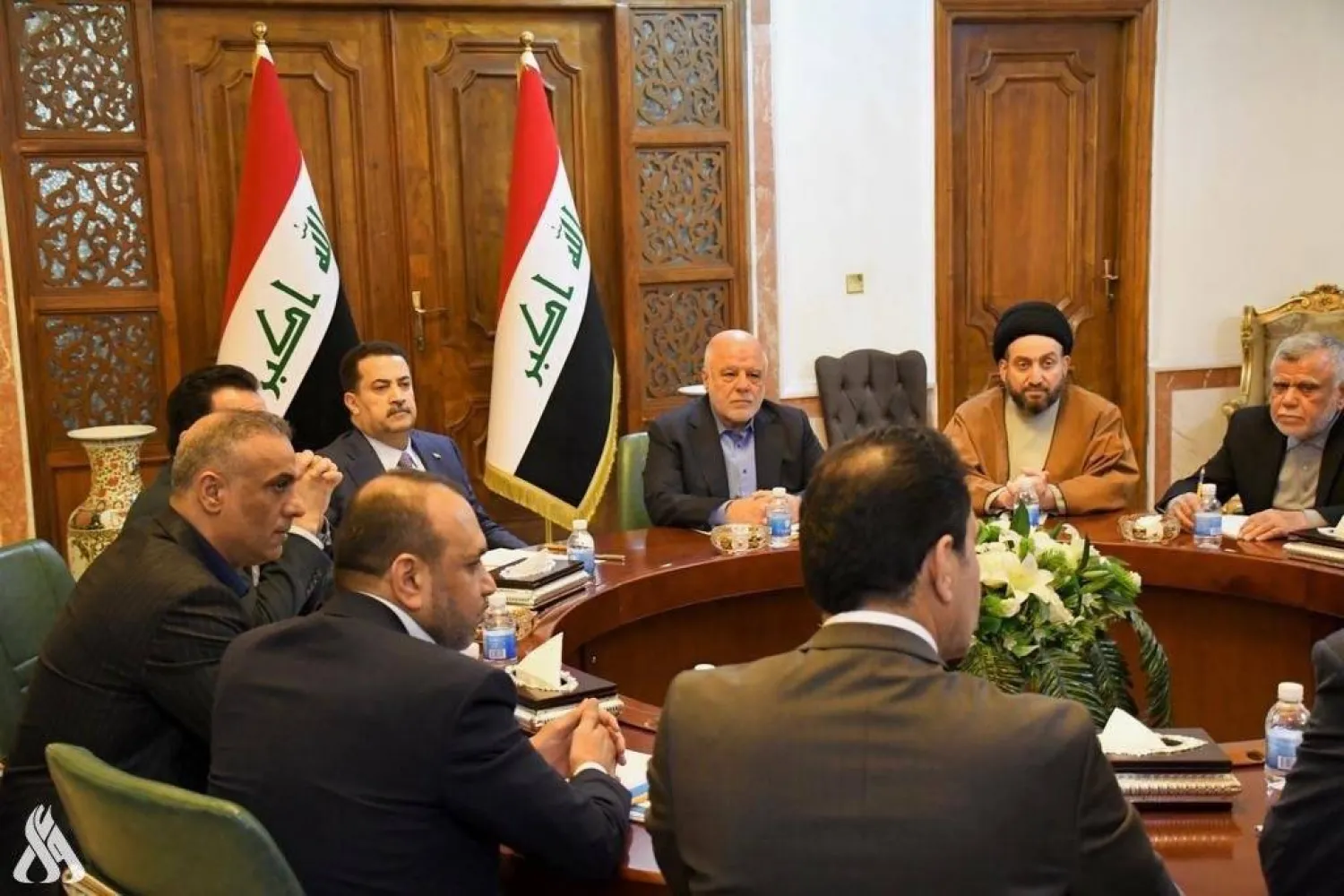



Maliki Can Withdraw as Candidacy as Iraq PM the Easy or Hard Way

Members of the Coordination Framework hold a meeting. (Iraqi News Agency)
TT

Maliki Can Withdraw as Candidacy as Iraq PM the Easy or Hard Way

Members of the Coordination Framework hold a meeting. (Iraqi News Agency)

Iraqi Former Prime Minister Nouri al-Maliki declined at the last minute to attend a meeting of the pro-Iran Coordination Framework on Monday night that was aimed at settling the crisis over his nomination as prime minister.

Instead of declaring that he was pulling out as candidate, as had been expected, Maliki informed his close circle that he is “following through with his nomination to the end,” trusted sources told Asharq Al-Awsat.

Iraq has come under intense pressure from the US to withdraw the nomination. In January, President Donald Trump warned Baghdad against picking Maliki as its PM, saying the United States would no longer help the country.

“Last time Maliki was in power, the Country descended into poverty and total chaos. That should not be allowed to happen again. Because of his insane policies and ideologies, if elected, the United States of America will no longer help Iraq,” Trump wrote on Truth Social.

Maliki also dismissed as “extortion and intimidation” talks of renewed US sanctions on Iraq, added the sources.

However, circles within the Coordination Framework have started to “despair” with the impasse over naming a new prime minister and are weighing the possibility of taking “difficult” choices, they revealed. Maliki has become a prisoner of his own nomination.

The Sunni Progress Party (Takadum) had voiced its reservations over Maliki’s nomination before Trump made his position clear and which has since weighed heavily on Iraq.

‘Indefinitely’

Maliki’s decision to skip the Framework’s meeting on Monday forced the coalition to postpone it “indefinitely”, exposing more differences inside the alliance that have been festering for months. The dispute over the post of prime minister is threatening to evolve into one that threatens the unity of the coalition itself.

Several sources told Asharq Al-Awsat that Maliki had sent the Framework a written message on Monday night informing them that he will not attend the meeting because “he was aware that discussions will seek to pressure him to withdraw his candidacy.”

Maliki was the one to call for the meeting to convene in the first place, they revealed.

Reports have been rife in Iraq that Shiite, Sunni and Kurdish political leaderships have all received warnings that the US would take measure against Iraq if Maliki continued to insist on his nomination.

Former Foreign Minister Hoshyar Zebari told Dijlah TV that “Shiite parties” had received two new American messages reiterating the rejection of Maliki’s nomination.

Necessary choice

Maliki and the Framework are now at an impasse, with the latter hoping the former PM would take it upon himself to withdraw his candidacy in what a leading Shiite figure said would help protect the unity of the coalition.

Leading members of the coalition were hoping to give Maliki enough time to decide himself to withdraw, but as time stretches on, the coalition may take matters into its own hands and take “necessary” choices, said the figure.

Other sources revealed, however, that Maliki refuses to voluntarily withdraw from the race believing that this is a responsibility that should be shouldered by the Framework. This has effectively left the alliance with complex and limited choices to end the crisis.

Sources close to Maliki said he has made light of US threats to impose sanctions, saying that if they were to happen, Iraq will emerge on the other side stronger, citing other countries that came out stronger after enduring years of pressure.

Moreover, he is banking on an American change in position, saying mediators have volunteered to “polish his image before Trump and his team.” Members of Maliki’s State of Law coalition declined to comment on this information.

Sources inside the Framework said the coalition may “ultimately withdraw Maliki’s nomination if he becomes too much of a burden on an already weary alliance.”

Doing so may cost them a strong ally in Maliki and force the Framework to yield to Washington’s will, said the Shiite figure. “Maliki may come off as stubborn and strong, but he is wasting his realistic options at this critical political juncture,” it added.

The Framework is divided between a team that is banking on waiting to see how the US-Iran tensions will play out to resolve the crisis and on Maliki voluntarily withdrawing his nomination. The other team is calling for the coalition to resolve the crisis through an internal vote.

Leading Shiite figures told Asharq Al-Awsat that opponents of Maliki’s nomination in the coalition have no choice but to apply internal pressure inside the Framework, which is on the verge of collapse.


Australia Bars Citizen Held in Syria’s Roj Camp from Returning Home

Members of Australian families believed to be linked to ISIS leave Roj camp near Derik, Syria February 16, 2026. REUTERS/Orhan Qereman
TT

Australia Bars Citizen Held in Syria’s Roj Camp from Returning Home

Members of Australian families believed to be linked to ISIS leave Roj camp near Derik, Syria February 16, 2026. REUTERS/Orhan Qereman

Australia has barred one of its citizens from returning home from a Syrian detention camp because of security concerns, the government said Wednesday.

The unidentified person is among a group of 34 Australian women and children at the Roj camp related to suspected members of ISIS.

"I can confirm that one individual in this cohort has been issued a temporary exclusion order, which was made on advice from security agencies," Home Affairs Minister Tony Burke said in a statement sent to AFP.

"At this stage security agencies have not provided advice that other members of the cohort meet the required legal thresholds for temporary exclusion orders."

The minister can make temporary exclusion orders lasting up to two years to prevent terrorist activities or politically motivated violence.

The Australians were released from the camp on Monday but failed to reach the capital Damascus on their way home, a Kurdish official told AFP in Syria.

The official said they were turned back to the detention camp, citing "poor coordination" with the Syrian authorities.

Prime Minister Anthony Albanese underscored his government's refusal to help repatriate the women and children.

"You make your bed, you lie in it," he said, accusing the group of aligning with an ideology that seeks to "undermine and destroy our way of life".

"We are doing nothing to repatriate or to assist these people," he told reporters Wednesday.

"I think it's unfortunate that children are caught up in this. That's not their decision but it's the decision of their parents or their mother."

The humanitarian organization Save the Children Australia filed a lawsuit in 2023 on behalf of 11 women and 20 children in Syria, seeking their repatriation.

But the Federal Court ruled against Save the Children, saying the Australian government did not control their detention in Syria.


Saudi Intervention Ends Socotra Power Crisis

Socotra power generators restarted after Saudi intervention (X)
TT

Saudi Intervention Ends Socotra Power Crisis

Socotra power generators restarted after Saudi intervention (X)

Electricity has returned to Yemen’s Socotra archipelago after urgent Saudi intervention ended days of outages that disrupted daily life and crippled vital institutions, including the general hospital, the university and the technical institute.

The breakthrough followed a sudden shutdown of the power plants after the operating company withdrew and disabled control systems, triggering widespread blackouts and deepening hardship for residents.

The Saudi Program for the Development and Reconstruction of Yemen said its engineering and technical teams moved immediately after receiving an appeal from local authorities. Specialists were dispatched to reactivate operating systems that had been encrypted before the company left the island.

Generators were brought back online in stages, restoring electricity across most of the governorate within a short time.

The restart eased intense pressure on the grid, which had faced rising demand in recent weeks after a complete halt in generation.

Health and education facilities were among the worst affected. Some medical departments scaled back services, while parts of the education sector were partially suspended as classrooms and laboratories were left without power.

Socotra’s electricity authority said the crisis began when the former operator installed shutdown timers and password protections on control systems, preventing local teams from restarting the stations. Officials noted that the archipelago faced a similar situation in 2018, which was resolved through official intervention.

Local sources said the return of electricity quickly stabilized basic services. Water networks resumed regular operations, telecommunications improved, and commercial activity began to recover after a period of economic disruption linked to the outages.

Health and education rebound

In the health sector, stable power, combined with operational support, secured the functioning of Socotra General Hospital, the archipelago’s main medical facility.

Funding helped provide fuel and medical supplies and support healthcare staff, strengthening the hospital’s ability to receive patients and reducing the need to transfer cases outside the governorate, a burden that had weighed heavily on residents.

Medical sources said critical departments, including intensive care units and operating rooms, resumed normal operations after relying on limited emergency measures.

In education, classes and academic activities resumed at Socotra University and the technical institute after weeks of disruption.

A support initiative covered operational costs, including academic staff salaries and essential expenses, helping curb absenteeism and restore the academic schedule.

Local authorities announced that studies at the technical institute would officially restart on Monday, a move seen as a sign of gradual stabilization in public services.

Observers say sustained technical and operational support will be key to safeguarding electricity supply and preventing a repeat of the crisis in a region that depends almost entirely on power to run its vital sectors.