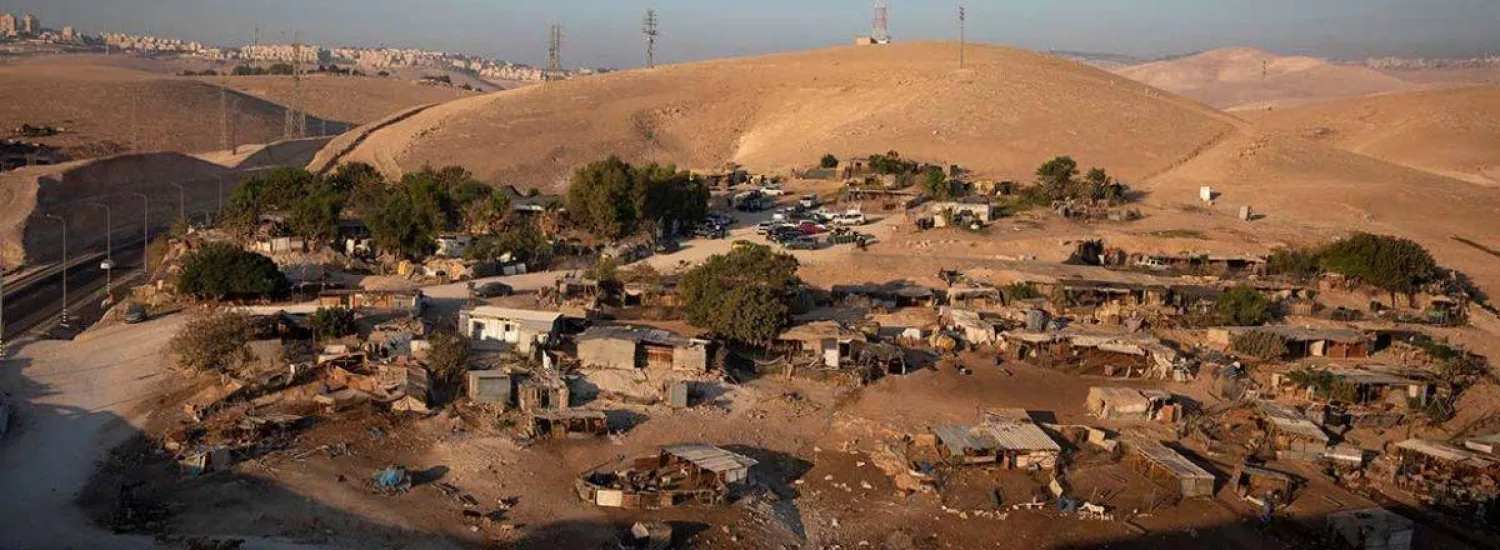
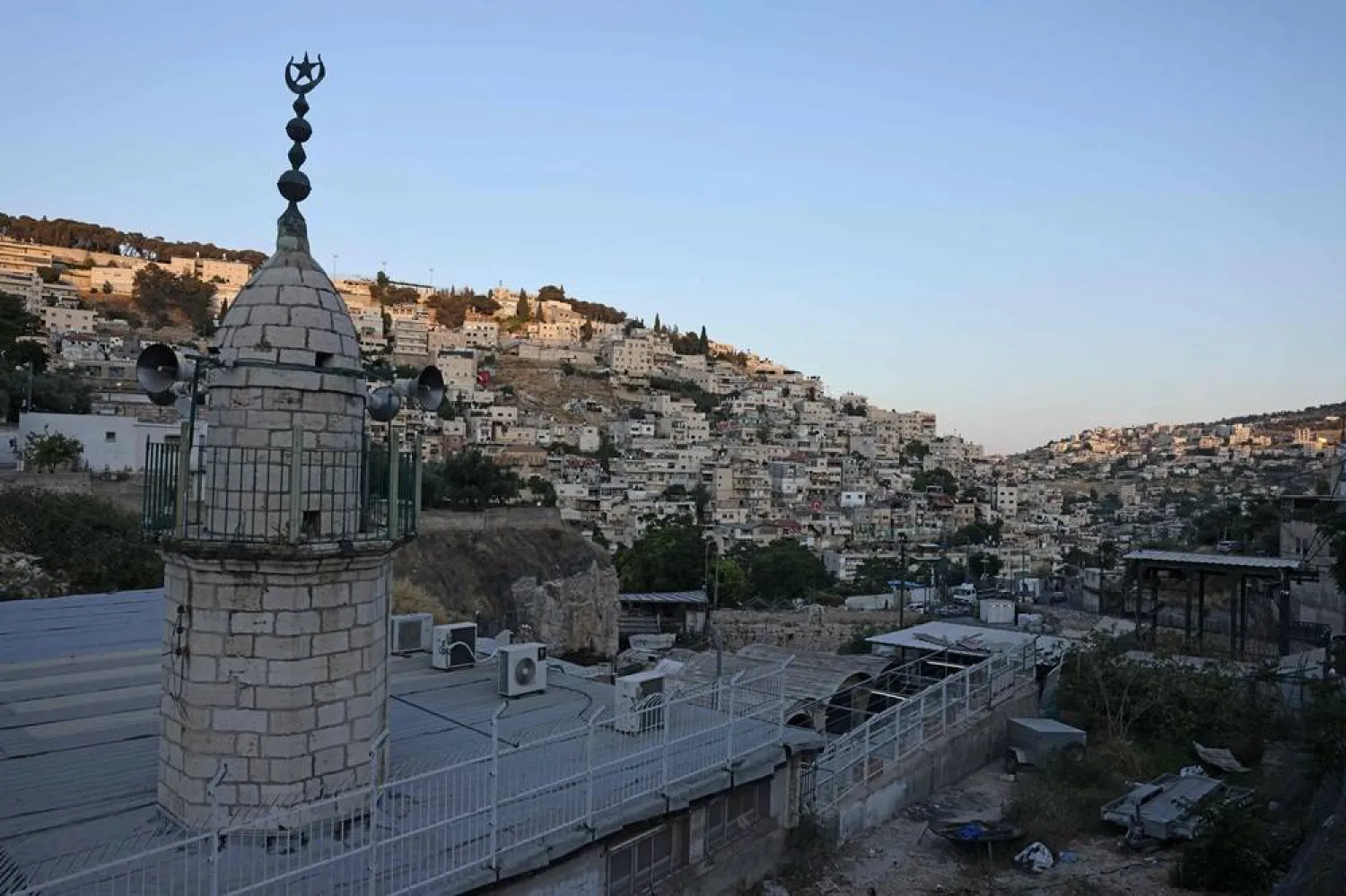
On the road to the impoverished Bedouin community of Khan al-Ahmar, in the heart of the West Bank, the upscale Israeli settlement of Maale Adumim occupies a large, elevated and commanding stretch of land.
But that is no longer enough for Israel’s far-right government, which now plans to annex everything, Maale Adumim, Khan al-Ahmar and the surrounding area, to Jerusalem under the controversial E1 project.
The plan aims, among other things, to realize the dream of Greater Jerusalem, the most important step in a project to change the face of the West Bank by cutting through it with a settlement belt.
That would strengthen the presence of settlers and settlements in what Palestinians describe as a new state of settlers, end the dream of a contiguous Palestinian state, and isolate Jerusalem, the hoped-for capital, from it.
No one in the West Bank has faced more demolition orders and threats than the residents of Khan al-Ahmar, which now finds itself in a battle larger than itself. Over many long years, they have fought several legal battles and ground confrontations, holding on to their land and tents and trusting in victory.
That confidence has been shaken only by Israel’s fierce and sweeping assault on everything Palestinian since Oct. 7.
“The situation is different”
Tension hung over Khan al-Ahmar days after a decision by Bezalel Smotrich. Eid al-Jahalin, also known as Abu Khamis, the head of the Bedouin council, had no clear answers for hundreds of calls, messages and questions from journalists and activists, some of whom came to the area to document what was happening inside and around the temporary tents and structures.
He told Asharq Al-Awsat that he did not know exactly what would happen.
Abu Khamis, who speaks several languages, including English and Hebrew, was trying hard to deliver one message: that demolishing this simple and poor place would open the door to the most dangerous plan in the West Bank, “Greater Jerusalem.”
In his modest tent, among many others, there are maps, a coffee pot, journalists, visitors, solidarity activists and foreign delegations. He has grown used to such scenes with every Israeli threat to demolish Khan al-Ahmar. This time, however, he is more worried than ever.
“The situation this time is completely different and very dangerous,” Abu Khamis said. “In 2018, all Palestinians were with us. The government and civil society were sleeping here. I had 5,000 people with me. International pressure was strongly present, and our cause was at the top of the Middle East agenda. Today, the situation is different.”
Explaining his fears, he said: “After Oct. 7, Israel became more aggressive, and the West Bank has been turned into a state of settlers. This is a state war against us, not a problem caused by individuals. In the West Bank, we now have a thousand Khan al-Ahmars: killing, displacement and fire consuming every part of the West Bank, while the Palestinian effort is scattered.
“Internationally, too, there is the Gaza war, the war in Lebanon and the Hormuz war. The world is also busy and distracted. Governments have changed in America, Israel and elsewhere.”
He said the occupation believes this is the right time.
For Abu Khamis, Smotrich’s latest decision “was issued for actual implementation, and only real international pressure will stop it.”
Evacuation order and declared war
Smotrich, who is leading what Israelis describe as a revolution to change the status quo in the West Bank, signed an evacuation order for Khan al-Ahmar last month as part of the “beginning of a war” he declared against the Palestinian Authority.
He accused the PA of being behind a secret arrest warrant issued by the International Criminal Court, which had earlier rejected the matter.
Speaking at a news conference about 10 days ago, against the backdrop of reports that the ICC in The Hague had issued a secret request for an arrest warrant against him, Smotrich said: “The hands are the hands of The Hague, but the voice is the voice of the Palestinian Authority, the terrorist organization wrongly called the Palestinian Authority.”
Smotrich claimed that issuing arrest warrants against Prime Minister Benjamin Netanyahu, former Defense Minister Yoav Gallant, and himself amounted to “a declaration of war.”
“In the face of a declaration of war, we will respond with an all-out war,” he said.
“I am not a submissive Jew, no. The Palestinian Authority has started a war, and it will get a war. From today, any economic or other target that falls within my powers as finance minister and as a minister in the Defense Ministry, and that I can harm, will be attacked. There will be no words and slogans, only actions.”
He added: “I announce here the first target. As soon as I finish speaking here, I will sign an order to evacuate Khan al-Ahmad under my powers as a minister in the Defense Ministry. I promise all our enemies: this is only the beginning.”
Smotrich immediately signed the decision to evacuate Khan al-Ahmar and ordered that “all necessary measures” be taken to demolish it.
The decision to demolish Khan al-Ahmar can only be seen as part of a campaign Smotrich has led for years against Palestinians in the West Bank.
It has included seizing large areas of land, changing laws related to control, ownership, land registration procedures and possession of property, as well as powers related to law enforcement.
It has also included his relentless work to weaken and dismantle the Palestinian Authority and turn the West Bank into a state of settlers by advancing major settlement plans and giving settlers a free hand in the area.
But Khan al-Ahmar’s significance is exceptional because it is a major obstacle to implementing the huge E1 settlement project, which involves a dangerous linking of a group of large surrounding Israeli settlements with Jerusalem, forming Greater Jerusalem.
The plan would connect Jerusalem to the large settlement of Maale Adumim in the central West Bank, in a way that Israeli rights group B’Tselem has said would severely threaten the possibility of a future Palestinian state and entrench a binational apartheid state.
The Palestinian National Information Center said that, in addition to the historically declared goal of linking Maale Adumim settlement with Jerusalem and excluding Palestinian neighborhoods from their natural development space, the plan serves the broader vision of “Greater Jerusalem,” covering about 600 square kilometers, or around 10% of the West Bank, through road belts, industrial zones and new neighborhoods.
Implementation depends on the settlement project known as the “fabric of life” road and alternative routes to separate Palestinian movement from the center of the West Bank, while connecting nearby Palestinian areas through controlled corridors in tunnels.
An old plan revived
Since 2009, Israel has sought to demolish the site. Each time it came close, however, it faced a storm of Palestinian, Arab and international reactions and criticism, until Khan al-Ahmar became a symbol of the conflict.
Israel therefore avoided demolishing it, even though an Israeli court gave the green light for the demolition.
Every time the court asked for an explanation as to why the site had not been demolished despite a judicial ruling, the Israeli government offered a different explanation for not evacuating the residential compound.
Yedioth Ahronoth said the evacuation of Khan al-Ahmar, which has become a global symbol, had turned into a diplomatic headache for the government because of international public opinion.
Even this time, 85 members of the US House of Representatives called on President Donald Trump’s administration to use all available diplomatic tools to halt the Israeli colonial construction project known as E1, warning that implementing it would impose a permanent reality on the ground and undermine the prospects of a two-state solution.
The appeal came in a letter from the lawmakers to US Secretary of State Marco Rubio.
The signatories said the E1 area, which extends over about 12 square kilometers east of Jerusalem, is one of the most sensitive areas in the West Bank because settlement construction there would separate the northern West Bank from its south and strengthen geographic contiguity between Jerusalem and the settlement of Maale Adumim, entrenching Israeli control over a strategic area in the heart of the West Bank.
They also pointed to other Israeli measures linked to the project, including plans to build what is known as the “Sovereignty Road,” as well as steps targeting the Bedouin community in Khan al-Ahmar. They said these measures were part of an accelerating process aimed at imposing new facts on the ground that would be difficult to reverse in the future.
In the view of the lawmakers, implementing the E1 settlement project would undermine the possibility of establishing a geographically contiguous Palestinian state. They called on the US State Department to clearly inform the Israeli government that moving ahead with the project contradicts declared US positions on the future of the West Bank.
Before them, more than 400 ministers, ambassadors and European officials called in an open letter to European Union leaders to “act now” against Israel’s “illegal annexation” of the occupied West Bank through the E1 project, under which it plans to build thousands of homes.
The 448 signatories, including former European Commission Vice President Josep Borrell and former Belgian Prime Minister Guy Verhofstadt, wrote: “The EU and its member states, in cooperation with their partners, must take immediate steps to deter Israel from continuing its illegal annexation of Palestinian land in the West Bank.”
The signatories said that “at a minimum, the EU must impose targeted sanctions, including visa bans and bans on conducting business activities in the EU, against all persons involved in illegal settlement operations, especially those promoting, participating in tenders for and implementing the plan related to the E1 area.”
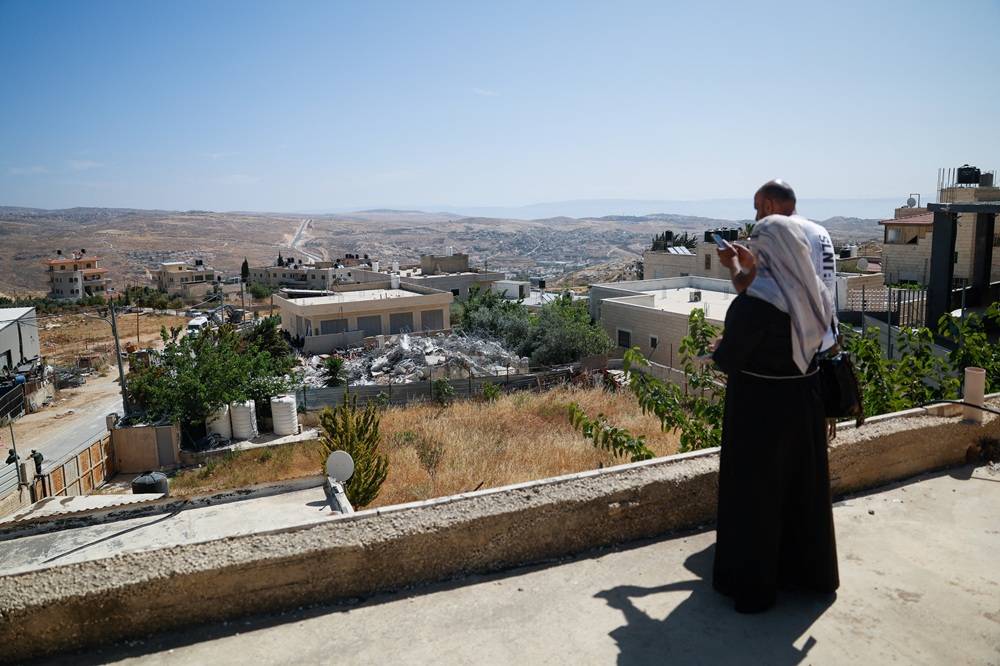
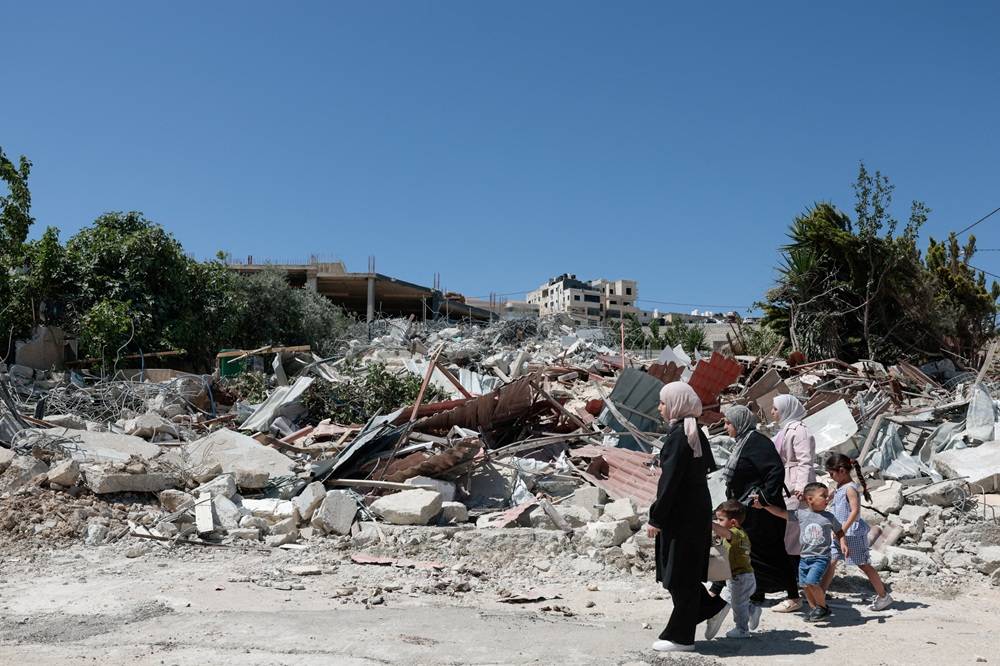
These calls came after Israel took another practical step toward beginning the plan by issuing an official notice to demolish 50 structures and commercial premises in the town of al-Eizariya, southeast of occupied Jerusalem, that fall within the settlement plan.
These repeated international positions are what currently complicate the demolition of Khan al-Ahmar.
The decision to demolish may not be in Smotrich’s hands alone, according to Yedioth. It goes back to Prime Minister Benjamin Netanyahu, in coordination with Defense Minister Israel Katz and the Israeli army, and would require explicit approval from the cabinet because of its consequences, which could complicate matters for Israel, embroil it politically and lead to very severe sanctions against it by the European Union.
But Meir Deutsch, director-general of Regavim, the movement founded by Smotrich that petitioned the High Court on the issue months ago, said: “The situation is different now and there is an opportunity.”
“Over the past two years, the Israeli government has taken unprecedented and historic decisions to ensure the future of the State of Israel,” he added. “Now, more than ever, the time has come to enforce the law against the aggressors in this field, and thus thwart the Palestinian Authority’s plan to seize this important site as part of establishing a terrorist state in the heart of the country.”
The Palestinian Authority understands this situation better than anyone. In previous years, when the situation was very different, the PA threatened to cancel agreements if Israel proceeded with the E1 project because it would kill the Palestinian state. It organized major campaigns to maintain a presence at the site, unlike what is happening now.
Geopolitical significance
Attorney Hassan Mlihat, the general supervisor of the Al-Baidar Organization for the Defense of Bedouin Rights, told Asharq Al-Awsat that “what must be understood is that Khan al-Ahmar is an area of enormous geopolitical importance. It is located northeast of occupied Jerusalem, specifically on the vital road linking Jerusalem and Jericho.”
“The extreme danger of this area lies in the fact that it falls within the E1 settlement plan, the most dangerous project targeting the Palestinian cause and the West Bank in the history of the conflict,” he added.
Mlihat said the danger of the project also lies in the fact that it would form Greater Jerusalem by taking control of 12,000 dunams in the heart of the West Bank and create continuous geographic contiguity between Jerusalem and Maale Adumim settlement all the way to the Dead Sea. This, he said, is the practical implementation of the Greater Jerusalem project.
For Mlihat, the project has other catastrophic consequences because it “re-engineers the demographic composition of these areas by expelling Palestinians and replacing them with settlers, and divides the West Bank into two separate parts, north and south. This means that the establishment of any geographically contiguous Palestinian entity or state would become impossible. The occupation’s success in this area would also become a starting point for isolating and targeting the rest of the West Bank.”
“This is a dangerous and huge project, and Khan al-Ahmar is the biggest obstacle,” he said.
Khan al-Ahmar at the heart of Greater Jerusalem
But it is not only Khan al-Ahmar. Mlihat believes the assault on Khan al-Ahmar is part of a wider attack on Palestinian Bedouins. While Israel has not demolished Khan al-Ahmar so far, it has already displaced more than 88 Bedouin communities in the West Bank.
Mlihat said that since 2019, specifically after the announcement of the “Deal of the Century,” the targeting of Bedouins had intensified, with the fierce assault on them escalating in an unprecedented manner after the events of October.
“This war targets the Bedouin presence in all areas and pockets of Area C, especially in the central West Bank east of Jerusalem because of the E1 plan, and in Jericho and the Jordan Valley because of their border and security dimensions,” he said.
Dozens of families have already been forced to leave their homes in the Palestinian Jordan Valley after several attacks by the army and settlers, in a recurring scene Mlihat described as an ongoing Nakba.
It was striking that the Bedouins were forced to face their fate alone in a battle larger than themselves, the same situation Jahalin pointed to in Khan al-Ahmar.
“Alone in the battle”
Abu Khamis looks after about 300 Bedouins in Khan al-Ahmar, who live in a place that includes a school, a mosque and a health clinic. These also serve many Bedouins from outside the community who come for education or treatment.
Abu Khamis looked toward the simple school as children played there, trying to steal a little space for joy, and asked many questions about whether the Israelis would really attack the place.
“We are alone in this battle,” Abu Khamis said.
“The war today is focused and directed specifically against the Bedouins,” he added. “It is the product of the consequences of the Oslo Accords and the division of the land into Areas A, B and C. Area C makes up about 62% of the West Bank. And who is in it? The Bedouins.”
“The problem of Khan al-Ahmar is that it lies at the heart of the Greater Jerusalem project, from al-Eizariya to the border of the Dead Sea. In this vast area, there is no Palestinian village or camp except Khan al-Ahmar,” he said.
Abu Khamis understands the matter well.
“If we are uprooted from here, the occupation will connect the settlements of Maale Adumim, Kfar Adumim, Mishor Adumim and Alon to form a settlement belt that clamps down on the eastern gate of Jerusalem and closes it completely,” he said.
“It will then cut up the West Bank and separate its north from its south. Jerusalem today is being surrounded by a massive settlement bloc, and Khan al-Ahmar lies at the heart of this most dangerous settlement project since the beginning of the occupation until today.”
This awareness is present among all residents of Khan al-Ahmar, even its children.
Ali had just finished his school day when he went to check on his family’s livestock. Ali told Asharq Al-Awsat: “They attack us from time to time, insult us and threaten us.”
The young Ali refused to accept moving where he lives, saying he loves the place and will not leave.
“We will not leave,” he said. “Even if they demolish the houses, we will not leave. It’s fine, let them demolish, but we will not leave. We want to stay here. This land is ours, and we will not leave it.”
Ali represents the fifth generation born in Khan al-Ahmar since its residents arrived there in the 1950s, displaced from Tel Arad in the Negev.
Sheikh Mohammed Abu Dahouk, 56, who was born in Khan al-Ahmar, told Asharq Al-Awsat: “My grandfather and my father were here. I was born here, and now my children and grandchildren were born here.”
Abu Dahouk does not intend to leave the place, although he expects them to demolish it at any moment.
“We expect anything from them,” he said. “Today, blood is flowing everywhere. But if they demolish, we will remain here in the sun. We will sit here. If they demolish, there is nowhere for us to go. Where would we go? There is nowhere for us to go. We will stay sitting in the sun.”
Like others, Abu Dahouk rejects the idea of moving to what Israel calls a “proper area.”
“Give us permits here,” he said. “We are the owners of the land. This is our land, and our land is dear to us. We are not leaving for any other place, whatever it may be.”
Alongside many previous legal battles, the residents of Khan al-Ahmar and the Arab al-Jahalin communities filed an objection to a plan to concentrate Bedouin communities in a “planned urban compound.”
The objection, filed through the Israeli group Bimkom, said the plan does not suit the communities’ way of life and could lead to their forced removal from the space where they have lived for decades.
Architect Alon Cohen-Lifshitz of Bimkom told Yedioth Ahronoth that this was “a plan of uprooting under the cover of planning,” stressing that it was part of a broader policy to shape the space in East Jerusalem and the West Bank.
Meanwhile, the saga of Khan al-Ahmar continued. Jahalin continues to receive European and local officials and activists, takes many calls, holds Zoom meetings with institutions and activists abroad, and has met, among others, Palestinian Prime Minister Mohammad Mustafa at his office. Mustafa, for his part, promised to support the residents’ steadfastness.
But none of this was new to Jahalin.
“Our struggle is not new,” he said. “It has continued since 1967, when Israel declared the area a closed military zone. They used to shoot to frighten them, before they were later surprised that those ‘military lands’ had turned into large settlements, including Maale Adumim and Kfar Adumim.”
Jahalin repeated what he had said several times: “It is a state of settlers, and this time is different from those before it.”
Yet despite everything that changed after Oct. 7, the Bedouin mentality has not changed.
Abu Khamis said it plainly: “I am a Bedouin, and I have spent 60% of my life in the sun. It will not hurt me if I spend 100% of it in the sun. I will be here or at the closest possible point to Khan al-Ahmar. Even if I remain suspended between the sky and the earth, I will not leave.”