

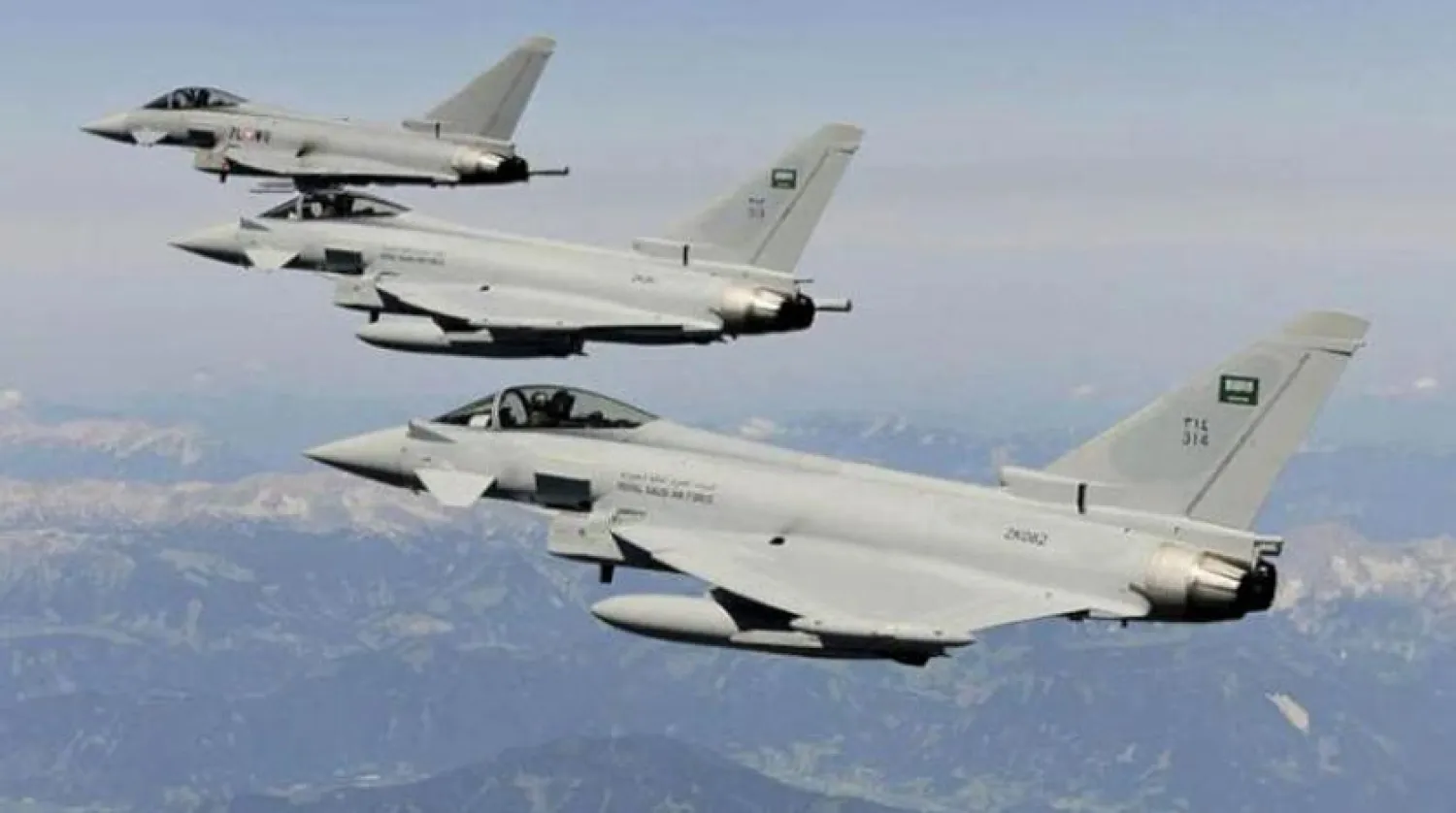

Arab Coalition Strikes Iran Revolutionary Guard, Hezbollah Hideout in Yemen

Saudi fighter jets, Asharq Al-Awsat
TT

Arab Coalition Strikes Iran Revolutionary Guard, Hezbollah Hideout in Yemen

Saudi fighter jets, Asharq Al-Awsat

The Arab Coalition in Yemen has announced its airstrikes took out a secret hideout in Yemen housing experts belonging to the Iran Revolutionary Guard and Lebanese Hezbollah. This came as part of a wider operation the Coalition had staged on Thursday across four Yemeni governorates.

The Coalition explained that it had carried out a large-scale operation for legitimate military objectives. The operation was in response to the Houthi ballistic and drone threat.

The Coalition warned that civilian airports and civilians are a red line and that it will strike firmly within the framework of international humanitarian law.

The capital, Sanaa, as well as locations in the governorates of Dhamar, Saada, and Al-Jawf were hit in the wide-ranging Coalition operation to weaken the Iran-backed Houthi militia.

Al-Dulaimi airbase and warehouses in Sanaa were struck by coalition forces.

Hours earlier, the coalition blew up an explosive drone targeting Abha International Airport, in Saudi Arabia’s Asir province.

Abdulaziz bin Saqr, the head of the Gulf Research Center, stressed that the focus on air operations comes to ensure two things: the first is to provide cover and air support for the Yemeni forces on the ground, and the other is to strike strategic sites linked to the Revolutionary Guards and Hezbollah.

Speaking to Asharq Al-Awsat, Saqr pointed out that “Houthi forces do not possess and operate the missile and ballistic capabilities. Instead, they depend on external forces, mainly the Iranians and Hezbollah.”

“Air operations sometimes cannot hit Houthi sites that are stationed among civilians, and the focus is on targeting and destroying strategic sites, as we saw in the last operation that was carried out on Thursday,” Saqr told Asharq Al-Awsat.



Missile Debris Kills One in Abu Dhabi as Iran Presses Gulf Attacks

A photograph shows Doha's skyline on March 10, 2026. (AFP)
TT

Missile Debris Kills One in Abu Dhabi as Iran Presses Gulf Attacks

A photograph shows Doha's skyline on March 10, 2026. (AFP)

Falling debris from a missile intercept killed one person on Tuesday in the Emirati capital of Abu Dhabi and injured two medical staff in Kuwait, authorities said, as Iran pressed its attacks against Gulf countries. 

The Gulf has borne the brunt of Iran's attacks in response to US-Israeli strikes that sparked the Middle East war, with Tehran targeting US assets but also civilian infrastructure. 

Debris fell in the Bani Yas area "following the interception of a ballistic missile by air defenses", the Abu Dhabi Media Office said on X. 

The day before a Palestinian national was killed on the edge of the city when a missile hit his car. 

As well as hitting ports, airports, residential buildings and hotels along with military sites across the region, Iran has also struck energy facilities across the Gulf. 

On the east coast of the country, the oil industrial zone of Fujairah was hit on Tuesday morning, sparking a fire but causing no injuries, local authorities said. 

It was the second day in a row that the site was hit, with a source telling AFP on Monday that oil storage loading had been shut down by an attack. 

In Kuwait, two medical staff were injured when shrapnel fell on an emergency medical center where they were working, the state's health ministry said. 

An AFP journalist heard several explosions in Doha on Tuesday and Qatar's defense ministry said it had intercepted a missile attack. 

Later, the country's civil defense said it was dealing with a minor fire in an industrial area following the interception, with no injuries reported. 

In nearby Dubai, an AFP journalist heard three explosions after a mobile phone alert warned residents of the United Arab Emirates' most populous city to "immediately seek a safe place" because of "potential missile threats". 

Iran has fired more than 1,900 missiles and drones at the UAE, more than any other country targeted by Tehran since the start of the war. 

The strikes have upended travel plans in the financial hub, despite its air defense intercepting the vast majority of projectiles. 


Saudi Arabia, Kuwait Stress Importance of Security Coordination, Integration

Saudi Minister of Interior Prince Abdulaziz bin Saud bin Naif bin Abdulaziz and Kuwaiti First Deputy Prime Minister and Interior Minister Sheikh Fahad Yusuf Saud Al Sabah. (Saudi Interior Ministry)
TT

Saudi Arabia, Kuwait Stress Importance of Security Coordination, Integration

Saudi Minister of Interior Prince Abdulaziz bin Saud bin Naif bin Abdulaziz and Kuwaiti First Deputy Prime Minister and Interior Minister Sheikh Fahad Yusuf Saud Al Sabah. (Saudi Interior Ministry)

Saudi Minister of Interior Prince Abdulaziz bin Saud bin Naif bin Abdulaziz held telephone talks on Tuesday with Kuwaiti First Deputy Prime Minister and Interior Minister Sheikh Fahad Yusuf Saud Al Sabah on the importance of continued coordination, cooperation and integration between their countries to bolster security and stability.

They reviewed the current regional developments and their security implications amid Iran’s malicious attacks against Gulf countries and the region.

Prince Abdulaziz stressed Saudi Arabia’s solidarity with Kuwait and support for all the measures it takes to preserve its security and stability.


Saudi, Egyptian FMs Discuss Regional De-Escalation Efforts

Saudi Foreign Minister Prince Faisal bin Farhan bin Abdullah and his Egyptian counterpart Badr Abdelatty meet in Riyadh on Monday. (SPA)
TT

Saudi, Egyptian FMs Discuss Regional De-Escalation Efforts

Saudi Foreign Minister Prince Faisal bin Farhan bin Abdullah and his Egyptian counterpart Badr Abdelatty meet in Riyadh on Monday. (SPA)

Saudi Foreign Minister Prince Faisal bin Farhan bin Abdullah received in Riyadh on Monday his Egyptian counterpart Badr Abdelatty for talks on bilateral relations and the latest developments in the region.

The tackled efforts to de-escalate the tensions to help restore regional security and stability.

They reiterated their condemnation of Iran’s malicious attacks against the Kingdom and several Arab countries.

Earlier, Prince Faisal held telephone talks with United Arab Emirates Deputy Prime Minister and FM Sheikh Abdullah bin Zayed Al Nahyan.

They discussed regional developments amid Iran’s unjustified attacks against Gulf countries, as well as means to consolidate security and stability in the Middle East.