Thee Ain Village: Architectural Masterpieces on the Brink of World Heritage Status

Thee Ain, Saudi Arabia (Asharq Al-Awsat)
TT

Thee Ain Village: Architectural Masterpieces on the Brink of World Heritage Status

Thee Ain, Saudi Arabia (Asharq Al-Awsat)

Nestled in the highlands of Tihamah, the Saudi village of Thee Ain captivates with its unique characteristics and meticulously paved streets and alleys.
As visitors wander through, the village’s architectural history unfolds, revealing the legacy of its 49 pyramid-shaped palaces built by skilled artisans centuries ago.
These structures have become a focal point for researchers and heritage enthusiasts intrigued by traditional construction methods.
The village’s rich cultural and natural heritage is now eagerly awaiting its potential inclusion on UNESCO’s World Heritage List.
The Saudi Heritage Commission has worked diligently to prepare Thee Ain for this prestigious designation, transforming it into a tourist destination that attracts history enthusiasts and researchers.
The village’s geographical location adds to its historical and cultural significance, enhancing its appeal to visitors.
To fully grasp the beauty of Thee Ain’s structures, it’s essential to know they were built on a rocky hilltop 800 meters above sea level. Ancient builders carefully planned every detail, using early forms of “blueprints” to ensure that the buildings, some reaching up to four stories, fit perfectly with the available space.
Despite centuries of change and harsh weather, these buildings have remained sturdy and resilient. Today, they draw tourists from around the world, showcasing a rich architectural heritage that has evolved from a local gem to a global attraction.
Yahya Aref, a heritage expert and member of the Saudi Urban Heritage Association, told Asharq Al-Awsat that Thee Ain, spanning 15,354 square meters, was once called the “Marble Village” due to its rich marble deposits.
The village, built centuries ago, sits on a white cliff and features colorful, layered marble stones.
Aref explained that the village is designed in a pyramid-like shape with three levels. The top level includes forts for watching over farmland and providing protection. The central area houses the palaces, buildings, pathways, and a mosque.
He added that Thee Ain’s construction style is influential across the Arabian Peninsula.
Heritage buildings in the village start with a broad base that narrows by about 7 inches as it rises.
This design boosts the building’s durability. Additionally, small openings in the walls, which are wide inside, allowed residents to use sunlight to confuse and deter attackers.



Top Prosecutor: Louvre Heist Probe Still Aims to Recover Jewelry

FILE - People wait for the Louvre museum to open, Thursday, Dec. 18, 2025 in Paris. (AP Photo/Thibault Camus, File)
TT

Top Prosecutor: Louvre Heist Probe Still Aims to Recover Jewelry

FILE - People wait for the Louvre museum to open, Thursday, Dec. 18, 2025 in Paris. (AP Photo/Thibault Camus, File)

French investigators remain determined to find the imperial jewels stolen from the Louvre in October, a prosecutor has told AFP.

Police believe they have arrested all four thieves who carried out the brazen October 19 robbery, making off with jewelry worth an estimated $102 million from the world-famous museum.

"The interrogations have not produced any new investigative elements," top Paris prosecutor Laure Beccuau said this week, three months after the broad-daylight heist.

But the case remains a top priority, she underlined.

"Our main objective is still to recover the jewelry," she said.

That Sunday morning in October, thieves parked a mover's truck with an extendable ladder below the Louvre's Apollo Gallery housing the French crown jewels.

Two of the thieves climbed up the ladder, broke a window and used angle grinders to cut glass display booths containing the treasures, while the other two waited below, investigators say.

The four then fled on high-powered motor scooters, dropping a diamond-and-emerald crown in their hurry.

But eight other items of jewelry -- including an emerald-and-diamond necklace that Napoleon I gave his second wife, Empress Marie-Louise -- remain at large.

Beccuau said investigators were keeping an open mind as to where the loot might be.

"We don't have any signals indicating that the jewelry is likely to have crossed the border," she said, though she added: "Anything is possible."

Detectives benefitted from contacts with "intermediaries in the art world, including internationally" as they pursued their probe.

"They have ways of receiving warning signals about networks of receivers of stolen goods, including abroad," Beccuau said.

As for anyone coming forward to hand over the jewels, that would be considered to be "active repentance, which could be taken into consideration" later during a trial, she said.

A fifth suspect, a 38-year-old woman who is the partner of one of the men, has been charged with being an accomplice but was released under judicial supervision pending a trial.

Investigators still had no idea if someone had ordered the theft.

"We refuse to have any preconceived notions about what might have led the individuals concerned to commit this theft," the prosecutor said.

But she said detectives and investigating magistrates were resolute.

"We haven't said our last word. It will take as long as it takes," she said.


Desert X AlUla Unveils Acclaimed Lineup of Saudi and Global Artists in 2026 Edition

Running from January 16 to February 28, the exhibition will feature an exceptional selection of specially commissioned artworks. SPA
TT

Desert X AlUla Unveils Acclaimed Lineup of Saudi and Global Artists in 2026 Edition

Running from January 16 to February 28, the exhibition will feature an exceptional selection of specially commissioned artworks. SPA

Arts AlUla has announced the lineup of Saudi and international artists participating in the fourth edition of Desert X AlUla, the international open-air art exhibition held in collaboration with Desert X.

Running from January 16 to February 28, the exhibition will feature an exceptional selection of specially commissioned artworks, ranging from large-scale installations and sound pieces that stretch across and beneath the desert landscape, to kinetic works and immersive interactive experiences.

The showcase reflects a deep connection to AlUla’s unique environment, its dramatic natural landscapes, and rich cultural heritage.

Desert X AlUla, the region’s first public art biennial, will feature 11 artists presenting diverse perspectives, materials, and artistic traditions in their large-scale works in its 2026 edition.

The program offers a delightful mix of performances and interactive family activities, alongside dedicated programs that blend sound, movement, storytelling, and play.

Also, the visitor pavilion will host a live music program curated in collaboration with AlUla Music Hub, creating moments where art, nature, and community converge in a shared experience shaped by rhythm and a strong sense of place.

Arts AlUla confirmed that Desert X AlUla 2026 will be open to the public.


Saudi Heritage Commission Announces Discovery of 20 Rock Engravings in Soudah Peaks Project

The newly identified sites feature inscriptions and rock carvings estimated to be between 4,000 and 5,000 years old. (SPA)
TT

Saudi Heritage Commission Announces Discovery of 20 Rock Engravings in Soudah Peaks Project

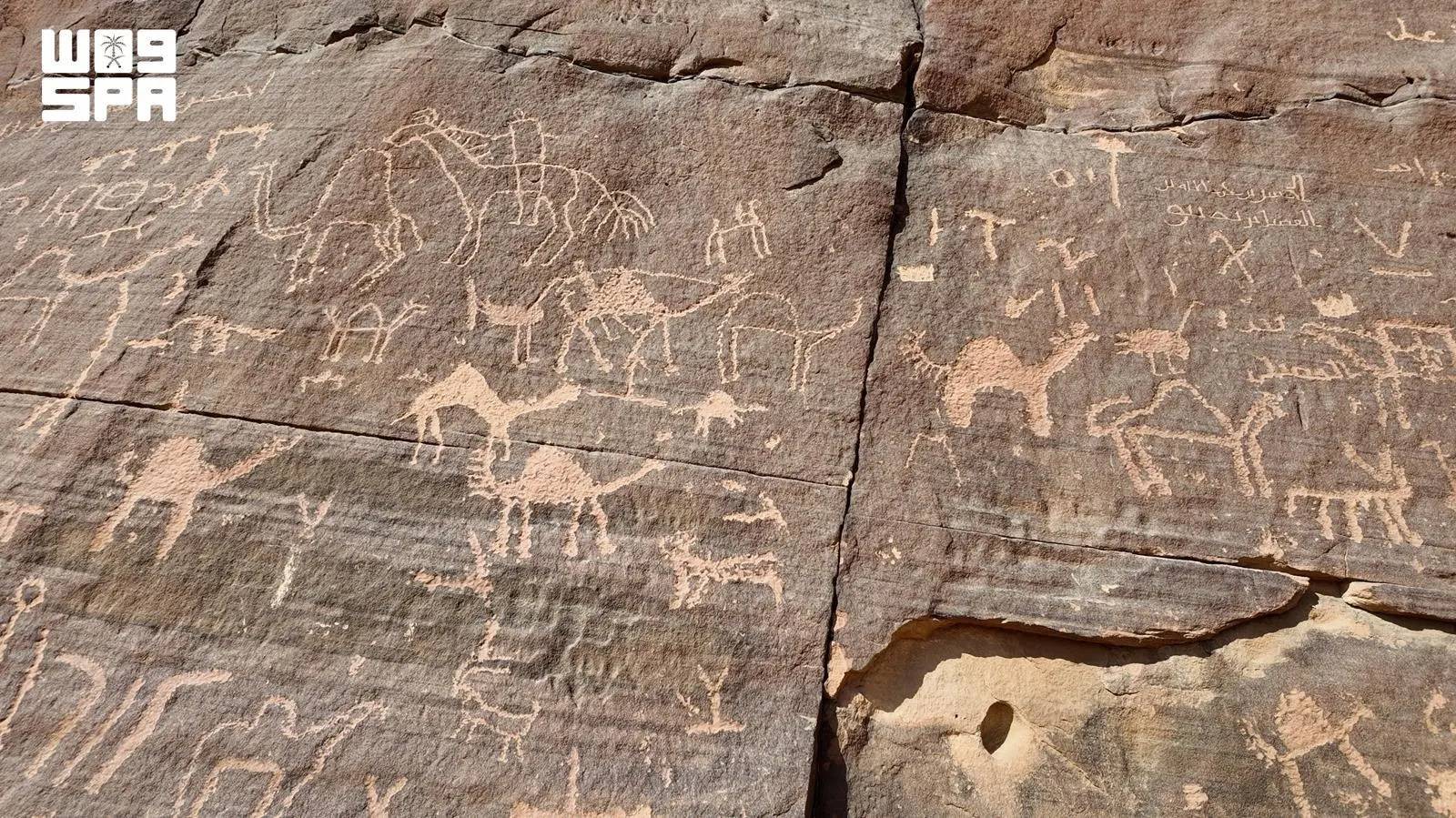
The newly identified sites feature inscriptions and rock carvings estimated to be between 4,000 and 5,000 years old. (SPA)

Saudi Arabia’s Heritage Commission, in collaboration with Soudah Development, a Public Investment Fund company, announced on Tuesday the discovery of 20 ancient rock art sites within the Soudah Peaks area.

Spanning more than 636.5 square kilometers across Soudah and parts of Rijal Almaa, the project area is now recognized as home to some of the region’s oldest cultural landmarks. The newly identified sites feature inscriptions and rock carvings estimated to be between 4,000 and 5,000 years old, offering valuable insights into the region’s rich history.

The findings include Thamudic inscriptions, along with vivid depictions of ibex, hyenas, and ostriches, as well as scenes of hunters, dancers, palm trees, and weapons, reflecting the environmental and social practices of the ancient communities that once inhabited the area.

The survey forms part of a memorandum of understanding signed between the Heritage Commission and Soudah Development. Conducted in four scientific phases, the initiative began with data collection and site analysis, concluding with the documentation and classification of high-value archaeological sites in preparation for future development and preservation efforts.

Soudah Development remains committed to protecting and promoting the natural and cultural heritage of the project area. The company continues to work towards creating an integrated cultural and tourism experience that reflects the authenticity and historical richness of the region, in line with its vision to transform Soudah Peaks into a premier luxury mountain destination rooted in heritage.