


War Casts Shadow over Lebanon’s Ancient Baalbek

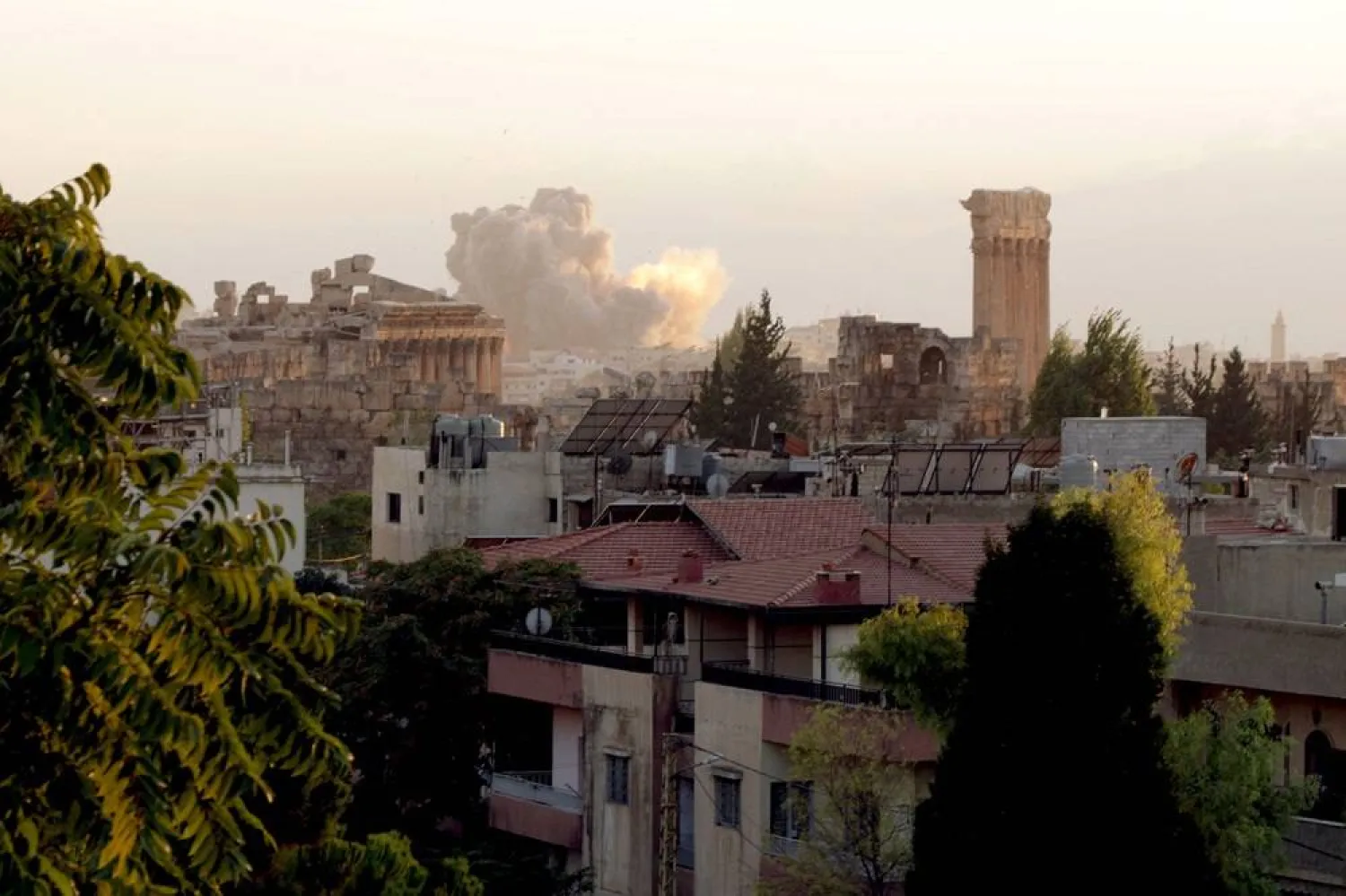
Smoke billows from the site of an Israeli airstrike on the Lebanese city of Baalbek in the Bekaa valley on September 23, 2024, behind the ancient Roman ruins and the six columns that remain standing at the Temple of Jupiter. (AFP)
TT

War Casts Shadow over Lebanon’s Ancient Baalbek

Smoke billows from the site of an Israeli airstrike on the Lebanese city of Baalbek in the Bekaa valley on September 23, 2024, behind the ancient Roman ruins and the six columns that remain standing at the Temple of Jupiter. (AFP)

Since war erupted between Israel and Hezbollah, the famed Palmyra Hotel in east Lebanon's Baalbek has been without visitors, but long-time employee Rabih Salika refuses to leave -- even as bombs drop nearby.

The hotel, which was built in 1874, once welcomed renowned guests including former French President Charles de Gaulle and American singer Nina Simone.

Overlooking a large archaeological complex encompassing the ruins of an ancient Roman town, the Palmyra has kept its doors open through several conflicts and years of economic collapse.

"This hotel hasn't closed its doors for 150 years," Salika said, explaining that it welcomed guests at the height of Lebanon's 1975-1990 civil war and during Israel's last war with Hezbollah in 2006.

The 45-year-old has worked there for more than half his life and says he will not abandon it now.

"I'm very attached to this place," he said, adding that the hotel's vast, desolate halls leave "a huge pang in my heart".

He spends his days dusting decaying furniture and antique mirrors. He clears glass shards from windows shattered by strikes.

Baalbek, known as the "City of the Sun" in ancient times, is home to one of the world's largest complex of Roman temples -- designated a World Heritage Site by UNESCO.

But the latest Israel-Hezbollah war has cast a pall over the eastern city, home to an estimated 250,000 people before the war.

Smoke billows from the site of an Israeli airstrike that targeted Lebanon's eastern city of Baalbek in the Bekaa valley on September 25, 2024, behind the ancient Roman ruins and the six columns that remain standing at the Temple of Jupiter. (AFP)

- Life at a standstill -

After a year of cross-border clashes with Hezbollah, Israel last month ramped-up strikes on the group's strongholds, including parts of Baalbek.

Only about 40 percent of Baalbek's residents remain in the city, local officials say.

On October 6, Israeli strikes fell hundreds of meters (yards) away from the Roman columns that bring tourists to the city and the Palmyra hotel.

UNESCO told AFP it was "closely following the impact of the ongoing crisis in Lebanon on the cultural heritage sites".

More than a month into the war, a handful of Baalbek's shops remain open, albeit for short periods of time.

"The market is almost always closed. It opens for one hour a day, and sometimes not at all," said Baalbek mayor Mustafa al-Shall.

Residents shop for groceries quickly in the morning, rarely venturing out after sundown.

They try "not to linger on the streets fearing an air strike could hit at any moment," he said.

Last year, nearly 70,000 tourists and 100,000 Lebanese visited Baalbek. But the city has only attracted five percent of those figures so far this year, the mayor said.

Even before the war, local authorities in Baalbek were struggling to provide public services due to a five-year economic crisis.

Now municipality employees are mainly working to clear the rubble from the streets and provide assistance to shelters housing the displaced.

A Baalbek hospital was put out of service by a recent Israeli strike, leaving only five other facilities still fully functioning, Shall said.

A cat walks at the entrance of the historical Palmyra hotel in the eastern Lebanese city of Baalbek on October 19, 2024. (AFP)

- 'No one' -

Baalbek resident Hussein al-Jammal said the war has turned his life upside down.

"The streets were full of life, the citadel was welcoming visitors, restaurants were open, and the markets were crowded," the 37-year-old social worker said.

"Now, there is no one."

His young children and his wife have fled the fighting, but he said he had a duty to stay behind and help those in need.

"I work in the humanitarian field, I cannot leave, even if everyone leaves," he said.

Only four homes in his neighborhood are still inhabited, he said, mostly by vulnerable elderly people.

"I pay them a visit every morning to see what they need," he said, but "it's hard to be away from your family".

This picture shows closed shops on an empty street in the eastern Lebanese city of Baalbek on October 19, 2024. (AFP)

Rasha al-Rifai, 45, provides psychological support to women facing gender-based violence.

But in the month since the war began, she has lost contact with many.

"Before the war... we didn't worry about anything," said Rifai, who lives with her elderly parents.

"Now everything has changed, we work remotely, we don't see anyone, most of the people I know have left."

"In the 2006 war we were displaced several times, it was a very difficult experience, we don't want this to happen again," she said.

"We will stay here as long as it is bearable."


Riyadh Art Unveils Tuwaiq Sculpture 2026

The exhibition site on Tahlia Street was strategically chosen for its historical legacy of innovation to provide a conceptual framework for the works. SPA
TT

Riyadh Art Unveils Tuwaiq Sculpture 2026

The exhibition site on Tahlia Street was strategically chosen for its historical legacy of innovation to provide a conceptual framework for the works. SPA

The Royal Commission for Riyadh City, via its Riyadh Art program, has launched the Tuwaiq Sculpture 2026 exhibition on Prince Mohammed bin Abdulaziz Street (Tahlia).

Open to the public from February 9 to 22, the exhibition showcases 25 new artworks themed "Traces of What Will Be," exploring transformation and urban renewal.

The sculptures were crafted during a live phase from January 10 to February 5, during which artists from 18 countries used local stone and recycled metals, allowing the public to witness the creative process firsthand.

The exhibition site on Tahlia Street was strategically chosen for its historical legacy of innovation to provide a conceptual framework for the works.

Overseen by a panel of international experts, the exhibition serves as an interactive cultural platform featuring workshops and panel discussions to foster community engagement.

All 2026 pieces will join Riyadh Art's permanent collection, which has hosted over 170 artists since 2019 and already installed more than 60 sculptures across the city to integrate contemporary art into Riyadh's urban fabric.


Syrian Culture Minister Applauds Saudi Pavilion at Damascus Book Fair

The 2026 Damascus International Book Fair is held from February 6 to 16 - SPA
TT

Syrian Culture Minister Applauds Saudi Pavilion at Damascus Book Fair

The 2026 Damascus International Book Fair is held from February 6 to 16 - SPA

Syrian Minister of Culture Mohammed Yassin Saleh visited the Kingdom’s pavilion at the 2026 Damascus International Book Fair, held from February 6 to 16, where the Kingdom is serving as the Guest of Honor.

He commended the efforts of the Literature, Publishing and Translation Commission in showcasing the rich diversity of the Saudi cultural and literary scene. The pavilion features exhibitions of manuscripts, a Saudi fashion corner, and archaeological replicas, SPA reported.

The minister reviewed the commission's Tarjim translation initiative and Saudi literature comics.

This participation at the 2026 Damascus International Book Fair showcases Saudi creativity and fosters cultural dialogue, supporting Saudi Vision 2030’s goals of knowledge exchange and cultural leadership.


Saudi Arabia, Syria Underline Depth of their Cultural Ties

Syrian President al-Sharaa receives the Saudi minister of culture and the accompanying delegation at the Conference Palace in Damascus on Thursday. (SPA)
TT

Saudi Arabia, Syria Underline Depth of their Cultural Ties

Syrian President al-Sharaa receives the Saudi minister of culture and the accompanying delegation at the Conference Palace in Damascus on Thursday. (SPA)

Saudi Arabia and Syria underlined the strength of their cultural relationship during high-level meetings held in Damascus on Thursday, on the sidelines of the opening of the Damascus International Book Fair 2026, where the Kingdom is participating as guest of honor.

Syrian President Ahmad al-Sharaa received Saudi Minister of Culture Prince Badr bin Abdullah bin Farhan at the Conference Palace in the capital.

Earlier the same day, Prince Badr met with his Syrian counterpart, Minister of Culture Mohammad Yassin Saleh, during an official visit to attend the fair. T

he Saudi minister congratulated Syria on hosting the exhibition and expressed his wishes for continued prosperity, progress, and stability for the Syrian government and people.

Both meetings highlighted the depth of cultural relations between the two countries, the importance of expanding joint cultural cooperation across various fields, and the alignment of positions on issues of mutual interest in a way that serves both nations.

The Saudi delegation included senior officials and advisers, among them representatives from the Royal Court, the Ministry of Culture, and the King Abdulaziz Public Library, reflecting broad institutional engagement in the visit.

In the evening, Prince Badr attended the opening ceremony of the fair’s special session, held under the patronage and in the presence of al-Sharaa. The event drew wide official and cultural participation, including Arab ministers, political and intellectual figures, and a distinguished group of writers and cultural figures.

In a post on the X platform, Prince Badr thanked “our brothers in Syria for their generous hospitality and their efforts in organizing the Damascus International Book Fair.”

The minister also inaugurated the Kingdom’s pavilion at the fair in the presence of the Syrian minister of culture and the Qatari minister of culture.

Saudi Arabia’s guest-of-honor participation continues until Feb. 16 and reflects its growing prominence and leadership in the Arab and global cultural landscape.

This participation aligns with Saudi Vision 2030, which places culture at the heart of national development, viewing it as a space for dialogue, a bridge for civilizational communication, and a tool for strengthening ties among Arab peoples.

The Saudi Literature, Publishing and Translation Commission is leading the Kingdom’s participation, highlighting the development of the cultural sector and reaffirming the central role of books as carriers of knowledge and awareness.

The Saudi pavilion boasts a comprehensive cultural program featuring intellectual seminars, poetry evenings, a manuscript exhibition, traditional Saudi fashion displays, hospitality corners, archaeological replicas, and performing arts that express the depth of the Kingdom’s cultural heritage.

On the sidelines of the visit, Prince Badr, accompanied by Minister Saleh, toured the National Museum of Damascus, which houses rare artifacts spanning prehistoric eras, ancient Syrian civilizations, classical and Islamic periods, as well as traditional and modern art.
