


China Pushes Back at US Demands to Stop Buying Russian and Iranian Oil

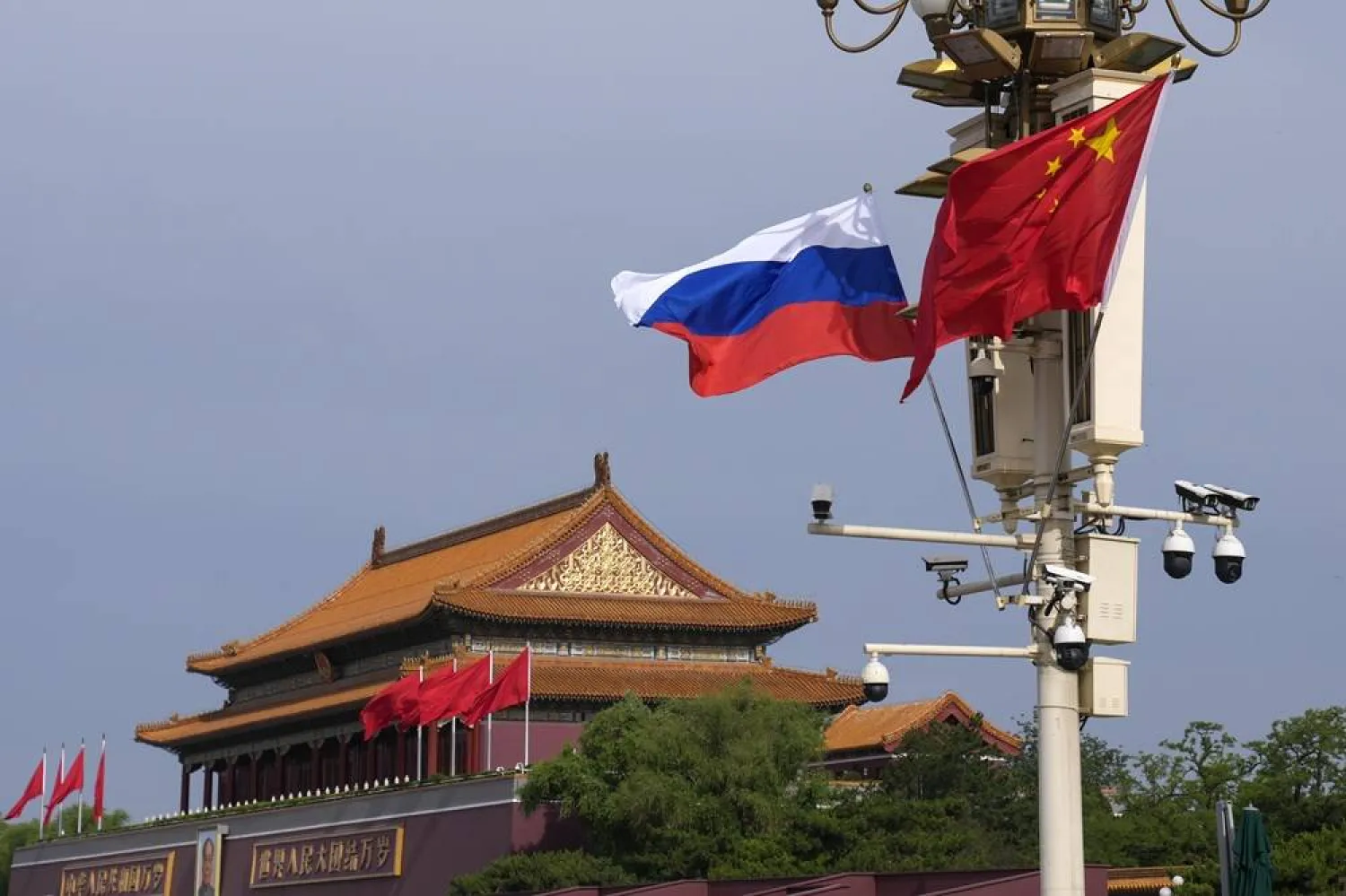
A Russian and Chinese national flag flutter near Tiananmen Gate for the visiting Russia's President Vladimir Putin, in Beijing, May 16, 2024. (AP)
TT

China Pushes Back at US Demands to Stop Buying Russian and Iranian Oil

A Russian and Chinese national flag flutter near Tiananmen Gate for the visiting Russia's President Vladimir Putin, in Beijing, May 16, 2024. (AP)

US and Chinese officials may be able to settle many of their differences to reach a trade deal and avert punishing tariffs, but they remain far apart on one issue: the US demand that China stop purchasing oil from Iran and Russia.

"China will always ensure its energy supply in ways that serve our national interests," China's Foreign Ministry posted on X on Wednesday following two days of trade negotiations in Stockholm, responding to the US threat of a 100% tariff.

"Coercion and pressuring will not achieve anything. China will firmly defend its sovereignty, security and development interests," the ministry said.

The response is notable at a time when both Beijing and Washington are signaling optimism and goodwill about reaching a deal to keep commercial ties between the world's two largest economies stable — after climbing down from sky-high tariffs and harsh trade restrictions. It underscores China's confidence in playing hardball when dealing with the Trump administration, especially when trade is linked to its energy and foreign policies.

US Treasury Secretary Scott Bessent, emerging from the talks, told reporters that when it comes to Russian oil purchases, the "Chinese take their sovereignty very seriously."

"We don’t want to impede on their sovereignty, so they would like to pay a 100% tariff," Bessent said.

On Thursday, he called the Chinese "tough" negotiators, but said China's pushback hasn't stalled the negotiations. "I believe that we have the makings of a deal," Bessent told CNBC.

Gabriel Wildau, managing director of the consultancy Teneo, said he doubts President Donald Trump would actually deploy the 100% tariff. "Realizing those threats would derail all the recent progress and probably kill any chance" for Trump and Chinese President Xi Jinping to announce a trade deal if they should meet this fall, Wildau said.

In seeking to restrict oil sales by Russia and Iran, a major source of revenue for both countries, the US wants to reduce the funding available for their militaries, as Moscow pursues its war against Ukraine and Tehran funds militant groups across the Middle East.

China plays hardball

When Trump unveiled a sweeping plan for tariffs on dozens of countries in April, China was the only country that retaliated. It refused to give in to US pressure.

"If the US is bent on imposing tariffs, China will fight to the end, and this is China’s consistent official stance," said Tu Xinquan, director of the China Institute for WTO Studies at the University of International Business and Economics in Beijing. WTO is the acronym for the World Trade Organization.

Negotiating tactics aside, China may also suspect that the US won't follow through on its threat, questioning the importance Trump places on countering Russia, Tu said.

Scott Kennedy, senior adviser and trustee chair in Chinese Business and Economics at the Center for Strategic and International Studies in Washington, said Beijing is unlikely to change its posture when it sees inconsistencies in U. foreign policy goals toward Russia and Iran, whereas Beijing's policy support for Moscow is consistent and clear. It's also possible that Beijing may want to use it as another negotiating tool to extract more concessions from Trump, Kennedy said.

Danny Russel, a distinguished fellow at the Asia Society Policy Institute, said Beijing now sees itself as "the one holding the cards in its struggle with Washington." He said Trump has made it clear he wants a "headline-grabbing deal" with Xi, "so rejecting a US demand to stop buying oil from Iran or Russia is probably not seen as a deal‑breaker, even if it generates friction and a delay."

Continuing to buy oil from Russia preserves Xi's "strategic solidarity" with Russian President Vladimir Putin and significantly reduces the economic costs for China, Russel said.

"Beijing simply can’t afford to walk away from the oil from Russia and Iran," he said. "It’s too important a strategic energy supply, and Beijing is buying it at fire‑sale prices."

China depends on oil from Russia and Iran

A 2024 report by the US Energy Information Administration estimates that roughly 80% to 90% of the oil exported by Iran went to China. The Chinese economy benefits from the more than 1 million barrels of Iranian oil it imports per day.

After the Iranian parliament floated a plan to shut down the Strait of Hormuz in June following US strikes on Iran's nuclear facilities, China spoke out against closing the critical oil transit route.

China also is an important customer for Russia, but is second to India in buying Russian seaborne crude oil exports. In April, Chinese imports of Russian oil rose 20% over the previous month to more than 1.3 million barrels per day, according to the KSE Institute, an analytical center at the Kyiv School of Economics.

This past week, Trump said the US will impose a 25% tariff on goods from India, plus an additional import tax because of India’s purchasing of Russian oil. India's Foreign Ministry said Friday its relationship with Russia was "steady and time-tested."

Stephen Miller, White House deputy chief of staff and a top policy adviser, said Trump has been clear that it is "not acceptable" for India to continue financing the Ukraine war by purchasing oil from Russia.

"People will be shocked to learn that India is basically tied with China in purchasing Russian oil," Miller said on Fox News Channel’s "Sunday Morning Futures." He said the US needs "to get real about dealing with the financing of this war."

Congress demands action

Sen. Lindsey Graham, a Republican from South Carolina, is pushing for sanctions and tariffs on Russia and its financial backers. In April, he introduced a bill that would authorize the president to impose tariffs as high as 500% not only on Russia but on any country that "knowingly" buys oil, uranium, natural gas, petroleum products or petrochemical products from Russia.

"The purpose of this legislation is to break the cycle of China buying oil below market price from Putin’s Russia, which empowers his war machine to kill innocent Ukrainian civilians," Graham said in a June statement.

The bill has 84 co-sponsors in the 100-seat Senate. A corresponding House version has been introduced, also with bipartisan support.

Republicans say they stand ready to move on the sanctions legislation if Trump asks them to do so, but the bill is on hold for now.



How the US Could Take Over Greenland and the Potential Challenges

05 February 2025, Greenland, Nuuk: Greenlandic flags fly in front of the Inatsisartut parliament in the capital Nuuk. (dpa)
TT

How the US Could Take Over Greenland and the Potential Challenges

05 February 2025, Greenland, Nuuk: Greenlandic flags fly in front of the Inatsisartut parliament in the capital Nuuk. (dpa)

US President Donald Trump wants to own Greenland. He has repeatedly said the United States must take control of the strategically located and mineral-rich island, which is a semiautonomous region that's part of NATO ally Denmark.

Officials from Denmark, Greenland and the United States met Thursday in Washington and will meet again next week to discuss a renewed push by the White House, which is considering a range of options, including using military force, to acquire the island.

Trump said Friday he is going to do “something on Greenland, whether they like it or not.”

If it's not done “the easy way, we're going to do it the hard way," he said without elaborating what that could entail. In an interview Thursday, he told The New York Times that he wants to own Greenland because “ownership gives you things and elements that you can’t get from just signing a document.”

Danish Prime Minister Mette Frederiksen has warned that an American takeover of Greenland would mark the end of NATO, and Greenlanders say they don't want to become part of the US.

This is a look at some of the ways the US could take control of Greenland and the potential challenges.

Military action could alter global relations

Trump and his officials have indicated they want to control Greenland to enhance American security and explore business and mining deals. But Imran Bayoumi, an associate director at the Atlantic Council’s Scowcroft Center for Strategy and Security, said the sudden focus on Greenland is also the result of decades of neglect by several US presidents towards Washington's position in the Arctic.

The current fixation is partly down to “the realization we need to increase our presence in the Arctic, and we don’t yet have the right strategy or vision to do so,” he said.

If the US took control of Greenland by force, it would plunge NATO into a crisis, possibly an existential one.

While Greenland is the largest island in the world, it has a population of around 57,000 and doesn't have its own military. Defense is provided by Denmark, whose military is dwarfed by that of the US.

It's unclear how the remaining members of NATO would respond if the US decided to forcibly take control of the island or if they would come to Denmark's aid.

“If the United States chooses to attack another NATO country militarily, then everything stops,” Frederiksen has said.

Trump said he needs control of the island to guarantee American security, citing the threat from Russian and Chinese ships in the region, but “it's not true” said Lin Mortensgaard, an expert on the international politics of the Arctic at the Danish Institute for International Studies, or DIIS.

While there are probably Russian submarines — as there are across the Arctic region — there are no surface vessels, Mortensgaard said. China has research vessels in the Central Arctic Ocean, and while the Chinese and Russian militaries have done joint military exercises in the Arctic, they have taken place closer to Alaska, she said.

Bayoumi, of the Atlantic Council, said he doubted Trump would take control of Greenland by force because it’s unpopular with both Democratic and Republican lawmakers, and would likely “fundamentally alter” US relationships with allies worldwide.

The US already has access to Greenland under a 1951 defense agreement, and Denmark and Greenland would be “quite happy” to accommodate a beefed-up American military presence, Mortensgaard said.

For that reason, “blowing up the NATO alliance” for something Trump has already, doesn’t make sense, said Ulrik Pram Gad, an expert on Greenland at DIIS.

Bilateral agreements may assist effort

US Secretary of State Marco Rubio told a select group of US lawmakers this week that it was the Republican administration’s intention to eventually purchase Greenland, as opposed to using military force. Danish and Greenlandic officials have previously said the island isn't for sale.

It's not clear how much buying the island could cost, or if the US would be buying it from Denmark or Greenland.

Washington also could boost its military presence in Greenland “through cooperation and diplomacy,” without taking it over, Bayoumi said.

One option could be for the US to get a veto over security decisions made by the Greenlandic government, as it has in islands in the Pacific Ocean, Gad said.

Palau, Micronesia and the Marshall Islands have a Compact of Free Association, or COFA, with the US.

That would give Washington the right to operate military bases and make decisions about the islands’ security in exchange for US security guarantees and around $7 billion of yearly economic assistance, according to the Congressional Research Service.

It's not clear how much that would improve upon Washington's current security strategy. The US already operates the remote Pituffik Space Base in northwestern Greenland and can bring as many troops as it wants under existing agreements.

Influence operations expected to fail

Greenlandic politician Aaja Chemnitz told The Associated Press that Greenlanders want more rights, including independence, but don't want to become part of the US.

Gad suggested influence operations to persuade Greenlanders to join the US would likely fail. He said that is because the community on the island is small and the language is “inaccessible.”

Danish Foreign Minister Lars Løkke Rasmussen summoned the top US official in Denmark in August to complain that “foreign actors” were seeking to influence the country’s future. Danish media reported that at least three people with connections to Trump carried out covert influence operations in Greenland.

Even if the US managed to take control of Greenland, it would likely come with a large bill, Gad said. That’s because Greenlanders currently have Danish citizenship and access to the Danish welfare system, including free health care and schooling.

To match that, “Trump would have to build a welfare state for Greenlanders that he doesn’t want for his own citizens,” Gad said.

Disagreement unlikely to be resolved

Since 1945, the American military presence in Greenland has decreased from thousands of soldiers over 17 bases and installations to 200 at the remote Pituffik Space Base in the northwest of the island, Rasmussen said last year. The base supports missile warning, missile defense and space surveillance operations for the US and NATO.

US Vice President JD Vance told Fox News on Thursday that Denmark has neglected its missile defense obligations in Greenland, but Mortensgaard said that it makes “little sense to criticize Denmark,” because the main reason why the US operates the Pituffik base in the north of the island is to provide early detection of missiles.

The best outcome for Denmark would be to update the defense agreement, which allows the US to have a military presence on the island and have Trump sign it with a “gold-plated signature,” Gad said.

But he suggested that's unlikely because Greenland is “handy” to the US president.

When Trump wants to change the news agenda — including distracting from domestic political problems — “he can just say the word ‘Greenland’ and this starts all over again,” Gad said.


US Stance on Iran Protests Balances Threats, Caution

Crowds of Iranian protesters gather in Taleghani Square in Karaj, west of Tehran. (Telegram)
TT

US Stance on Iran Protests Balances Threats, Caution

Crowds of Iranian protesters gather in Taleghani Square in Karaj, west of Tehran. (Telegram)

It may still be premature to say Iran’s ruling system is nearing collapse. Yet the unrest that has gripped the country in recent weeks has pushed Tehran into its most severe internal crisis in years.

Protests triggered by economic freefall and the collapse of the national currency have rapidly spread across regions and social classes, shedding their purely economic character and evolving into a direct challenge to the foundations of the political system.

As strikes have expanded, particularly in the bazaar and the oil sector, popular anger has deepened into a political crisis with existential stakes.

At the heart of these developments, the United States factor stands out as one of the most sensitive and influential elements, not only because of the long history of conflict between Washington and Tehran, but also due to the unprecedented tone adopted by US President Donald Trump, and the political and media reaction within Congress, which has reflected a calibrated division over how to approach the Iranian crisis.

From the early days of the escalating protests, Trump opted to depart from traditional diplomatic language. In a series of interviews and statements, he said he was following events in Iran “very closely,” expressing his belief that the country was “on the verge of collapse.”

More significant than his assessment, however, were his public warnings to the Iranian leadership against continuing to suppress protesters.

Trump spoke bluntly of live fire against unarmed demonstrators, arrests, and executions, describing the situation as “brutal behavior,” and stressing that he had informed Tehran that any bloody escalation would be met with “very severe strikes” from the United States.

This language amounts to an attempt at political and psychological deterrence rather than a declaration of an imminent military plan.

It pressures Iran’s leadership and sends a message of moral support to protesters, while simultaneously preserving ambiguity over the nature of any potential US action.

Vice President JD Vance expressed a similar stance, writing on X that Washington supports anyone exercising their right to peaceful protest, noting that Iran’s system suffers from deep problems.

He reiterated Trump’s call for “real negotiations” over the nuclear program, while leaving future steps to the president’s judgment.

Despite Trump’s clear support for the protests, his administration has so far avoided going further on the question of “the day after.”

This hesitation has been evident in its position on Reza Pahlavi, the son of Iran’s late shah, whose name has resurfaced as a figure of the exiled opposition.

While Trump described him as “a nice person,” he stopped short of holding an official meeting, saying it was still too early to determine who could genuinely represent the will of the Iranian people.

This caution reflects US awareness of the sensitivity of the Iranian scene, in light of past experiences in the region, from Iraq to Libya, where early bets on political alternatives led to disastrous outcomes.

Any overt US backing of a specific opposition figure could also give the Iranian authorities grounds to reinforce their narrative of a “foreign conspiracy,” a line already invoked by Supreme Leader Ali Khamenei and state media.

Alongside political rhetoric, the economic card occupies a central place in US calculations.

Treasury Secretary Scott Bessent has described Iran’s economy as on the edge of collapse, pointing to high inflation and a sharp erosion in living standards due to sanctions and mismanagement.

These remarks were not merely technical assessments, but a political message that Washington sees the economic crisis as a pressure point that could accelerate the erosion of the system’s ability to endure.

The economy is not only the spark that ignited the protests, but also one of the keys to their future. Continued strikes, particularly in the oil sector, threaten the main artery of state revenues, compounding pressure and narrowing room for maneuver.

In this context, Washington appears convinced that time is working against Tehran and that allowing the crisis to play out internally may be more effective than any direct intervention.

Another factor closely watched by US decision-makers is the international stance, notably the silence of Russia and China.

These two countries, which have provided Iran with political and economic cover in recent years, appear unwilling or unable to intervene to rescue the system from its internal crisis.

Their silence gives Washington a wider scope to escalate its rhetoric without fear of a major international confrontation.

At the same time, the US administration is keen to avoid appearing as the driver of regime change in Iran. Its declared support remains confined to an ethical and humanitarian framework, protecting protesters and preventing massacres, rather than shaping an alternative system.

This approach seeks to strike a balance between exploiting an adversary’s weakness and avoiding a slide into chaos.

The US response has not been limited to the White House, extending into Congress, where positions have reflected a disciplined division of opinion. The House Foreign Affairs Committee attacked the Iranian system in a post on X, describing it as a dictator that has stood for decades on the bodies of Iranians demanding change.

Within the Republican camp, alignment behind Trump has been clear.

Senator Lindsey Graham wrote that the president was “absolutely right,” that he “stands with the Iranian people against tyranny,” and called to “make Iran great again.”

Senator Ted Cruz said the protests had exposed the system’s “fatally weakened” status and that Iranians were “not chanting for cosmetic reforms, but for an end to clerical rule.”

Democrats, by contrast, expressed solidarity with protesters in a more cautious tone.

Senator Chris Murphy said Iranians deserve their future in their own hands, not through American bombs, warning that military intervention could undermine the movement.

Bernie Sanders said the United States should stand with human rights, not repeat the mistakes of forcibly changing regimes.

In the House, Representative Yassamin Ansari sparked further debate by voicing support for the Iranian people while warning against empowering the Mujahideen-e-Khalq, which she described as “an extremist group lacking legitimacy.”

Republican lawmakers such as Claudia Tenney and Mario Diaz-Balart adopted a harsher tone, calling for clear support for Iranians, “who are bravely demanding freedom, dignity, and basic human rights.”

This divergence reflects a complex US picture. Republicans see the Iranian moment as an opportunity to validate Trump’s pressure and deterrence strategy, while Democrats fear that verbal support could slide into ill-considered entanglement.

Yet both sides converge on a core point: holding Iran’s system responsible for violence and economic collapse and viewing current events as an unprecedented challenge to its legitimacy.

This relative alignment grants Trump room to maneuver domestically without imposing consensus on intervention.

Washington, as reflected in White House rhetoric and congressional debate, prefers at this stage to watch the fractures within Iran deepen, while keeping all options on the table and awaiting what happens on the streets.


A Timeline of How the Protests in Iran Unfolded and Grew

A general view from a street in Tehran, Iran, 08 January 2026. (EPA)
TT

A Timeline of How the Protests in Iran Unfolded and Grew

A general view from a street in Tehran, Iran, 08 January 2026. (EPA)

Demonstrations broke out in Iran on Dec. 28 and have spread nationwide as protesters vent their increasing discontent over the country's faltering economy and the collapse of its currency.

Dozens of people have been killed and thousands arrested as the daily protests have grown and the government seeks to contain them.

While the initial focus had been on issues like spikes in the prices of food staples and the country's staggering annual inflation rate, protesters have now begun chanting anti-government statements as well.

Here is how the protests developed:

Dec. 28: Protests break out in two major markets in downtown Tehran, after the Iranian rial plunged to 1.42 million to the US dollar, a new record low, compounding inflationary pressure and pushing up the prices of food and other daily necessities. The government had raised prices for nationally subsidized gasoline in early December, increasing discontent.

Dec. 29: Central Bank head Mohammad Reza Farzin resigns as the protests in Tehran spread to other cities. Police fire tear gas to disperse protesters in the capital.

Dec. 30: As protests spread to include more cities, as well as several university campuses, Iranian President Masoud Pezeshkian meets with a group of business leaders to listen to their demands and pledges his administration will “not spare any effort for solving problems” with the economy.

Dec. 31: Iran appoints Abdolnasser Hemmati as the country's new central bank governor. Officials in southern Iran say that protests in the city of Fasa turned violent after crowds broke into the governor's office and injured police officers.

Jan. 1: The protests' first fatalities are officially reported, with authorities saying at least seven people have been killed. The most intense violence appears to be in Azna, a city in Iran’s Lorestan province, where videos posted online purport to show objects in the street ablaze and gunfire echoing as people shouted: “Shameless! Shameless!”

The semiofficial Fars news agency reports three people were killed. Other protesters are reported killed in Bakhtiari and Isfahan provinces while a 21-year-old volunteer in the paramilitary Revolutionary Guard’s Basij force was killed in Lorestan.

Jan. 2: US President Donald Trump raises the stakes, writing on his Truth Social platform that if Iran “violently kills peaceful protesters,” the United States “will come to their rescue.” The warning, only months after American forces bombed Iranian nuclear sites, includes the assertion, without elaboration, that: “We are locked and loaded and ready to go.”

Protests, meantime, expand to reach more than 100 locations in 22 of Iran's 31 provinces, according to the US-based Human Rights Activists News Agency.

Jan. 3: Iran's Supreme Leader Ali Khamenei says “rioters must be put in their place,” in what is seen as a green light for security forces to begin more aggressively putting down the demonstrations. Protests expand to more than 170 locations in 25 provinces, with at least 15 people killed and 580 arrested, HRANA reports.

Jan. 6: Protesters conduct a sit-in at Tehran's Grand Bazaar until security forces disperse them using tear gas. The death toll rises to 36, including two members of Iranian security forces, according to HRANA. Demonstrations have reached over 280 locations in 27 of Iran’s 31 provinces.

Jan. 8 to 9: Following a call from Iran's exiled crown prince, a mass of people shout from their windows and take to the streets in an overnight protest. The government responds by blocking the internet and international telephone calls, in a bid to cut off the country of 85 million from outside influence. HRANA says violence around the demonstrations has killed at least 42 people while more than 2,270 others have been detained.