


Northeast US Digs Out from Brutal Snowstorm That Disrupted Flights and Canceled School 

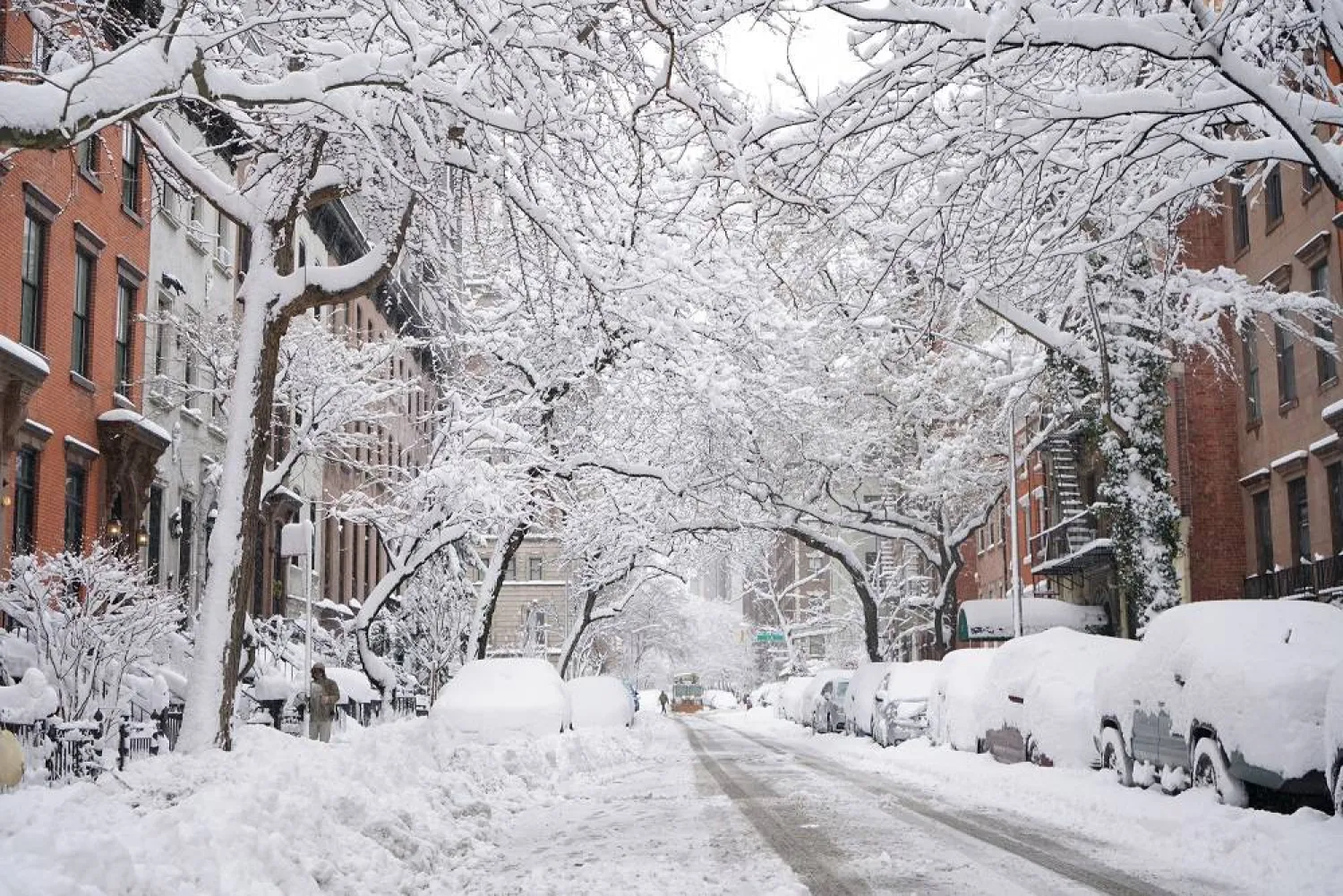
A snow plow crosses Second Avenue and heads down 19th Street to clear it after a snowstorm, Monday, Feb. 23, 2026, in New York. (AP)
TT

Northeast US Digs Out from Brutal Snowstorm That Disrupted Flights and Canceled School 

A snow plow crosses Second Avenue and heads down 19th Street to clear it after a snowstorm, Monday, Feb. 23, 2026, in New York. (AP)

Neighbors, government workers and a powerful railroad snow-clearing machine nicknamed “Darth Vader” scrambled to dig out much of the northeastern United States from a brutal and — in some areas — record-breaking storm that blanketed the region with snow and resulted in thousands of flight cancellations.

But as the snow moved northward and tapered off in other areas Tuesday, forecasters warned that another storm could be right around the corner.

Monday’s storm that meteorologists are calling the strongest in a decade dumped more than 2 feet (61 centimeters) of snow in parts of the Northeast. More than 3 feet (91 centimeters) fell in Rhode Island — surpassing snow totals from the historic Blizzard of 1978 that struck the Northeast, the National Weather Service said.

By Tuesday morning, roads were beginning to reopen, mass transportation was coming back online in some cities and power had returned for some of the hundreds of thousands who had lost electricity in Massachusetts, New Jersey, Delaware and Rhode Island.

Amtrak canceled some trains between Boston and New York and between New York and Philadelphia on Tuesday morning.

Some schools reopening while others stick with online learning In New York City, which canceled classed Monday, Mayor Zohran Mamdani announced that schools would reopen for in person learning on Tuesday, raising questions about how feasible that is with snow still piled along sidewalks.

Staten Island Borough President Vito Fossella said school should remain closed, while Michael Mulgrew, president of the United Federation of Teachers, described the situation as “a big mess.”

“There's going to be low attendance of students. You're going to have low attendance of staff because people don't know if they can travel, if they can get to schools,” he said.

Spokespersons for Mamdani didn’t respond to an email seeking comment but his schools chief, Chancellor Kamar Samuels, said in a post on X, that they were “confident in our decision to reopen.”

Philadelphia switched to online learning Monday and Tuesday. Districts on Long Island and elsewhere in the New York suburbs said they would cancel school again Tuesday.

Another storm is on the way

The weather service said it's tracking another storm that could bring more snow to the region later this week. A combination of rain and snow is expected Wednesday, with up to a couple of inches of possible snow.

While the new storm is not expected to be as strong, even a few extra inches of snow on top of hard-hit areas could make cleanup more difficult, said Frank Pereira, meteorologist for the weather service in College Park, Maryland.

“Any additional snow at this point is probably not going to be welcome,” he said.

Bomb cyclone cancels thousands of flights

The weather service referred to Monday’s storm as a “classic bomb cyclone/nor’easter off the Northeast coast.” A bomb cyclone happens when a storm’s pressure falls by a certain amount within a 24-hour period, occurring mainly in the fall and winter when frigid Arctic air can reach the south and clash with warmer temperatures.

More than 2,000 flights in and out of the United States were canceled Tuesday, according to the flight tracking website FlightAware. Most of the cancellations involved airports in New York, New Jersey and Boston.

Rhode Island’s T.F. Green International Airport paused its airport operations Monday as it dealt with nearly 38 inches (97 centimeters) of snow, according to the Weather Service, breaking a record of 28.6 inches (72.6 centimeters) set in 1978. The pause continued through Tuesday morning as the airport assessed conditions.

Central Park in New York City recorded 19 inches (48 centimeters) of snow. Warwick, Rhode Island, exceeded 3 feet (91 centimeters), topping the nation so far. The highest wind gust of 84 mph (135 kph) was recorded in Montauk Point, New York.

New York, Philadelphia and other cities, as well as several states, declared emergencies.

The Boston Globe management called off printing its daily newspaper for the first time in its more than 150-year history because snow and winds kept staff from safely getting to its printing plant, the newspaper said in an article on its website.

Christa Prince and two others were out in Brooklyn on Monday afternoon with shovels and an electric snowblower.

“We’re just making a path for this car,” Prince said. “It’s not our car but you know, we’re just doing our neighbor a kind deed.”



Barcelona Doubles Tourism Tax to One of Highest in Europe to Fund Housing

Tourists pose for a picture on a balcony of Casa Batllo, designed by architect Antoni Gaudi, at Passeig De Gracia in Barcelona, Spain February 24, 2026. REUTERS/Nacho Doce
TT

Barcelona Doubles Tourism Tax to One of Highest in Europe to Fund Housing

Tourists pose for a picture on a balcony of Casa Batllo, designed by architect Antoni Gaudi, at Passeig De Gracia in Barcelona, Spain February 24, 2026. REUTERS/Nacho Doce

Tourists in Barcelona could be taxed as much as 15 euros ($17.70) a night after the city raised its tourism fee to one of the highest in Europe on Wednesday as part of efforts to curb visitor numbers and help finance affordable housing.

Authorities in Catalonia have faced increasingly vocal protests from residents about excessive numbers of tourists they say are pushing up housing prices by driving a rise in short-term holiday leaves, said Reuters.

The regional parliament of Catalonia approved a law to double the tax for holiday rental guests to a maximum 12.5 euros per night, up from 6.25 euros, ahead of ‌an already ‌announced plan to ban all short-term rental accommodation by ‌2028.

Hotel ⁠guests will pay ⁠a maximum of between 10 and 15 euros per night from April, up from a current 5 euros to 7.5 euros, depending on the hotel category.

A two-night stay for a couple at one of the four-star hotels that make up nearly half of all hotels in Barcelona could now cost an extra 45.60 euros, as the local authority can charge up to 11.4 ⁠euros per night per person.

Guests at five-star hotels ‌could be charged up to 15 ‌euros a night and cruise passengers will continue to pay around 6 euros.

A quarter ‌of the revenue raised will help address the city's housing crisis, ‌according to the text of the law.

Irene Verrazzo, a 33-year-old nurse from Italy, said Barcelona was already very expensive and she doubted she'd return.

"I don’t think this added expense is fair. They already make money from tourists spending in shops, visiting ‌their monuments, etc.," she said.

The higher tax was unlikely to solve the housing crisis but the hike seemed ⁠reasonable, said 21-year-old ⁠student and local resident Ivan Liu.

Before the tax raise, Barcelona ranked 11th in holiday-rental platform Holidu's 2025 list, behind Amsterdam, where tourists paid the most in Europe at 18.45 euros per day.

Hotel owners are concerned the tax rise could drive away too many of the around 15.8 million tourists who visit Barcelona each year. The city ranks among the top four in the world for conventions, according to the local tourism board, and attendees will not be exempt from the levy.

Manel Casals, general director of Barcelona's hoteliers' group, said proposals to raise the tax gradually to monitor its effects were ignored.

"One day they will kill the goose that lays the golden eggs," he said.


Pakistani Sculptor Turns Scrap into Colossal Metal Artworks

Sculptor Ehtisham Jadoon spray paints a model of Optimus Prime, a film character from Transformers, made from scrap metal at his studio. Farooq NAEEM / AFP
TT

Pakistani Sculptor Turns Scrap into Colossal Metal Artworks

Sculptor Ehtisham Jadoon spray paints a model of Optimus Prime, a film character from Transformers, made from scrap metal at his studio. Farooq NAEEM / AFP

Sparks fly and metal groans in a cavernous workshop on the outskirts of Islamabad, where Pakistani artist Ehtisham Jadoon fuses discarded car parts into colossal pieces inspired by "Transformers" movies and dinosaurs.

The 35-year-old sculptor's studio brims with cogs, chains, hubcaps and engine parts as his hulking creations -- a lion with a mane of twisted steel, a giant Tyrannosaurus rex and a towering Optimus Prime -- take shape.

"I have always been fascinated by metal objects," Jadoon told AFP after assembling the 14-foot (4-metre) "Transformers" character, his biggest creation yet.

"When I see metals in scrap, I imagine forms in which it could be utilized."

It took Jadoon and his team months of welding and warping to fashion his Optimus Prime, with over 90 percent of its parts sourced from discarded vehicle pieces.

The arms are forged from motorbike springs and gears, its shoulders are curve from car rims, the spine is molded from a fuel tank and its knees are pieced together with chains and suspension parts.

Even its piercing eyes are crafted from vehicle bearings, completing a sculpture that is both intricate and awesome.

"Whenever I see an object, I visualize a form," Jadoon said.

"I could imagine a block transforming into a shape, so I simply solve the puzzle and bring it to life."

- 'Waste becomes valuable' -

Jadoon, a former martial artist who once worked in the steel fabrication business, has never formally studied art. He designs his gargantuan models spontaneously while working.

He told AFP he has to visit a doctor almost every week due to sparks affecting his eyes and burns on his hands and arms, yet he insists this is the only work in which he can channel the energy of his training as a fighter.

Jadoon's work primarily focuses on crafting giants, beasts and powerful forms, which he describes as a reflection of aggression.

"Setting the anatomy and proportions requires visualization from multiple angles and repeated adjustments," he said.

Every week, Jadoon tours scrapyards in Islamabad, sifting through tons of discarded metal in search of pieces that fit into his imagination and then become sculptures.

"What is waste to us became something valuable in his hands," scrapyard owner Bostan Khan told AFP.

"It's incredible to witness."


Scientists: Humans – Not Mimmo the Dolphin – Need Managing in Lagoon

The dolphin named Mimmo swims in the San Marco Basin, amid growing concerns about the impact of tourism on marine life, in Venice (Reuters) 
TT

Scientists: Humans – Not Mimmo the Dolphin – Need Managing in Lagoon

The dolphin named Mimmo swims in the San Marco Basin, amid growing concerns about the impact of tourism on marine life, in Venice (Reuters) 

Italian scientists monitoring the movements of a dolphin in the Venice lagoon have said humans are the ones who need managing, rather than wildlife.

Known as Mimmo, the bottlenose dolphin has been spotted on several occasions since it made its first appearance in June last year, prompting a research team from the University of Padova to spring into action, according to The Guardian.

While the animal has delighted tourists and residents with its acrobatic leaps, animal and environmental activists began a “save Mimmo” campaign amid fears it could be killed by the propellers of boats that crisscross the busy lagoon.

The scientists have now published a study in the journal Frontiers in Ethology, outlining their monitoring activities and the dolphin’s movements over several months.

“We present the case of one of the most charismatic animals in one of the most iconic cities: a solitary dolphin in Venice,” said the article’s senior author, Guido Pietroluongo, a conservation veterinary pathologist at the University of Padova’s department of comparative biomedicine and food science.

Pietroluongo added that the team’s observations documented the animal’s “remarkable adaptation to an unusual context” while highlighting “the need to manage human behavior to ensure its welfare.”

Bottlenoses are the most common species of dolphin in Italian waters and although they usually move around in pods, in recent years there have been several cases of solitary dolphins in the Adriatic who leave their pod and flock to coastal or urban areas.

Mimmo was first seen by Manuel Tiffi, a water-taxi driver, on 23 June 2025. He told Corriere della Sera that the dolphin often swam “right in front of the bow.”

Tiffi said water-taxi drivers reported sightings to warn people to be careful. “But the animal seems to have no fear,” he added.

Historically, dolphins have taken up residence in the Venetian lagoon and adapted to living there.

But while Mimmo’s behavior since its arrival has been “typical of the species," humans present a problem, the scientists said, with the greatest risk coming from them acting inappropriately towards the animal, especially through irresponsible driving of boats.

The scientists said that measures controlling speed and keeping boats at a safe distance were required.

“What is truly unusual is not the dolphin’s presence, but the persistent difficulty humans have in respecting such animals today,” said Giovanni Bearzi, who has been studying Adriatic dolphins for four decades.

He added: “We need to appreciate the opportunities to coexist with and enjoy wildlife. Historical and contemporary documentation clearly shows that dolphins have accompanied human maritime activities for millennia, yet we still struggle to coexist with them appropriately.”