


Iraq Raises June Basrah Medium Crude Price to Asia to $4.30 a Barrelhttps://english.aawsat.com/business/5271837-iraq-raises-june-basrah-medium-crude-price-asia-430-barrel
Iraq Raises June Basrah Medium Crude Price to Asia to $4.30 a Barrel
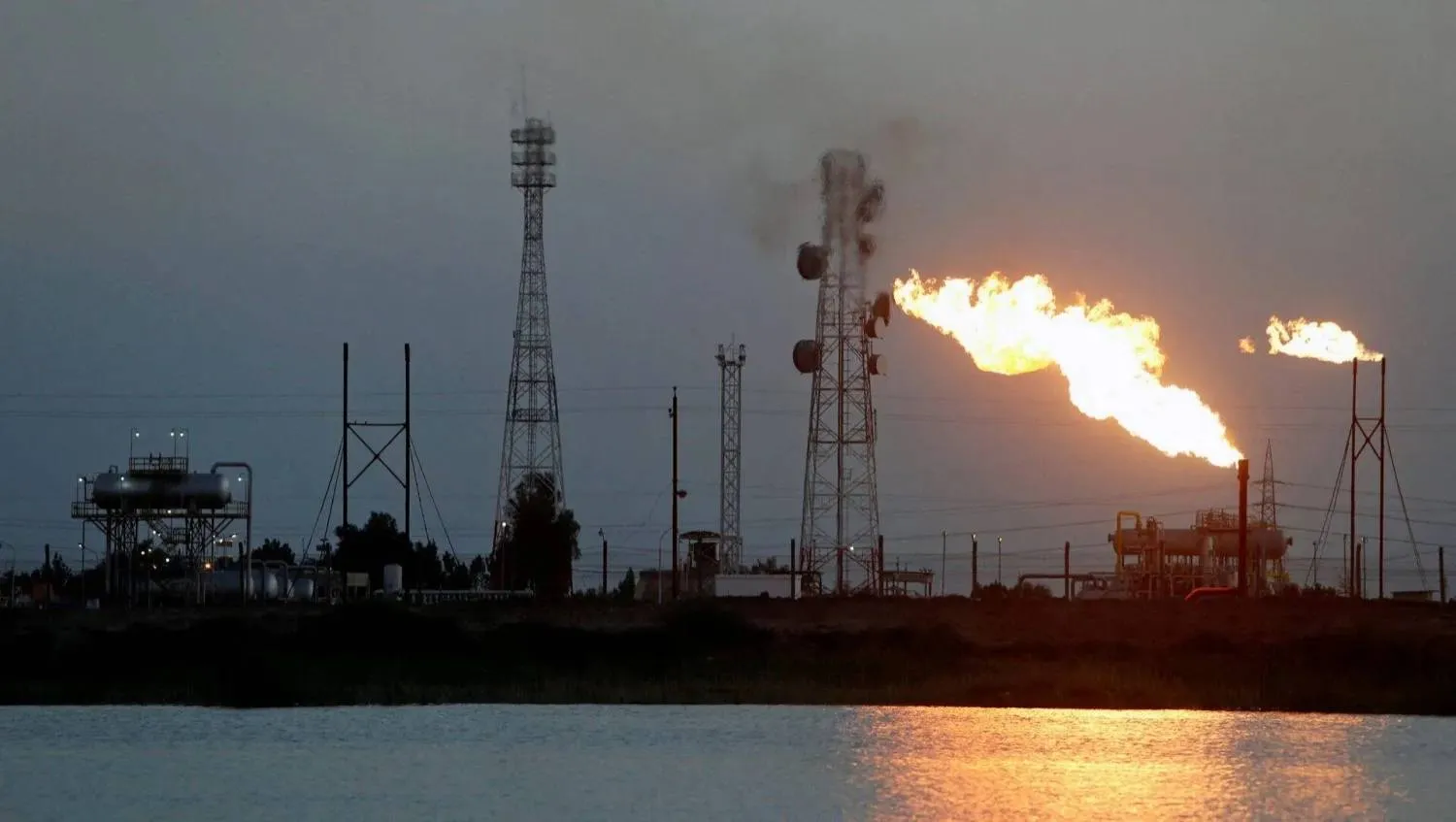
Flames emerge from flare stacks at Nahr Bin Umar oil field, north of Basra, Iraq March 9, 2020. (Reuters)
Iraq has raised the June official selling price for Basrah Medium crude oil to Asia to $4.30 a barrel against the average of Oman/Dubai quotes from the May OSP of $17.30 a barrel, state-owned Iraqi oil marketer SOMO said on Sunday.
Basra Heavy to Asia in the same month was priced at $2.20 a barrel to Oman/Dubai quotes, from $15.20 a barrel set for May.
Iraq has offered term buyers May-loading Basrah crude at steep discounts for loading inside the Strait of Hormuz, which has been largely blocked since the Iran conflict began.
The OPEC producer is offering its flagship Basrah Medium crude at discounts of $33.40, or $26 a barrel to its May official selling price, for loading on May 1 to May 10 or May 11 to May 31, respectively, according to a May 3 notice from state oil marketer SOMO seen by Reuters.
It also offered May-loading Basrah Heavy crude at a discount of $30 per barrel to the May OSP, the document showed.
The cargoes are sold on a free-on-board basis at the Basrah Oil Terminal or Single Point Moorings, both located inside the Strait of Hormuz.
The OSP is determined on the final destination of the cargoes, it said.
The discounts underscore mounting pressure on Iraqi crude exports as shipping risks persist in the waterway, a critical artery for global oil flows.
Iraqi crude exports, which averaged 3.33 million barrels per day in 2025, are mostly shipped to Asia, Kpler data showed.
In April, only two vessels loaded at Iraq's Basra port, one of them has past the Strait of Hormuz while the other one has not been out, according to Kpler.
01 September 2026, Algeria, Algiers: Johann Wadephul, German Minister of Foreign Affairs, makes a press statement at a hotel in Algiers. (dpa)
TT
TT
Germany Eyes Algerian Gas to Diversify Supply, Says FM
01 September 2026, Algeria, Algiers: Johann Wadephul, German Minister of Foreign Affairs, makes a press statement at a hotel in Algiers. (dpa)
Germany is looking for gas deals with Algeria to diversify its supply, Berlin's top diplomat said Thursday in Algiers, where he joined a business delegation visiting the North African country.
"We need to diversify... We need long-term gas contracts," Johann Wadephul told German public broadcaster ZDF from Algiers, as concerns grow in Germany that gas storage depots are only half full as autumn nears.
Wadephul said that he would meet with Energy Minister Mourad Adjal, and that representatives of German companies looking for long-term contracts were travelling with him.
Noting Algerian deals with Spain and Italy, Wadephul said "I also hope that Germany will now be able to secure part of its gas supply here. That is our core interest."
The EU's top economy used to rely on cheap Russian gas but large deliveries stopped after Russia launched its invasion of Ukraine in 2022, dealing a heavy blow to German industry.
Berlin has since largely replaced Russian energy with Norwegian piped gas as well as American liquefied natural gas -- though LNG prices are usually higher and more volatile than those from long-term piped gas deals.
The US-Israeli war on Iran has put further pressure on gas prices, leading to fears of a possible energy crunch this winter.
At the moment Germany's gas storage is just 53 percent full compared to an EU average of 65 percent, according to figures from the Aggregated Gas Storage Inventory.
"Since there is no prospect of a quick end to both crises it's clear that we need to diversify," Wadephul said. "We need more suppliers."
Following the gas crisis of 2022, the German government introduced mandatory minimum levels for gas storage in a bid to smooth out jumps in spot gas prices, with the state stepping in as a buyer if necessary.
The government has mandated that most gas storage facilities must be at least 80 percent full by November 1.
Turkish Manufacturing Contracts in August, PMI Showshttps://english.aawsat.com/business/5313365-turkish-manufacturing-contracts-august-pmi-shows
Pedestrians walk in the Mahmutpasa district, one of Istanbul's biggest textile shopping centers, near the Grand Bazaar, Istanbul, Türkiye, Nov. 24, 2021. (AFP)
TT
TT
Turkish Manufacturing Contracts in August, PMI Shows
Pedestrians walk in the Mahmutpasa district, one of Istanbul's biggest textile shopping centers, near the Grand Bazaar, Istanbul, Türkiye, Nov. 24, 2021. (AFP)
Türkiye's manufacturing sector contracted again in August as the war in the Middle East kept demand muted and led firms to cut output, jobs and purchasing, a business survey showed on Tuesday.
The Istanbul Chamber of Industry Türkiye Manufacturing Purchasing Managers' Index, compiled by S&P Global, rose to 48.1 in August from 47.7 in July. The 50 mark separates growth from contraction.
Although the headline PMI remained below the no-change mark again in August, it hit the highest in three months, the survey said, signaling a modest easing in business conditions.
"The war in the Middle East continues to cast a shadow over the Turkish manufacturing sector ... Despite this, firms have been able to limit the impact, with new orders easing to the smallest degree in three months during August," said Andrew Harker, economics director at S&P Global Market Intelligence.
Total new orders and new export business both fell again, though the declines were softer than in July as manufacturers continued to report muted demand and widespread uncertainty.
Production decreased for a third consecutive month, while companies cut employment and purchasing activity faster than in July. Firms also drew on existing inventories, reducing stocks of purchases and finished goods.
Input price inflation climbed to a three-month high on higher fuel, oil and raw material prices. Manufacturers raised their selling prices at a faster pace, too, while suppliers' delivery times lengthened amid war-related disruption.
Lucid in Saudi Arabia: From Assembly to Manufacturinghttps://english.aawsat.com/business/5313358-lucid-saudi-arabia-assembly-manufacturing
Lucid in Saudi Arabia: From Assembly to Manufacturing
Lucid CEO and board member Silvio Napoli. (Asharq Al-Awsat)
Lucid Motors is entering a new phase focused on improving liquidity and operational discipline, while launching new products and expanding manufacturing in Saudi Arabia as it seeks to address financial pressures and strengthen its capacity for growth.
The shift comes as the company continues to expand its business. Second-quarter revenue rose 56 percent year on year to $405 million, while vehicle deliveries increased 19 percent to 3,953.
At the same time, Lucid deliberately reduced production to better align supply with demand, cut inventory and preserve cash. Total liquidity stood at about $3 billion at the end of the quarter.
In an exclusive interview with Asharq Al-Awsat, Lucid CEO and board member Silvio Napoli outlined four priorities for the next phase: improving cash flow and costs, with the aim of generating $1.4 billion in savings in 2026; advancing its autonomous robotaxi program with Uber and Nuro; completing the transition of its AMP-2 plant in Saudi Arabia to fully integrated manufacturing; and advancing its midsize vehicle program toward launch readiness.
Napoli noted that Lucid possesses leading technology and distinctive products but is addressing financial challenges through stronger execution, centered on three pillars: liquidity and costs; customers and quality; and corporate culture and the workforce.
His comments came on the sidelines of the fifth LEAP 2026 conference in Riyadh, held under the theme “Into New Worlds,” where Lucid is showcasing its latest electric-vehicle technologies.
He added that the company is now focused on building a disciplined operating model that can translate Lucid’s strengths into sustainable and consistent performance.
Lucid's new factory in western Saudi Arabia. (Lucid Motors)
PIF investment
Napoli described Lucid’s relationship with Saudi Arabia’s Public Investment Fund as extending beyond a traditional investor-company relationship, calling PIF an important strategic partner whose support reflects shared confidence in the company’s capabilities and long-term growth prospects.
He explained that the company and PIF share a vision of helping shape the future of mobility and supporting Saudi Vision 2030.
Lucid’s presence in Saudi Arabia gives it access to engineering talent, research capabilities and advanced computing resources, while the expansion of AMP-2 in King Abdullah Economic City represents a pivotal step, he remarked.
The company’s ambitions extend beyond producing electric vehicles to helping build an integrated ecosystem for the automotive sector, technology and advanced industries in the Kingdom, he went on to say.
PIF has been Lucid’s principal investor through key stages of its development and continues to play an important role as a strategic partner as the company moves into its next phase of growth, implements its transformation plan and expands internationally.
Localizing vehicle manufacturing
Asked about Lucid’s gradual transition in Saudi Arabia from semi-knockdown, or SKD, assembly to integrated manufacturing, including vehicle bodies, paint and component production, Napoli confirmed that the company is moving toward full vehicle manufacturing in the Kingdom.
The AMP-2 expansion marks a new chapter in Lucid’s industrial presence in Saudi Arabia, he explained. Across the 1.36 million-square-meter site, operations will include stamping and forming body panels, body construction, painting and final assembly, as well as powertrain manufacturing and battery-pack assembly.
Lucid is currently installing and commissioning the manufacturing systems required to integrate those processes and will scale production gradually as the factory, products and supplier network become ready.
The long-term objective is to establish sustainable, integrated industrial capabilities in the Kingdom that support the growth of its electric-vehicle and advanced-manufacturing ecosystem, he revealed.
A Lucid vehicle in Saudi Arabia. (SPA)
Jobs and Saudi talent
Napoli expects significant workforce growth in manufacturing, engineering, quality assurance, logistics and supply chains as AMP-2 gradually expands toward its targeted annual production capacity of 150,000 vehicles.
The company’s ambitions go beyond creating jobs and include developing specialized expertise in Saudi Arabia. Lucid is investing in Saudi talent and practical training programs directly linked to advanced vehicle manufacturing, he noted.
The company is also working closely with authorities in King Abdullah Economic City to attract suppliers tied to its manufacturing requirements. The shared ambition is to turn the city into an integrated supplier hub, with Lucid serving as one of the strategy’s main anchors and attracting leading global Tier 1 and Tier 2 suppliers.
Napoli also highlighted the success of the supplier center at the King Salman Automotive Cluster in attracting international companies specializing in automotive components, including seats, vehicle structures, stamped parts, interior systems and exterior components.
Attracting qualified suppliers to establish operations near the plant, investing in Saudi skills and increasing local content would help create a manufacturing ecosystem capable of competing globally while meeting required standards for quality and cost efficiency, he underlined.
Supply chains
Lucid’s ambitions in Saudi Arabia extend beyond vehicle manufacturing to building an integrated base for engineering, supply-chain development, scientific research and Saudi talent development.
The company is working with suppliers localizing operations in the Kingdom, King Abdullah University of Science and Technology and other research institutions in technology and innovation, as well as the Human Resources Development Fund and the National Automotive and Vehicles Academy.
Through cooperation with these entities and the Saudi government, Lucid is contributing to the training and qualification of more than 450 Saudi talents to work in the electric-vehicle sector and at AMP-2, Napoli said, adding that Lucid expects more Saudis to benefit from these programs and opportunities in the next phase.
لم تشترك بعد
انشئ حساباً خاصاً بك لتحصل على أخبار مخصصة لك ولتتمتع بخاصية حفظ المقالات وتتلقى نشراتنا البريدية المتنوعة
