

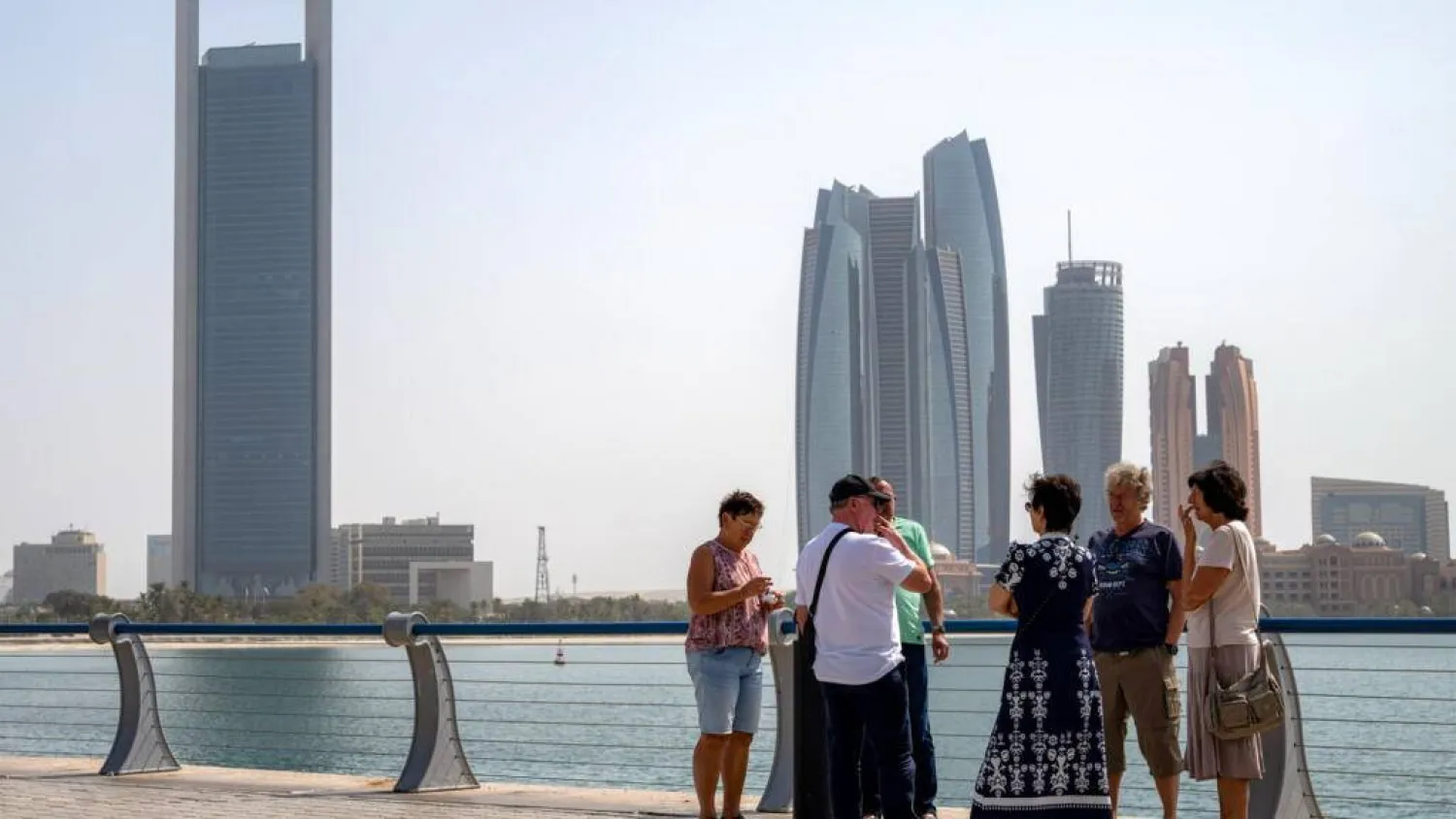

Tourism on Hold as Middle East War Casts Uncertainty

Tourism to the Middle East has boomed in recent years but war now threatens that success. Ryan Lim / AFP
TT

Tourism on Hold as Middle East War Casts Uncertainty

Tourism to the Middle East has boomed in recent years but war now threatens that success. Ryan Lim / AFP

Cancelled flights, postponed trips and a great deal of uncertainty: the war in the Middle East is casting a long shadow over the tourism outlook for a region that has become a prized destination for travelers worldwide.

"My last group of tourists left three days ago, and all the other groups planned for March have been cancelled," said Nazih Rawashdeh, a tour guide near Irbid, in northern Jordan.

"This is the start of the high season here. It's catastrophic," he told AFP.

"And yet there's no problem in Jordan. It's perfectly safe."

Across the world, tour operators are scrambling to find solutions for clients stranded in the region or who had trips planned there.

"The priority is getting those already there back home," said Alain Capestan, president of the French tour operator Comptoir des Voyages.

He said however that the war is also affecting customers who have travelled to other parts of the world, as the Gulf region is home to several major aviation hubs.

Like other companies, the German tour operators surveyed by AFP -- Alltours, Dertour, Schauinsland-Reisen -- announced they would cover the cost of extra nights for clients stranded in the Middle East. They also cancelled trips to the UAE and Oman until at least March 7.

The British travel industry association ABTA said agencies "would not be sending customers to the region for as long as the British Foreign Office advises against all non-essential travel".

Customers whose holidays were cancelled in recent days will be able to rebook or receive a refund, it said.

- Economic impact -

The war is disrupting a sector that had been booming in the region.

According to UN Tourism, in 2025 around 100 million tourists visited the Middle East -- nearly seven percent of all international tourists recorded worldwide. That figure had grown three percent year-on-year and 39 percent compared to the pre-pandemic period.

Depending on the destination, Europeans make up a large share of visitors, followed by tourists from South Asia, the Americas, and other Middle Eastern countries.

For example, nearby markets accounted for 26 percent of total visitors to Dubai in 2025, according to its Ministry of Tourism and Economy.

Against this backdrop analysts Oxford Economics warns that "a decline in tourist flows to the region will deal a more severe economic blow than in the past, as tourism's share of GDP has grown, as has employment in the sector".

"We estimate inbound arrivals to the Middle East could decline 11-27 percent year-on-year in 2026 due to the conflict, compared to our December forecast that projected 13 percent growth," said Director of Global Forecasting Helen McDermott.

That would translate, according to the firm, to between 23 and 38 million fewer international visitors compared to the prior scenario, and a loss of $34 to $56 billion in tourist spending.

After Covid and then the conflict in Gaza, tourists had been coming back, said Rawashdeh, the Jordanian tour guide.

"For the past six months, people working in tourism here had hope. And now there's a war. This is going to be terrible for the economy," he said.

"We've definitely noticed an understandable slowdown in new bookings from our partners right now, but we fully expect that to bounce back as soon as things settle down and travelers feel more confident," said Ibrahim Mohamed, marketing director of Middle East Travel Alliance, which offers direct tours to American and British operators.

He remains optimistic: "The Middle East has always been an incredibly resilient market, and demand always bounces back fast once stability returns."



Punch the Orphan Macaque is Outgrowing his Plushie and Making Friends

Punch, a Japanese macaque born on July 26, 2025, climbs on the back of another in the monkeys' playground at the Ichikawa city zoo in Tokyo's eastward neighboring city, Tuesday, March 3, 2026. (AP Photo/Hiro Komae)
TT

Punch the Orphan Macaque is Outgrowing his Plushie and Making Friends

Punch, a Japanese macaque born on July 26, 2025, climbs on the back of another in the monkeys' playground at the Ichikawa city zoo in Tokyo's eastward neighboring city, Tuesday, March 3, 2026. (AP Photo/Hiro Komae)

Punch the baby orphan macaque is outgrowing the orangutan plushie that comforted him through early rejection from his mother and other monkeys.

Images of Punch dragging around the toy bigger than him drew attention to the residents of a zoo near Tokyo. When other monkeys shooed the baby away, Punch rushed back to the toy orangutan, hugging it for comfort.

But he's been using the toy less. On a recent day, Punch was seen climbing on the back of another monkey, sitting with adults and sometimes getting groomed or hugged, The Associated Press reported.

“It was good to see him grow, and I’m reassured,” said Sanae Izumi, a 61-year-old Punch fan from Osaka who came to the zoo because she was worried about the baby monkey. “He is adorable!”

Punch was abandoned by his mother after his birth, presumably because of exhaustion. Zookeepers nursed him and gave him the toy to train him to cling, an ability newborn macaques need to survive.

“Helping Punch learn the rules of monkey society and being accepted as a member is our most important task,” said Kosuke Kano, a 24-year-old zookeeper.

Punch was so popular after images of him and his toy showed up online last month, the zoo had to set rules to make visitors be quiet and to limit viewing to 10 minutes to reduce stress for the more than 50 other monkeys.

Punch eschewing the toy most of the time now is a good thing.

“When he grows out of the plush toy that encourages his independence, and that’s what we are hoping for,” zoo director Shigekazu Mizushina said.

Punch still sleeps with his toy every night, but Mizushina said the next thing keepers want to see is Punch bunched up with other monkeys to sleep.


Saudi Arabia: NCW Marks World Wildlife Day with Strategic Plan for Biodiversity Protection

The NCW says it is focused on enhancing wildlife management efficiency. SPA
TT

Saudi Arabia: NCW Marks World Wildlife Day with Strategic Plan for Biodiversity Protection

The NCW says it is focused on enhancing wildlife management efficiency. SPA

The National Center for Wildlife (NCW) reaffirmed its commitment to protecting wildlife and preserving natural habitats, recognizing this responsibility as essential to nature conservation and ecosystem sustainability in Saudi Arabia. This observance aligns with World Wildlife Day, marked annually on March 3.

The center emphasized its efforts in wildlife development, which include breeding endangered species and reintroducing them into their natural habitats, developing and managing protected areas, and implementing environmental monitoring programs and scientific research.

This approach builds on a phased institutional effort, expanding breeding and reintroduction programs for wildlife species from seven to 21, with a strategic plan to reach 50 programs by 2030.

The NCW is also focused on enhancing wildlife management efficiency and advancing operational tools, thereby strengthening a national approach grounded in science and long-term planning.


Student Solves Mystery of Icy ‘Snowmen’ in Solar System’s Outer Reaches

Contact binaries are made up of two connected spheres, reminiscent of a snowman (Shutterstock)
TT

Student Solves Mystery of Icy ‘Snowmen’ in Solar System’s Outer Reaches

Contact binaries are made up of two connected spheres, reminiscent of a snowman (Shutterstock)

A student has unraveled a long-standing cosmic enigma concerning some of our solar system’s most peculiar objects: icy “snowmen” that populate its outer reaches, according to The Independent.

Astronomers have long debated the origins of these 'contact binaries' – objects comprising two connected spheres, reminiscent of a snowman.

Now, researchers at Michigan State University claim to have evidence.

These peculiar celestial “snowmen” are found in the Kuiper Belt, a vast expanse beyond Neptune, which is filled with icy remnants dating back to the solar system's formation. The region lies beyond the turbulent asteroid belt between Mars and Jupiter.

These ancient building blocks, known as planetesimals, have largely persisted untouched for billions of years. Roughly one in 10 of these objects are classified as ‘contact binaries.’

The enduring mystery has been how such delicate structures could have formed without being violently smashed together.

Jackson Barnes, a graduate student at the university, has developed the first computer simulation to show how such two-lobed shapes can arise naturally through gravitational collapse.

This is the process by which matter contracts under its own gravity, overpowering forces that would otherwise pull it apart.

The research has been published in Monthly Notices of the Royal Astronomical Society.

Earlier computer models treated colliding objects as fluid-like blobs that quickly merged into single spheres, making it impossible to recreate contact binaries.

Using high-performance computing facilities, Barnes’ simulations instead allow objects to retain their strength and settle gently against one another.

Other theories have suggested that rare events or exotic conditions might be required to produce these shapes, but researchers say such explanations are unlikely to account for their apparent abundance.

“If we think 10% of planetesimal objects are contact binaries, the process that forms them can’t be rare,” said Earth and Environmental Science assistant professor Seth Jacobson, the study’s senior author.

“Gravitational collapse fits nicely with what we’ve observed.”

Contact binaries were first seen in close detail in January 2019, when Nasa’s New Horizons spacecraft flew past a Kuiper Belt object later nicknamed Ultima Thule.

The images prompted scientists to re-examine other distant bodies, revealing that about 10% of planetesimals share the same distinctive shape.

In the sparsely populated Kuiper Belt, these objects drift largely undisturbed and are rarely hit by other debris.

In the early history of the Milky Way, the galaxy consisted of a disc of gas and dust. Remnants of that era persist in the Kuiper Belt today, including dwarf planets such as Pluto, along with comets and planetesimals.

Planetesimals are among the first solid bodies to form as dust and pebble-sized material clumps together under gravity. Much like snowflakes compressed into a snowball, they are loose aggregates pulled from clouds of tiny particles.

Barnes’ simulation shows that as one of these clouds rotates, it can collapse inward and split into two separate bodies that begin orbiting each other.

Such binary planetesimals are commonly observed in the Kuiper Belt. Over time, their orbits spiral closer until the pair gently touch and fuse, preserving their rounded shapes.

The reason these fragile-looking structures survive for billions of years, Barnes explained, is simple chance. In such a remote region, collisions are rare. Without a major impact, there is little to pull the two bodies apart, and many contact binaries show few, if any, impact craters.

Scientists have long suspected gravitational collapse was responsible, but until now they lacked models capable of testing the idea properly.

“We’re able to test this hypothesis for the first time in a legitimate way,” Barnes said. “That’s what’s so exciting about this paper.”

He believes the model could also help researchers understand more complex systems involving three or more bodies. The team is already working on simulations that better capture the details of the collapse process.

As future space missions venture deeper into the outer solar system, the researchers said the familiar snowman shape may turn out to be far more common than once thought.