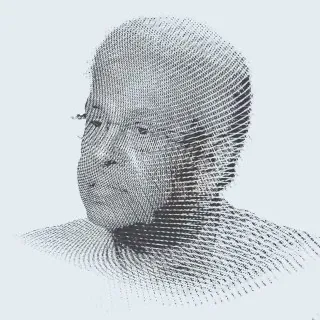
With his T-shirt and square-framed glasses, Zhang Peng looks more like an academic brainiac than a business executive. But the chief executive officer of Zhipu AI, one of the most storied startups in China’s booming artificial intelligence sector, groks the dichotomies of his domestic market better than most.
It’s no arena for the faint of heart, mind or wallet. Since the release of ChatGPT three years ago and the industrywide shock triggered by the subsequent debut of its rival DeepSeek, China’s AI sector has exploded into one of the world’s fiercest markets. Even as the US has sought to sandbag the country’s technological progress by restricting the export of advanced chips, Chinese companies have forged ahead. State-backed media boasts that they have launched more than 1,500 AI models, the highest share globally of computer systems that can understand language or produce images. And a torrent of open-source releases has driven down prices, creating a fast-evolving, cutthroat environment.
Making large language models affordable and accessible for users to download and optimize in this way is important, Zhang tells me through a translator, both to spur progress and to stop a few gatekeepers from monopolizing the technology. Still, he concedes: “Open-source itself, despite its merits, is not enough to sustain a company.”
This tension between breakneck innovation and shaky business models now shapes the future of Chinese firms vying for global influence. Their excitement for AI is among the highest globally, yet few of China’s notoriously frugal consumers are willing to pay. And with so many companies giving away open-source models and free-to-use products, how can any of them turn a profit? China’s quest to become the world leader in AI depends heavily on solving that puzzle.
Zhang is no Mark Zuckerberg, Elon Musk or Sam Altman. Unlike many of the broligarchy’s superstars, he would rather talk about mixture-of-expert techniques, model parameters and his team’s engineering achievements than geopolitics or cage matches. Still, he bristled a bit as he tried to explain his industry’s idiosyncrasies: All too often, Chinese business leaders must deal with outsiders who assume everything can be attributed to government subsidies. The reality is more nuanced: The monetization issues plaguing Chinese AI largely stem from how the technology has become commoditized amid fierce competition.
The price cuts and steep discounts may look “not normal” abroad, he tells me, but in China they’re simply “part of a process.” Eventually, as the industry develops, “we’ll be able to bring prices back up to a more reasonable level.”
This scale-’til-you-make-it strategy makes an eventual, painful shakeout inevitable, even if a consolidation now seems far off. It also has created a conundrum for China’s government, which is counting on AI to lift growth across industries, boost domestic consumption, drive scientific discovery and support its ambitions to displace the US in geopolitical dominance. In August, China’s State Council published a blueprint for its AI Plus initiative, which aims to deploy the technology into “pretty much everything,” as one analyst put it.
At the same time, President Xi Jinping has been questioning whether all provinces need to be developing “the same few things: artificial intelligence, computing power, new-energy vehicles.” China’s top economic planning body has been warning against excess competition in the AI sector, pledging the government will “resolutely avoid disorderly competition or a ‘follow-the-crowd’ approach.”
But for now, there’s no denying that ruthless competition at home has generated momentum more powerful than industrial policy. In a further twist, America’s efforts to constrain China’s AI development have actually forced the domestic industry to become more innovative and cost-conscious.
Outside pressures have fused with classic capitalism to produce a survival-of-the-fittest fight club that is training up a pack of dragons and tigers with unbridled global ambitions.
It’s a tale as old as time in China’s hypercompetitive business landscape. Whenever a new fad emerges — electric vehicles, food delivery, solar panels — scores of rivals crop up ready to capitalize, undercutting each other on price to gain market share, even at the expense of profit.
Chinese youth have developed their own internet slang to refer to this rat race: neijuan, or “involution” It may translate as “rolling inwards,” but what it really describes is the phenomenon of endlessly working harder and longer for ever-smaller rewards. The term has quickly evolved from a Gen Z buzzword to a top policy headache for Xi. When involution takes hold, it can foment a cycle of overexertion and burnout while raising costs for everyone.
The extant players in China’s AI landscape have already survived the so-called battle of a hundred models, or the free-for-all era that emerged after the launch of ChatGPT in 2022. Last year, Baidu Inc.’s CEO slammed the abundance of AI models as a “significant waste of resources.” In some ways, the shock of DeepSeek’s market-moving reasoning model in January end-capped this broader frenzy. But it also proved that any scrappy team with even a few hundred engineers could give Silicon Valley a run for its money, highlighting the low barriers to entry.
Analysts have pegged Zhipu, recently rebranded abroad as Z.ai, as one of the so-called Little Dragons or AI Tigers, referring to some half a dozen well-funded and competitive startups to emerge from the tumult. The Beijing-based company was conceived at Tsinghua University (think China’s MIT), the cradle of China’s AI development. Its mission, Zhang tells me, has remained unchanged since it was founded in 2019: to achieve artificial general intelligence, or create computer systems with humanlike cognition.
As of October, US firms still topped OpenCompass’ LLM leaderboard, a closely watched platform that ranks models based on tasks like reasoning, knowledge, math and coding skills. But only four — OpenAI, xAI, Alphabet Inc.’s Google and Anthropic — make the top 20; China has 10, including giants like Alibaba Group Holding Ltd., ByteDance Ltd. and Tencent Holdings Ltd. and startups like DeepSeek, Zhipu, Moonshot, MiniMax and iFlyTek Co.
The nation’s AI riches were on full display at this July’s World Artificial Intelligence Conference in Shanghai. Hundreds of companies showcased their latest breakthroughs on the banks of the Huangpu River, vying for attention with splashy displays. When I tried to exit the venue one afternoon, more than 50 people were ahead of me in line for a DiDi Global Inc. rideshare. It was the kind of organized chaos unimaginable in countries without 1.4 billion people: The motorbikes zipping by outside regularly came within inches of hitting people, but they never actually did.
Bloomberg