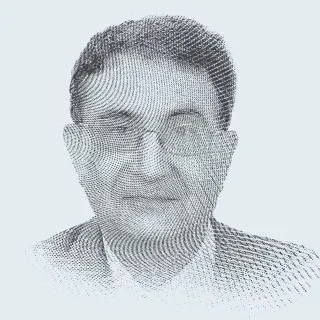
“He is injured but alive!” That is the message that Islamic Republic authorities passed on about the newly anointed “Supreme Guide” Mojtaba Khamenei who survived an Israeli air attack that claimed the lives of his parents and his wife at the start of the current war.
Speculation about Mojtaba succeeding his father Ayatollah Ali Khamenei in a new dynastic twist isn’t new. It started almost 10 years ago when a campaign was launched to designate Ali Khamenei as “the Imam” rather than a mere ayatollah. That campaign was inspired by the fact that the 12 imams of duodecimal Shiism owe their position to their bloodline unlike traditional Islam that bestows the title of imam on learned theologians regardless of their bloodline.
The buzz about Mojtaba as his father’s successor was amplified when - at a public gathering attended by Khamenei - a mullah referred to Mojtaba as “agha-zadeh,” a title reserved for sons of grand ayatollahs. A visibly annoyed Ali Khamenei retorted that Mojtaba was an “agha-zadeh” but an “agha” in his own right. After that, official media was ordered to use the title of “ayatollah” when mentioning Mojtaba.
In a sense, Mojtaba deserved that title more than his father who by getting involved in politics wasn’t able to complete the classical theological studies that could take 20 years.
Nor did the late “Supreme Guide” publish a “risalah” or thesis required for claiming the title of mujtahid (religious guide). Ali Khamenei lacked another “must” of ayatollah-ness: endorsement by four recognized “marja al-taqlid” (source of emulation).
Mojtaba fulfils those qualifications. How he obtained them is a different
matter. Thus, he could have thrown in his turban in any competition for the position of “Supreme-Guide.”
However, had the issue been raised under normal circumstances I doubt that he would have sailed so smoothly to the top of the ladder. There would have been a dozen or more contenders with stronger claims to the top slot.
But these are not normal circumstances in Iran.
Claiming the top turban is a gamble that not many wish to make. Official
accounts of how Mojtaba was “elected” admit that 15 percent of the members of the Assembly of Experts, the body that has the task of choosing the” Wali al- Faqih,” didn’t vote for him.
Moreover, the assembly was already incomplete because nine of its 88
members who had died have not been replaced. Of the 81 remaining members several couldn’t be traced because of complications caused by the war. At least two refused to offer their candidacy. As far as we know, the final list put to a vote through cyberspace consisted of three names including that of Mojtaba.
Would it be impertinent to suggest that Mojatba may owe his rise to the top to a war triggered by those who killed his father?
At any rate, Mojtaba could be seen as the only logical choice by a regime shaken by war and internal dissension.
His first advantage is name-recognition, something that none of the others mentioned as possible leaders enjoyed. A little known new “Wali al-Faqih” would have needed time - maybe years to secure the recognition needed for claiming authority.
Mojtaba’s second advantage is that though he didn’t have an official position, he was his father’s favorite son, intimately involved in or informed about all key aspects of policy for at least the past 15 years. Thus, he can, if and when he recovers from his injuries, quickly join the process of decision-making in a shaken system.
His third advantage is that he has full knowledge of the Khomeinist political, military and business nomenclature, the few hundred big players in the system.
Finally, compared to his father, he has the advantage of having a broader knowledge of the outside world.
The late Khamenei spent most of his life in a cocoon, first as a theological student and then as a minor political activist in Mash’had extended by a two-year internal exile in Iranian Baluchistan followed by a sudden jump to become a member of Khomeini’s Revolutionary Council. Within a couple of years, he rose from Deputy Defense Minister to the presidency of the Islamic Republic, largely because, without undervaluing his rhetorical talents, he was just available.
Being caged in pubic positions, Khamenei was unable to gain direct
understanding of the outside world. As president he visited a few countries, notably North Korea, Serbia and Zimbabwe. As “Supreme Guide” he seldom stepped out of his cocoon in Tehran. In time, he was surrounded by a few dozen members of the “yes-sir” tribe, some of whom for more than 30 years.
Mojtaba, in contrast, has traveled all over Iran to establish a personal network of social, political and business contacts. He has learned English, been a frequent visitor to London, kept a keen eye on global media and made investments in various Western counties.
Many ask whether he is more of a hardliner than his father. The answer is that his father started as a “moderate” compared to the firebrands of the time like Prime Minister Mir-Hossein Mousavi, but became a hardliner when he realized that one cannot be a moderate in an immoderate system.
He realized that in today’s chaotic world one can brag, bully and brutalize at will without hitting a hurdle. He also knew that he could always do what he called “heroic backtracking” when and if anyone seriously defied him.
Mojtaba takes the reins - if he does - at a time that being a hardliner is no longer cost-free as there are people prepared to kill you in your bunker regardless of international law and convention about sovereign immunity.
For the leftover ruling elite in Tehran, Mojtaba is the most logical choice. The elite knows that at some point it will have to trim its sails if not actually raise the white flag to survive in what T.S Eliot called “living and half living.”
A little known new “Supreme Guide” wouldn’t have fitted the role of salesman for anything resembling surrender. In 1988 no one in Iran could have accepted the humiliating end of the war with Iraq, no one but Ayatollah Khomeini.
My guess is that the late Khamenei who designed the current Samson Option had also envisaged some kind of “heroic backtracking” from the brink. Now that he isn’t there, his son inherits that mission. None of the midgets left under the limelight in Tehran has the stature to do so.
Whether or not he will then become the scapegoat for the midgets remains to be seen.