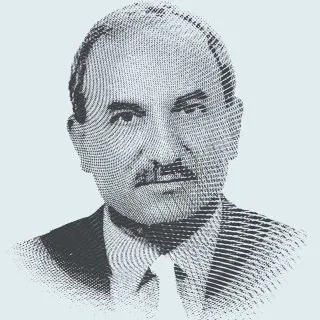
Amjad Youssef has finally fallen into the hands of officers from the Syrian Ministry of Interior. He is among the most wanted figures of the Assad regime and among the most notorious war criminals of the regime’s war on its own people between 2011 and 2024 - a war that ended with the regime’s collapse, Assad’s escape, the disintegration of its security and military institutions, and the flight of its officials, with some managing to escape and go into hiding abroad.
Youssef is notorious for being the principal perpetrator of the Tadamon massacre that was carried out in the southern Damascus neighborhood of the same name, where 41 people, including women and children, were killed in April 2013. Their arbitrary detention and execution encapsulated the regime’s sick mind, as the victims were herded into a pit in the middle of a residential area, they were shot, and the pit was then filled in over their corpses.
This massacre, like dozens of others still being uncovered in Tadamon even a year and a half after Assad’s fall, could have faded into obscurity if a video recording of the killings had not gotten into the fands of activists, among them Syrian researcher Annsar Shahhoud and Professor Uğur Ümit Üngör of the Holocaust and Genocide Studies Center at the University of Amsterdam. They spent three years analyzing the footage, reconstructing its details, including Youssef’s role, before publishing their findings in the British newspaper The Guardian in 2022.
The arrest of Amjad Youssef carries real weight; it is comparable to those of others who had committed crimes against the Syrian people. It offers some solace to the families of victims who lost loved ones, affirming that perpetrators will be held accountable and that rights are neither forgotten nor erased by the passage of time.
None of that amounts to full redress for the devastation wrought by the crimes inflicted on Syrians during the war. One reason is the scale and nature of those crimes, which reflect deep social pathologies, particularly in terms of national cohesion and communities’ sense of belonging to a single country. The pathologies were evident from the discourse and conduct of the regime’s thuggish local enforcers, or Shabiha, and its leadership, which repeatedly promoted the notion of a “homogeneous society.” Only those who supported the regime were truly Syrian, while opponents and critics were enemies and traitors that deserve death, displacement, and exile.
Another reason is the ripples of the regime’s crimes, which goes beyond the direct victims and touches their families, relatives, and even friends. Moreover, Syrians have not only suffered from crimes committed under Bashar al-Assad, but also from those committed in the 1970s and 1980s by his father Hafez. These crimes have left behind humanitarian, moral, social, and financial devastation to families and entire communities.
In this environment shaped by the criminality of the fallen regime, Syrians and the international community have come to recognize that transitional justice is the only viable path to a real path further. This entails holding perpetrators accountable and imposing penalties but also goes further: creating a climate of civic peace that can rebuild relationships within national communities on the basis of tolerance, equality, justice, restitution of rights, and reparations. These are indispensable steps toward addressing what has happened and preventing its recurrence. Success requires the participation of all Syrians, alongside social, civil, and community organizations in a holistic political, economic, social, and legal process.
The arrests of Amjad Youssef and others are particularly significant because they came within a broader environment moving toward deeper engagement with transitional justice. The signs are many: surging public demands for this process; government action to arrest perpetrators who had remained in hiding for a year and a half; referrals of detainees to court, with promises that some trials will be public; and the involvement of transitional justice bodies, alongside statements pointing to tangible progress. All of this gives Syrians and observers reason to expect meaningful progress, perhaps starting with transitional justice.